An Important STEM Challenge for Kids Dominoes Challenge- Full of Life Lessons

STEM challenge- Dominoes challenge for Kids

Today, my little one, Pratham, came to me with an unusual request; he had chanced upon a stirring challenge from one of his favourite kids’ shows. With a glowing face, dilated pupils, and frequent blinking eyes, he asked, ‘Mommm, should I attempt a Dominoes chain challenge?’.

I said, “Wait a minute, why ‘SHOULD’ baby? Please go ahead if you are feeling excited to try one. Never ignore your creative instincts!”

Beware of the 'Should' questions of kids! Don't let the 'should' questions define your experience and display of your creative expressions and aptitudes!

The next few paragraphs are for parents and caregivers who connect to the experiential and instinctual way of parenting. If you want to delve right into the dominoes challenge, you can skip the following three paragraphs, but we would love it if you stay!

I would want to say it out loud to each of you reading this, don’t let the ‘should’ questions define your experience and display of your creative expressions and aptitudes! Unfortunately, we are so conditioned to limit ourselves with the ‘should(s)’ that we hinder our accomplishment of ‘would’. 

If today just casually I would have replied to his eager ‘should’ question with a ‘yes or no’, he would have had his first limiting acknowledgement coming from me, and eventually, he might have ingrained several ‘Should’ experiences that might limit his potential, which as a parent, I would not want him to experience. Asking for permission is one thing, but seeking validation for multi-dimensional experiences and risking not following our ideas and wants because of limits set in the mind or society is not something we got to pass on to our younger ones.

There was a realization in this for me too! As I choose to give my child a conscious parenting experience, why would I be casual in my responses and remarks, and why not deliberately co-create positively! The way I would not limit my dreams and desires, why would I fetter his dreams, aspirations, and desires that way.

Now, going back to my experience of the day…

When I asked him what the dominoes challenge is, he looked around here and there, a bit puzzled for a couple of minutes and then brought his Legos to explain what the challenge looks like.

To explain to you further, Pratham doesn’t have a dominoes deck at home as of now, and to illustrate the challenge as a demo to me, he avidly found a creative way out and utilized his Lego bricks, the rectangular ones (2X4 variants), to make a dominoes’ contraption/chain. Voila, the Dominoes chain was right in front of me!

I, as an ardent reader, did not stop there. I further tried digging up on the subject by reading on the Internet about the Dominoes Challenge. So, here I am to sort you up about ‘Domino Chain Reaction: an important STEM Challenge for Kids’ and its significance in creating an exponential learning curve for kids, which in turn teaches essential life skills.

Now, what Are Dominoes challenge and the theory behind it?

Have you ever heard of the phrase “fall over like a row of dominoes”? It traces back to the Cold War years, and the first person to propose ‘The Domino theory’ was President Harry S Truman. He introduced it to justify sending military aid to countries that asked for it. However, the analogy was made popular by President Dwight Eisenhower.

The domino theory or the domino chain reaction refers to a series of equally placed (rectangular tiles) dominoes toppling over when the first one is knocked. What happens is, when the first domino in the chain or series is pushed, it topples over the second, then the third up until the last one going over very quickly with a profound influence. One by one, all of them fall over due to kinetic energy.

Science, Technology, Engineering, and Math (STEM) aims to improve education by teaching children basic life-changing skills like problem-solving, time management, coping with failures, thriving skills, and many more. The Dominoes STEM challenge refers to Lego towers (each Lego 2×4) placed the same way dominoes are. The legos are supposed to increase in size as they go on, so the demonstration of transferring kinetic energy can be seen clearly.

You get readily available dominoes decks- wooden, plastic, glass, or marble; colourful or black & white ones- in the market.

Benefits of Dominoes chain STEM challenge: 

Benefits of the Dominoes Challenge- 1) It helps in fine motor development in children,
2) It helps exercise concentration muscles well,
3) It helps display best creative expression,
4) It helps understand the spatial dimensions needed to make curves and spirals.

Dominoes challenge helps in:

  • fine motor development in children,
  • helps exercise concentration muscles well,
  • display best creative expression,
  • understand the spatial dimensions needed to make curves and spirals.

As mentioned above, the Dominoes STEM challenge helps instil values in the minds of children, so encouraging this challenge from a young age is the best bet.

Here’s a list of 9 life lessons that the Dominoes Chain STEM challenge is helpful in. Picture this- if the child is working on a Dominoes challenge with siblings or parents or friends. What are the lessons they’ll pick up on?

Life lessons from Dominoes STEM challenge- Patience, Commitment, Concentration

1) Patience

Patience is always a desired virtue in any career field. 

Building and placing dominoes (or legos) is a repetitive process that involves a lot of time and patience of a person making one. Sometimes, it takes several attempts to build the anticipated domino chains. However, the art of putting each of them in the desired position perfects patience skills.

2) Commitment

Making domino chains is a process that might take a very long time, depending on the final output size, factoring in the number of failed attempts that may happen.

Dedicating so much time and energy can be exhausting, but the spirit of commitment goes a long way in the world.

3) Concentration

The dominoes (or legos) demand being placed perfectly behind each other. One small mistake can mess everything up. Thus, concentration is an indispensable skill to have when it comes to making a Domino Chain Reaction.

It is essential to be focused on whatever you are doing, even later in life. Short attention spans are unhealthy and can be unattractive in future relationships, work, or otherwise.

Life lessons from Dominoes STEM challenge- Communications, Planning, Organizing skills

4) Communication

This particular challenge teaches the most fundamental values of communicating with your peers if she/he is playing in a group. Without verbal communication, the whole model can go haywire and result in no achievements at all.

Communicating with your peers is one of the essential skills to have in the real world. Lack of this skill can lead to disruption in personal and work relationships.

5) Planning and Organising Skills

The whole base of this challenge lies in planning and development. If the model is planned wrong, the whole experiment can fail. Hence, planning and organizing everything is the basis of the Domino STEM Challenge.

Organizing is one of the extra talents looked for in the corporate world. This talent can also help in your daily life planning, and make you more focused on your goals.

Life lessons from Dominoes STEM challenge- Trust and Forgiveness

6) Trust

Different children working on different model sections means that they have to trust each other in the making process.

Trust is the basis of all relationships in your personal life. Without trust, you wouldn’t be close to anyone, and it might also lead to various mental illnesses.

7) Forgiveness

A lot of crashes and collisions take place in challenges like these. If the child is playing with siblings, parents, or friends, she/he gets to understand that being angry at the one who made the unintentional mistake or crash is not good. Mistakes can happen with anyone, and that forgiveness is necessary for such situations.

Everyone makes mistakes, but everyone doesn’t forgive. Forgiving is considered one of the most important virtue. Having it is the most helpful attitude of living a compassionate life for oneself and others.

Life lessons from Dominoes STEM challenge- Anticipation and Excitement and Creativity

8) Anticipation and Excitement

The excitement and fun of the building process teach kids to enjoy the process while anticipating the best results in the end.

Similarly, enjoying the process is the most crucial part of a big project or goal in the real world. Work without enjoyment makes the project lifeless and results in an unsatisfying output. 

9) Creativity

Making models and design ideas sparks creativity and lead to creative thinking in toddlers, pre-schoolers, or high school kids. They imagine and produce designs in their head first when an idea strikes.

Creativity is a life-changing skill that can increase passion and love for certain things while expanding imagination and encouraging thinking. Moreover, it is an everlasting skill that makes you happy.

Here are a few variants** of the DOMINOES challenge that the kids of Preschool to High school can enjoy, learn concepts and develop skills together:

Variant -1 for Dominoes Challenge that the kids of Preschool to High school goers can enjoy with the right amount of challenge mixed with age appropriateness
Variant -2 for Dominoes Challenge that the kids of Preschool to High school goers can enjoy with the right amount of challenge mixed with age appropriateness

**- sourced from the Internet

The Domino Chain STEM Challenge definitely got to be taken up by the children of the modern age. So utilize the Lego bricks (2X4 variant) or buy the readily available decks to make your child develop into a well-rounded being!

I trust that I have explained to you everything about the Dominoes Chain STEM challenge in today’s post and if you have any questions about it, drop me a message in the comment section below, and I’d be more than happy to assist you with it.

Thank you for reading, and happy parenting!

Classic Childhood Games That Teach Important Life Skills

Classic Childhood Games That Teach Important Life Skills

“Opportunities of learning are everywhere, even while playing games!”

The three primary activities that form a part of early childhood experiences unless the formal education starts are- Playing, Eating and Sleeping- the only three mindful affairs at least the 90s born can remember, isn’t it!

Play is the leading form of learning, and games are the natural need for children. We all know that games (whether traditional or contemporary) positively influence the upbringing and growth of each individual. And if you as a parent, also trust that play can raise and help a child thrive in unimaginable ways, you’ll easily relate that as childhood is the budding age for growth and learning, playing games can lay the ground for children to learn essential life skills in play-way spirits; whether it is for learning human relations skills, pre-academic skills, healthy humour or it is moral, emotional, physical and mental development in children.

For this simple reason, we as parents want to pass on our favourite childhood games to our offspring. The added benefits of learning through play are many. Read** on to discover how each game finely and secretly models real-world situations and helps children learn how to live and act naturally.

**Our excitement ended up making this blog a long one. If you, too, are excited and can’t wait to try one of these classics, you can enjoy the list of games and the benefits of each game via the creatives we have made with extra effort!

Here are some of the classic childhood games that teach children essential life skills in play-way spirits :

  1. Musical Chairs

 5 people. 4 chairs. Always one chair less than the people playing. As soon as the music stops, everyone rushes to get their seats. Who will be left out?

Musical Chairs: Classic Childhood Games That Teach Important Life Skills

Musical Chairs is one of the only games that teach children how to talk their way out of arguments. It teaches how to deal with the frustration of failure. Sharpening a child’s auditory skills is another perk. This game works on being happy for others and cheering them on from the sidelines. This game teaches a child how to be a cheerleader not only for others but also for oneself. 

Moreover, musical chairs can be played by all age groups.

2. Name, Place, Animal, Thing!

 A multiplayer paper-pen game. As the name of this game goes, all you need to do is make four columns on a paper and label the columns Name, Place, Animal, Thing. One of the player commands ‘Start’ and whoever completes the list first commands ‘Stop’. Now, who gets all the four columns (correctly) filled with the instructed letter of the alphabet in a row? 

Name, Place, Animal, Thing! - Classic Childhood Games That Teach Important Life Skills

Playing this with your child can have surprising results and definitely increase her concentration levels. Teaching phonics becomes easy; introducing ‘Noun’ to a 5-year young child feels effortless too. Other perks of this game are: vocabulary development for sure happens, but more amazingly, geography and map reading happens too. Eagerness to learn and memorise names of cities, towns to quickly fill the row with correct feeds also ensues, independent thinking, time management, and spelling advancement… all can happen leisurely in play-way spirit. 

3. Hide and Seek 

 A multiplayer game. 1 finder. Who will be caught first?

Hide and Seek is a game of rational thinking and patience. The finder has to think and memorise all the spots where the people could hide. At the same time, the hiders have to look for the best places to hide quietly, without making a sound. Patiently waiting is also an essential part of this game. 

Hide and Seek: Classic Childhood Games That Teach Important Life Skills

 In real life hostage situations, the hide and seek game can be re-enacted. This game definitely makes to the list of games that prepare a child to determine and manage undesirable situations.

4. Dumb Charades

 A multiplayer game, which can even be played among 2-3 people if the family is a nuclear one. 

No materials required. All you do is hum a song or enact a folktale/story you’ve just heard/read together or act out a portion from the documentary series on Netflix you and your family may have watched together. Ask the participants to name the song, or story or documentary! It’s a lot of fun. 

Dumb Charades: Classic Childhood Games That Teach Important Life Skills

The benefits of this game are many; to list a few, here we go. It helps in listening skills, concentration and memory, audio processing of a child, and mindfulness practices. 

5. Indoor Hopscotch 

A multiplayer game. You can make a Hopscotch board with masking tape on the floor. And then be ready to hop, jump and balance with your little one!

With variations like hopping on the even/odd numbers
or the count down 10 to 1,
or adding numbers and jumping on the resultant number
makes learning numbers fun

How about alphabet hopscotch for letter recognition?

Indoor Hopscotch: Classic Childhood Games That Teach Important Life Skills

Hoping, jumping, and balancing on one foot helps develop good gross motor muscles and provides exercise that children (and we!) need staying indoors. 

Psst! Gross motor movements keep everybody sane! Not only can Hopscotch keep the child physically strengthened, but also can help them learn numbers and letter recognition on a hop. It also supports decision making, positive relationship, self-regulation, patience and turn-taking skills.

6. Monopoly

28 properties. 3-8 players. Two dice. 1 board. Who will be the richest in the end?

Monopoly: Classic Childhood Games That Teach Important Life Skills

Monopoly (also known as a Business Game) is a contemporary game based on strategy and tactical skills, which helps a child with financial literacy, the most important in building 21st-century life skills. It is never early for a child to have financial skills and budgeting knowledge. It sharpens the mind of the young ones and teaches them monetary control. The feeling of being organised and having complete control of your assets is what Monopoly promotes.

 Currently, Monopoly has 1144 versions, fictional and real editions included. It is a must-have game.

7. Table Tennis

2 people. 1 table. 1 ball. Who will miss the shot first?

Table Tennis: Classic Childhood Games That Teach Important Life Skills

Table Tennis is an Olympic sport practised in schools and colleges, too. This indoor sport mainly focuses on hand-to-eye coordination and impulses. Being cautious and focusing on the ball are some of the other perks that later can be used. It helps fasten your impulses and to withdraw from the jump-away-from-the-ball-coming-towards-you impulse that people generally have.

Playing this with your child can have surprising results and definitely increase his concentration levels.

8. Rock! Paper! Scissors! 

A simple and interesting hand game usually played between two individuals in which the participants simultaneously outstretches one of the three shapes- rock (a closed fist), paper (a flat hand), scissors (we all know how! Victory sign with index and middle finger making a ‘V’ shape). The possible outcomes are only two: a draw or one of the participant wins.

Rock Paper Scissors: Classic Childhood Games That Teach Important Life Skills

This simple game helps in consciousness, concentration and control of the mind, identifying patterns and predicting the future behaviour of the player. For adults, this game can be 5 minutes’ de-stressor between work intervals.

9. Football

11 people in 2 teams each. 2 goal nets. 1 ball. Who will land a goal first?

 Football is one of the leading sports worldwide, which is making parents put their child into this rapidly growing field. Teamwork and sportsmanship are two of the main reasons why football makes it to this list. 

Football: Classic Childhood Games That Teach Important Life Skills

The intricate art of hand-to-leg coordination and anticipating your teammate’s move at any given time makes the players alert 24/7. Not only does it physically strengthen the child, but it also makes her learn how to play and dribble a ball to perfection.

10. A – Z Gratitude Game (our featured and most talked-about game)

Gratitude journaling and mindfulness practices help everyone sail well and bounce back, especially when the going gets tough. 

So, here’s a little about the game. Read the full blog here.

Name an object or a toy that begins with each letter of the English Alphabet: Starting from A till Z, ask the child to look around for all the toys, favourite and not so favourite objects/things/items present in and around the house. Sort of treasure hunt!

A - Z Gratitude Game: Classic Childhood Games That Teach Important Life Skills

A – Z Gratitude Game’ helps your child look for his long unattended toys, re-connect with the things she/he has, feel grateful for the things he already has. This game also aids in vocabulary development in young children.

Conclusion

Children are at home during the pandemic, and a child’s mental health is more important than academics at the moment, is what I feel. And what better than learning in play-way spirits for children can happen because we know learning opportunities are everywhere, even while playing games!

While many of the above games teach patience, perseverance, self-regulation and turn-taking, some games from the above list also teach about other facets of real-life secretly. And most of the games mentioned above can have variations and extensions and can be made age-appropriate.

Virtues and morals are essential for social skills development, helping a person act duly according to the situation. Aside from reading moral stories, these games form an integral part of the learning process, assisting children bond with peers and adults in a better way at the same time teaching them life skills.

Mentally and physically strengthening our young ones is one of the first steps to parenting. Inculcating values for life in children in their early life stages helps them later in life.

Pandemic has come as a gift of time when it comes to spending priceless bonding time with family members. Bonding over playtime is an activity that all age groups enjoy. So, why not make the most of this time to cherish it forever and re-experience the childhood days with children in a whole new episode.

So jet-set-go, grab a pen and paper, note down the games you can plan with your child next time they ask you to play, unless it is an outdoor game ‘Football’, if you have a spacious backyard, then why wait, go ahead!

Help them learn and grow into well-rounded human beings.

Thank you for reading, and have a happy, playful parenting!

Top 10 Open-Ended Toys that Promote Creativity and Learning

What are open ended toys and what are the top ten open ended toys that promote creativity and learning in Kids

The world is ever-changing, and we all want our kids to be physically and mentally equipped and trained to navigate through the changes easily and effortlessly. If you, too, wonder how to inculcate these in your kids, make them better at handling various issues, and improve their problem-solving skills, open-ended plays are a must. As a parent, our mindful investment in toys that inspire open-ended plays is vital. 

Now, 

What are open-ended toys?

Toys that the kids of different age groups can play with in numerous ways, invested in for long hours, are open-ended toys. These toys allow them to think for themselves, act out real-life scenarios and express their creativity in multiple ways. Anyone at any age can play with open-ended toys: babies, early toddlers, pre-schoolers and beyond.

Why to choose open ended toys for kids

In simple words, toys that inspire open-ended plays are open-ended toys. Open-ended toys are 90% child and 10% toy based, giving plenty of room for inputs to come from the child. The concept ‘Less is more’ can be best explained with open-ended toys. 

Here are ten open-ended toys that promote creativity and learning 🔽

  1. Legos
Open ended toy for kids- Lego

Legos have been around for years. One can build almost anything with legos, from models of skyscrapers to robots, by rearranging them in the shapes that one desires. This helps give life to the user’s imagination. Legos come in various shapes and colours too.

2. Letter Blocks or Magnetic Letters

Open ended toys for kids- Letter Blocks and Magnetic Letters

Letter blocks are not only useful in teaching children about word formations and new vocabulary but also offer a fun way to express what’s on their mind. They can get creative with new words or leave funny messages to each other with them. Magnetic letters can be rearranged on the fridge door every day to teach kids a new word per day.

3. Doll house

open ended toys for kids- Doll House

Who doesn’t love a doll house? They come with a variety of dolls, furniture and an empty house. These give children the freedom to rearrange the dolls and furniture according to their whims and fancies. Also, there is no instruction pamphlet instructing the users as to what furniture goes where. A tea party with Barbie and her friends on a Monday can turn into a quiet dinner with iron man and the avengers on a Tuesday. 

4. Paints

Open ended toys for kids- paints

Out of the different items available for kids in the market, this age-old art supply is the most versatile one. From painting on paper to painting pottery and even fabrics, it can be used to decorate and enhance almost anything. Painting offers a lot of opportunities for one to express their creativity and allows for a huge scope of imagination. Children can learn about different types of colours and their mixing with each other to give secondary colours.

5. White Board

open ended toys for kids- WhiteBoard

Almost anybody can use this play item. It is used to draw or write whatever one wishes. It can be used to play Pictionary and other games. It is a great means of teaching and learning simultaneously. You can casually draw or scribble new ideas on it, with the perks of being able to erase it later and use it to express something new. 

6. Play Dough

Open ended toys for kids- Playdough

Do you want an inexpensive and easy relaxing activity for your hands after a long day? Playdough is the answer. Playdough is loved by people of all ages. Much like legos, playdough allows the user to bring to life almost anything they can imagine. Playing with playdough has proven to improve fine motor senses in young children. So they can be used as an exercise to build and strengthen these senses as well.

7. Binoculars or Telescope

Open ended toys for kids- Binoculars or Telescopes

These devices can be used in multiple ways. They make way for a person’s inquisitiveness to grow in different directions. They are great tools to learn about one’s surroundings. Children can enjoy not just the thrill it offers but also learn new things with the help of it.

8. Tents

Open ended toys for kids- Tent and Tent house

Tents come with multiple poles, attachments and soft satin tent cloths. Most of them are convertible and can be used to accommodate 1, 2, 3 or 4 people. Tents can be used outdoors and indoors too. Are you planning a lakeside camping trip or narrating bedtime stories in your room when it is raining outdoors? Go for it as people of different age groups can enjoy it.

9. Kinetic sand

Open ended toys for kids- Sand and Kinetic Sand

Similar to clay dough, kinetic sand allows the user to knead it as they like. It gives the children the feel of playing with sand on a beach. Most children living in cities have not experienced playing with sand. Kinetic sand offers them this opportunity and, at the same time, doesn’t create a mess in their vicinity.

10. Balls

Open ended toys for Kids- Balls

Balls are probably one of the most common yet versatile toys used in various sports activities. The best of all, you can play with it in more than a hundred ways. Kids love it and it comes in various sizes and colours. Plus, you can find it easily in any store. The development of basic actions- throw, kick, roll, aim, catch and strategizing all happens with a dose of unmatched fun.

Benefits of open-ended toys:

  1. All the above toys not only offer ways to enhance one’s creativity and imagination skills, but they also offer more than one way to express it. 
  2. Open-ended toys keep the kids occupied for long hours, away from the screen- it is something which almost every parent wants.
  3. If you struggle in getting your kid to play independently, open-ended toys help encourage independent play. 
  4. Kids learn to keep themselves entertained with open-ended toys.
  5. Open-ended toys help in improving a child’s problem-solving skills.  
  6. Open-ended toys help stretch cognitive skills in children.
  7. They also aid self-regulation.
Benefits of Open ended toys and open plays are many

Open-ended toys can be affordable depending upon the choice, whether wooden or plastic or elastic ones. Wooden open-ended toys usually last for a very long time but are generally expensive.

Wooden Vs Plastic Toys:

At our place, we care for sustainable toys, and we believe in mindful investments in toys. So, our preferences are usually the open-ended wooden ones over the plastic toys when choosing between the above two types. And as per our experience and learnings, the wooden ones are the real open-ended toys. Wooden open-ended toys are a little expensive, but they are usually one-time investment which lasts long. But because children outgrow a toy very quickly, so the inclination towards plastic toy purchase feels attractive.

But if the objective or purpose is clear in toy selection for kids, then open-ended toys require only a one-time investment, especially for first-time parents. And in my opinion, kids do not really need too many toys to keep themselves entertained. If we as parents bring toys to nurture their creative and imaginative skills, then even a stick in hand can become a toy- a magic wand or a sword or a cricket bat.

Do we need expensive open-ended toys?

My answer to the above is ‘No’.

As parents, we get enticed seeing high-end colourful toys, dome climbers, and expensive hot wheelsets on Instagram, but frankly speaking, kids do not need expensive open-ended toys.

But there are three things we do not compromise our investments on for our little one, first is BOOKS, second is Lego sets, thirdly cars.

Lego sets are something we’ve intuitively felt guided towards; also, his Lego classes needed the initial investments, so are his collections. Fondness for cars, he has inherited from his grandfather and father. You can read about his love for cars at the blog A to Z Gratitude game‘. We have a declutter charity-based practice in place for ‘CARS’ and toys, so the investment in cars reminds us of the bigger purpose it serves us with.

Having said that, I nowhere disregard anyone’s interest in expensive toys. And we too have commercialized toys, expensive electronic toys at home, but they have either been gifted by friends and family members on birthdays or festivals or passed on to my little one from his elder cousins. We have pre-loved open-ended toys too.

Our emphasis is teaching our little one basic life skills, instilling the attitude of gratitude for things he has and fostering an environment where he gets plenty of room to think and create imaginative plays independently.

Let us know what open-ended toys connect with you for your little ones. Also, let us know which part of the blog resonated with you the most. If you found it helpful, share it with your family members and friends. 

Thank you for reading! Happy parenting!

11 Powerful Reasons to Make Audio Stories a Part of your Family and Kids’ Life

The medium via which information is passed down to young children has fairly been consistent throughout time, i.e., written and spoken words. And ‘Stories’ have always been the single most effective way of transferring knowledge and making children wiser on the dynamic scale of life. Telling children stories is not only a bonding moment but also an opportunity to teach them the nuances of life and life skills. With that said, I’d like to add, little ones tend to have much more energy and, of course, more free time than adults. So, it can sometimes get a bit challenging to manage the time and energy gap. This is where Audio stories come in.

Listening to’ Audio stories’ is one creative and thoughtful way out to keep children entertained and ahead of time in the new, digitized world. The rhythmic and dramatic narration with a backdrop organum has the power to take anyone into the tale and open the gates of one’s mind to different dimensions.

What are Audio Stories?

Audio stories, or as you may have heard, Audio Books, is a captivating way of telling stories. The narrator, using a combination of music and effective narrating skills, captures the attention of the child to educate and entertain them simultaneously. Despite what you may think, Audio stories isn’t a new trend. Audio stories have been around since the 1930s, but it has gained mainstream appeal only since the advent of the internet. 

11 Powerful Reasons to Make Audio Stories a Part of your Family and kids’ Life:

Reason 1: Listening to audio stories with your little ones on, say a playdate, can not only keep them entertained but also create memories they and you will remember fondly.

Reason 2: Sometimes, we adults can get a bit off the track in life. Listening to audio stories intended for kids provides us with some nostalgia and, perhaps, learn from the “moral of the story” alongside the young ones. An individual is, after all, never too old to learn.

Reason 3: Research has shown that audio stories can help us deal with anxiety and stress. Listening to the mixture of soothing music and the calming voice of the narrator can help subside whatever chaos we might be facing temporarily. 

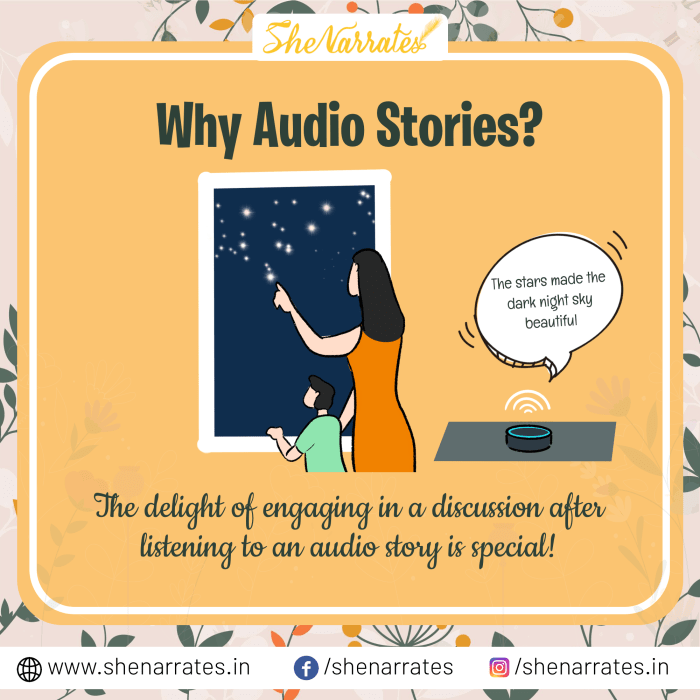
Reason 4: One of the most enjoyable aspects of listening to a story is the discussion that follows upon its end. Listening to an audio story together and then expressing your thoughts and feelings about the chapter/story can be quite a delight.

Reason 5: The way a narrator of an audio story speaks is not only calm and soothing but also highly expressive. These narrators are professionals that have oratory skills much more advanced than an average joe. Children pick up on these professionals’ patterns of speech and invariably improve their oratory skills. 

Reason 6: Some children enjoy reading while some may despise it. For the latter, audio stories are a highly effective alternative. Children who are reluctant to read can simply enjoy listening to a book and gain all the knowledge from it. On the flip side, if they have the book in hand or on a device, they should try and read it alongside the narrator. Doing this will not only build up interest but also improve their fluency and help them be efficient readers.

Reason 7: If you, the parent/guardian, are an avid reader, you would naturally want your children to appreciate the wonderful world of literature as well. However, as discussed, it can sometimes be a bit tough getting kids to read. So, you can introduce them to this world via audio stories. And sometimes kids follow their parents, so GO ON, parents continue reading books! A reason which is a trade-off!

Reason 8: One of the biggest challenges for parents today is the increase in their children’s screen time. Audio stories are an excellent alternative. Instead of spending time on phones or laptops, children can spend their time listening to these stories entertaining and passively educating themselves.

Reason 9: Listening to audio stories is an activity that most individuals can enjoy no matter the age. Adults and children can together enjoy these stories and spend some quality family time together. You will be surprised by how entertaining stories intended for kids can be. Especially if you see how much the young ones are enjoying them. 

Reason 10: The advantages of audio stories are numerous, but the most important one, in my opinion, is its ability to help with language comprehension. A child may be reluctant to read because they may lack comprehension of the language, suffer from a small vocabulary, or lack fluency; everything audio stories have shown to help with. 

Reason 11: An audio story helps with the growth of your child’s visualizing and listening skills. Being a good listener helps one learn and empathize with others. The ability to visualize makes the events of a story much more engaging. 

Where can you encourage your kids to listen to audio stories?

Well, well well, audio stories for kids at ‘Storyland™’ by ‘She Narrates ™’! These are free! You can access several audio stories on ‘She Narrates ™’ for free! The stories at ‘Storyland’ have been curated by a team of professionals for educational as well as entertainment purposes. The editing team has done a fantastic job of incorporating sound effects relevant to each story and using background music to fill in any gaps. The narrator has an immaculate way of speaking, perfectly suited for kids. For informative and entertaining audio stories, visit ‘She Narrates ™’.

Make a ‘Ritual’ out of audio stories!

This is my favourite part when it comes to audio stories. One audio story can make way for a variety of engaging activities for the child, and what I like to call, even a ‘family bonding activity’!  Stories at Storyland are purposely kept short, simple, and narrated in a way that is aimed at boosting a child’s imagination.


Try this weekend activity powered by Storyland by She Narrates ™:
1. Pick an audio story of your choice and listen to it with your little one on a Saturday night.

2. Try engaging in a discussion aimed at the moral of the story.

3. On Sunday, sit together and try recalling the story, and using that to draw/colour/plan puppet plays with the characters in the story, and let your child’s imagination go wild! (If you need help, you can take inspiration from our innocently artistic audio stories’ thumbnails!)

4. This time go the other way round! Before your little one is spoiled by his/her grandparents with a new story, this time let them narrate the audio story or the moral lesson they listened to and learned the day before! 

This is our audio story ritual! If there are more fun activities you can help us with, we will be excited to hear!

Furthermore, we are all ears to your feedback and open to customizing audio stories at ‘Storyland’ by She Narrates for you, so do share your experiences in the comment section below. Also, let us know what you would like your kids to listen to, any age group that you want us to prioritize, let us know. ☺

Happy listening and as always happy parenting!

Why is it Important to Develop a Schedule for Children?

Why is it Important to Develop a Schedule for kids?

“Sow the seeds of adaptability early on, so as the little ones grow up, they can design their lives simply and easily, on their own.”Pallavi Prakash Kumar.

Having a schedule for oneself is an important aspect of life. Unsolicited advice like this feels annoying, isn’t it! But they are true and wise. In terms of personal health or career-wise, we all know that following a routine is rewarding or having a structure in place helps us feel sorted to a large extent. The same is applicable for children.

The difference between schedule and routine is also covered in the later part of the blog, so read it till the end. And if you want to know my son’s schedule, one that we’ve been following during the ongoing pandemic, check them out; it is towards the end of this blog.

Now, why is it important to develop a schedule for children?

Children are just like adults in certain aspects, one of which is our shared fear of the unknown. Not knowing what to do next can be pretty stressful. Having a schedule takes away that stress to an extent and instead provides one with something to look forward to.

So, developing a schedule for a child is perhaps one of the most important responsibilities of a parent. OR raising a child who follows a routine is one of the major contributions a parent can make in a child’s developing stage.

Schools also follow a routine, however, school is an environment that is beyond our control. There are many variables in there. Teachers, other students, whatnot. Inside one’s own home, there is a better sense of control for customization and planning. Here, we can help our child develop a schedule as per how she/he wants or based upon our understanding.

So, here are some of the reasons why keeping a consistent schedule is important for children:

1. Decreases stress and anxiety: 

Why develop the habit of following a  Schedule in kids?
It helps in decreasing stress and anxiety by bringing in familiarity

Studies have shown that we are amidst an epidemic of anxiety which, as the sound of that might lead you to believe, isn’t the ideal situation. To help our children deal with the stressors of life, we must help them develop a schedule. A routine will provide the child with a sense of freedom as she/he will no longer worry about what is to come; they already know. There is comfort in familiarity and thus, that comfort helps to tackle stress and anxiety.

2. Builds a sense of independence:

Why develop the habit of following a schedule in kids?
It helps build a sense of independence by brining in the feeling of accomplishment

If a child has a routine and we reward them for sticking to it, they will develop a sense of independence by following it. If they know “Homework at 4 pm” or “Breakfast at 8 am”, they will try to accomplish those tasks and this will build up their confidence and independence. It may seem like a little thing to adults but for a child, waking up on time and being at the table when asked to be is an accomplishment that they will be proud of themselves for. We must celebrate every little thing our children accomplish or achieve.

3. Develops healthy habits for a good lifestyle:

Why develop the habit of following a schedule in kids?
It helps develop healthy habits for a good lifestyle

Children learn and adapt much faster than we do. If we try to include healthy and constructive habits into their routine, they will potentially adopt these habits for the rest of their life. Eating a meal on time, working out, yoga, cleaning their room etc. got to be a part of their everyday routine, meditation too.

4. Evokes comfort and familiarity amidst the chaos:

Why develop the habit of following a schedule in kids?
It helps evoke comfort and familiarity amid chaos

No family is perfect. If unfortunately, a family is going through a tough time, a schedule can help provide the child with a sense of comfort and familiarity. Despite the turmoil that the child may face, following a routine will provide her/him with some stability.

Having a structure to your day gives a sense of control in times of unpredictability and uncertainty.

5. Helps them understand the concept of “Work and Win”:

Why develop the habit of following a schedule in kids?
It helps make a kid understand the concept of 'Work and Win' and makes the surprises even more fun!

One of the tougher challenges of parenthood are not spoiling our children. A routine, wherein they are rewarded for following it through, will teach them the basic concept of “You must work to reap the rewards”. Moreover, it makes the surprises even more fun! Guess how?

One of the biggest benefits of having your child follow their schedule is, ironically, when they do not. The happiness your child may experience when instead of her/him having to clean their room, you have let the child go for free play or have some minutes of screen time. And one of the benefits I feel is not pointed out more often. This point might seem to contradict this entire article. However, our end goal is to provide our children with the best possible childhood. One that prepares them for the future, yes, but also a childhood full of memories they can look back upon fondly. Finding the right balance is the key!

Where to start?

As I wrote above, there is no better place to start building our child’s schedule than our home. We can start with basic things like having them make their bed, having breakfast with the family, etc. If our child can follow these, we can slowly build up and add more complex and tougher tasks to their schedule. If we build a schedule for them that includes fun activities as well, they will be much more inclined to stick to it.

Remember, our aim should always be to help the child, not control. Parenthood is a journey, not a race. Take things easy and step-by-step.

A little note for understanding here: a routine is based on the flow of activities and is a step in the direction of having a schedule, i.e., carrying out activities in a time-defined manner. As we grow, we learn more about our way of working and what ways work for us, taking us closer to where we desire to be.

The basic idea behind this blog has been to encourage you to start building a routine for your child that brings in familiarity, clarity, and a sense and practice of discipline.

Sow the seeds of adaptability early on, so as they grow, they can design their own routine!

I am enclosing Pratham, my 5-year old’s (at-home) routine, our joint effort in bringing back balance in our Covid-affected life! And, we are still learning!

Here's my son, Pratham's Daily Routine in covid- affected life

Thank you for reading & happy Parenting!

Resolving Parenting Challenges amidst Covid [Toddlers’ Edition]

Challenges parents are facing amid Covid, resolving parenting challenges

The shift coronavirus pandemic has brought into the lives of everyone, to the families, and the style of parenting is sudden but worth meditating over. We have been thrust into a new way of living. Many of us have not experienced such a situation before. Navigating through the sudden shift is challenging and overwhelming. This is a time of tremendous loss and change too.

In any event, the development of the child never stops. The development of a child keeps happening, so it matters, and the early stages of childhood development are crucial for them to flourish as adults. Parents and caregivers are facing difficulties to keep up with the change and adapt to new ways. Children, as well as parents, are not able to do basic outdoor activities such as educational trips, family vacations, camping, etc. This, too, is increasing stress, and conflicts at home, besides adapting to the new way of living. 

So, the question comes ‘How to comfort small children amidst Covid?‘. Read the blog from start to finish, if you have a small child at home aged 2-8 years.

Mental and Emotional Trauma-

Resolving parenting challenges amid Covid with the language of love and comfort

Parents find themselves in a difficult situation explaining what’s happening in the world to their children. Small children, especially toddlers, are always curious and, while they are in their developing age, ask questions about anything and everything. It is important to answer their questions and handle the situation mindfully. Parents must groom the child as per her/his development stage**. Explaining something to a three-year-old is different from explaining something to a teenager, we all know. Small children, especially, toddlers leap back and forth between reality and their imagination. They make sense of the world with ‘Why-What-How’ questions.

With that said, talking about the adversity of any situation might take a toll on a child’s mental and emotional health.

  • It is advised to create a covid-free zone with less negative energy when toddlers or small children are around.
  • It’s imperative to limit their exposure to watching or listening to the news.

It can be challenging to explain the loss of a family member to a toddler. Parents need to use the language of love and comfort. Accepting death as a natural process takes time for adults, and it’s almost impossible to expect it from a small child.

Sense of Discontinuity

Resolving parenting challenges amid Covid with routine and schedules for kids

Adaption is a human super-power. But, it’s a long process. Parents’ worries are natural on the discontinuation small children are facing in their routine, hence in their mental growth. “But we can tell ourselves that we’ve heading towards a renewed parenting style, and at present, things are ever-changing”, a perspective that I remind myself to keep going positively. 

Toddlers are used to a routine that they like to follow- a sense of regularity is what keeps them mentally healthy. They have meals at a certain time. They have preschool activities, coloring time, outdoor time, reading time. These routines are difficult to hold on to due to various reasons. There might be a sick person at home. The toddler itself might be sick. Parents or caregivers might be stuck at work. This does create irregularity and uncertainty among toddlers, leaving them confused.

In such a situation,

  • Parents must make their children follow a routine, a new one. Introducing a new routine will make them ready to adapt to change at a very young age.
  • Surprise is needed, too, so the irregularities and uncertainties can be explained as a change in the plan to them and for us to keep going buoyantly. Please avoid using this perspective as an excuse and try keeping up with the routine or schedule as much as possible.

If you want to have a look at our son, 5-year-young-child, Pratham’s routine that we’re following, check it out here.

Small children, especially toddlers, thrive on regularity and knowing what to expect. Little things like getting them out of their pyjamas and getting dressed for the day would help a kid feel productive and excited.

  • Parents need to schedule their time and find ways to make connections as a family.
  • Parents taking turns with child’s activities and chores so that each one is getting enough time for themselves.

Work-From-Home as a Challenge

Resolving parenting challenges amid Covid by planning out a night before

Working from home is challenging, which parents are facing during the pandemic. Toddlers, being at a growing age, ask for a lot of attention. It isn’t easy to manage work and kids simultaneously unless there’s a helping hand.

So, it becomes important to make sure that the children know their parents’ work schedule and be reminded timely. They might create a disturbance that leads to unproductivity. So, family members coming together as a team is needed in such situations. 

Here’s what I do

  • Plan out my day a night before,
  • put things and activities in time chunks (exercise time, meditation time, meal preparation time, mealtime, activity time, reading time, etc.)
  • And share it with my partner in advance. This is how I plan myself regularly or otherwise; you may give this a try too.

Planning a night before is helpful and has been emphasized largely by Marie Forleo

Remember, basic tasks are to be done first and foremost, especially when we are in unpredictable and uncertain times like covid-19, and try accomplishing the basic and important ones in the first half of the day.

Taking care of a Sick Child

Resolving parenting challenges amid Covid with Nutritious wholesome meals and balanced diet

Treating mild symptoms of Covid in children is the same as treating any other respiratory virus such as a cold or flu.

  • It requires a lot of rest and intake of fluids to regain energy.
  • Other than prescribed medicines, it’s important to use other support systems.
  • A humidifier in the bedroom is helpful, especially if the child has nasal congestion and cough. (recommended by Dr Rakesh Malhotra, Malhotra Clinics, Dwarka-4, New Delhi)
  • Kids over 12 months of age can be fed honey (only if they are not allergic to it) which is good for their throat.
  • Dressing a kid appropriately, so they don’t feel too cold or too warm, is helpful.

Post-Covid Treatment

Post-recovery Covid tip

It’s important to keep in mind that it will take time for things to get back to normal, or we coming to new terms of adaptations. Even after Covid, a toddler would require proper care and attention.

  • Their diet is the most important aspect. It must include green leafy vegetables, high protein food, and vitamin C-rich goodness.
  • Keeping up with the intake of fluids and staying hydrated in the recovery period is important too. 

 After nutrition comes hygiene, a child’s sanitation is important.

  • Precautions like washing hands regularly, face masks, sanitize if water not available, and social distancing have to be taught to them so that they feel comfortable when going out resumes.

Here’s Post- Covid recovery tip from Dr Sweta Bajaj (Dental Surgeon and Lactation Consultant), something which goes overlooked:

  • Change the toothbrush, tongue cleaner, dental floss and other oral hygiene products as these can continue to harbour the virus, so it is better to discard them and get new ones. 🙏 

Last Words-  

On top of everything, creating a sense of normalcy around toddlers is the need of the hour. It is crucial to make them sense positivity. They must feel safe and heard as their families surround them. 

Try and shield your four walls from negative thoughts and suffering that’s around. This is not to say that we should stop being empathetic; in fact, this might be the right time to introduce the feeling of empathy to your little one with the tiny contributions you can make. But the need of the hour to survive and thrive is to develop the right positive environment at your home, like a complete ‘ecosystem’ in itself. The need is to re-align your priorities and re-design your little world!

Dear Parents, your contribution in allowing your comforting and nourishing thoughts for yourself and your child matters. It is safe to feel safe!

Sending you loads of best wishes and healing energies! 

**Four Stages of Cognitive Development in children as outlined by Jean Piaget’s theory:

  • Stage 1: Sensorimotor stage: birth to 2 years- A child is learning about the world through their movements, sensations, and manipulating objects. They are extremely egocentric.
  • Stage 2: Preoperational stage: ages 2 to 7- A child begins to think through symbols, answers from people around them. They are egocentric and struggle to view things from other’s perspectives. 
  • Stage 3: Concrete operational stage: ages 7 to 11- A child is becoming aware of external feelings and emotions other than their own, beginning to think logically about concrete events, building inductive logic, less egocentric.
  • Stage 4: Formal operational stage: ages 12 and up- A child is ready to use logic to solve problems and start building deductive logic.

Note: All children have different rates of development. For any concerns about a developmental milestone, talk to your child’s paediatrician. In many cases, early intervention and treatment help in better outcomes.

Mother-Child Relationship

The Purest Bond-

In a world where we get so lost, absorbed in daily chores and activities, we have mother’s-day that reminds us of the power of loving care there is. Mother’s day restores our faith in the power of love.

And here’s a poem for all mothers and mother-like figures out there

‘Just like Four Seasons
Spring, Summers, Fall and Winters
In a year
She is all Four Seasons
Every day
From fresh and breezy 
To fuming and fretted 
From calm and collected
To cold and stony
But nurturing and caring always’

Celebrating motherhood every day…

(☝️ poem ©2020 Pallavi Prakash Kumar)

The bond between a mother and her child is eternal. It remains unchanged and is unconditional. The purest form of love is when a mother holds her baby for the first time and it only increases after that. Every time a baby is born, a mother does too.

Holding my baby for the first time was such a divine feeling that that day’s soulful zing, despite the labour pains and surgery, I can feel the reverberation of happiness streaming in every cell of my body, even today. To receive the purest form of love in two hands is an unforgettably exceptional feeling to have for a mother…

When babies are born, they are a clean slate, pure as divine in all their essence. They know no one, not even their parents. They certainly don’t know any right or wrong, good or bad ways to interact with the world. So, they do what comes naturally to them and develop into a fine specimen of a human. It is our art of parenting that can assist the art of living in our children and in their becoming of what they want to BE as a Being.

And how it begins-

The concept of attachment in infants begins when they are inside their mother’s womb. It is hypothesized that an infant’s attachment with its mother grows stronger each day. This attachment grows stronger and stronger with time and corresponds overwhelmingly with age.

Not exaggerating, I have experienced the connection and the feelings of attachment with my little one much before the actual conception manifested. The nature of the menstrual cycle, changes in the daily preferences, bodily preparation, and rise in caring instincts all had started paving its way for the new way of life, for a new creation to take place, well in advance. And when the actual conception sowed its seed, and positive reports of pregnancy were around, I knew that these reports were a mere reaffirmation to the cues that were already orchestrating. Voila, bun in the oven! and then Drumrolls in the family begins!!!

I completely believe that the mother-infant relationship is a prime opportunity for early intervention and prevention. The fetus experiences the mother’s life. It means that the foetus can perceive aspects of her life and get shaped by her thoughts, beliefs and experiences. And one of the most joyous moments for an expectant mother is to have a moment of getting access to the fetus through ultrasound and receiving positive acknowledgements from the fetus kick-boxes. It reminds that the special mother-child relationship is starting.😊

Motherhood is an opportunity, celebrate motherhood-

In the upcoming two points, I want to share with you how a change in the perspective and a change in the narrative around motherhood and the way we mother can bring about a big shift in your parenting style and improve your relationship with your little one/s for the good.

So here they are, life-altering perspectives and narrative change that I have constantly reminded myself of to evolve as a person, as a conscious parent and to bond more meaningfully with my little one:

  • Perfect parents and Mothers as Superheroes to ‘Mothers as Celebration‘ or ‘Celebrate motherhood’
  • Motherhood is challenging to ‘Motherhood is an oppourtunity

The expansion of the above thoughts is here, in the following paragraphs, stay with me and please read on.

Mothers as Celebration-  

Mothers hold the central part of life for all. It’s natural to turn to mothers during an emotional affair, be it a bad day or a successful one. It is because mothers are the foundation of all the emotions. From the gift of life to the gift of home and education, a mother does the best for her children in her best capacity possible.

But narratives like ‘Mothers as Superheroes’ and ‘Perfect parents’ need to change now. We hear countless stories of moms giving up their education or jobs, in some cases taking more than one job to make their children flourish; single mothers fighting harder to fulfil the needs of their children. These narratives aren’t serving mothers or the upcoming generation well.

First, the weight of these stories wouldn’t let a mother operate from a space of joy, abundance or self-fulfilment. Second, she would always feel the burden of her repressed or bottled emotions coming on the way in raising her child happily. Third, she would get exhausted easily, later resentful in running her errands peacefully. And as children always learn by examples, in scenarios like these, the example presented to them is not a healthy one.

To raise our children to be free and happy, and emotionally healthy, it’s important mothers work on their inner beliefs, learned behaviours, self-worth and self-esteem. They must first take care of their physical, mental and emotional well-being before catering to others.

I, as a mother, resonate with the excerpts from Louise Hay’s book ‘Empowering Women’ a lot and here it goes:

The best thing parents/mothers can do for their children is to learn to love themselves, for children always learn by example. That ways, parents/mothers will have a better life, and their children will have a better life, too.”

And if the above perspective moves you also internally, start taking small steps for a better future of you and your little ones, today. Peel off the layers of burdening inner beliefs and thoughts that ain’t serving you, embrace yourself the way you are and accept where you are, help yourself in healing the unhealed parts of you and BE the change for yourself. Know that it is safe to love oneself and the Universe has your back. And if you are already working on yourselves keep at it dear one, things only get better and better.

I will be sharing my everyday self-love practices in a blog soon.

Motherhood is an opportunity- 

A Mother-child relationship is an opportunity for spiritual awakening

Motherhood is the most beautiful gift in the world. But it does come with its shares of responsibilities and gamut of emotions to be managed along the way; many unlearning of inner beliefs and learned behaviours happen along the way. A mother caters to a lot of things in a day’s time along with her work and daily activities, at the same time fulfilling the needs of her children, such as cooking, cleaning, schooling, changing diapers, playing games, planning activities, reading and repeat. It’s easy to get overwhelmed during the journey, and it does leave a mother feeling adrift, untethered, clueless many a time. 

Despite the challenges, a mother caters to her responsibilities wholeheartedly. Mothers have an innate sense of nurturing and caring. After all, she is the epitome of creation which she wears in all its glory like a crown.

And if we just remind ourselves on a timely basis that “The challenge of parenting/motherhood is a great opportunity for spiritual awakening. Becoming a fully conscious parent is the greatest gift to give a child.” (Quoted by Eckhart Tolle), we would be able to get along with things more easily, peacefully and happily.

From a mother-

The mother-child relationship is the purest bond that I could get to experience. I feel blessed and contented as a mother. Beginning my day with an anchor thought that my child chose me as one of his first spectators, cheerleader and contributor for his smiles, soul’s expansion, and a partner for co-creation fills my heart with words of gratitude and appreciation. What better gift could have I asked for from the Universe! I very deliberately (the intent is most of the time) choose contributing, complimenting, and celebrating the co-creation as an avid cheerleader, avid spectator and avid contributor in the growth and expansion as a Being with him. 

I am happy to be sharing my experiences, my perspectives with you! Feel free to leave your thoughts in the comment section below.

And thank you for reading! Happy Mother’s Day! And Happy Parenting!

10 best Santa gift ideas for kids between 4 years to 6 years of age

December is here, the month when we prefer to slow down, snuggle up and surprise our loved ones with gifts or games. Oh when talking about gifts it reminded me to share with you what are some of the Santa gifts that you can plan for your kids if they are between age group 4 years to 6 years! So before we buy the Santa gifts or games for kids this time let us understand the importance and how to select the right toys or games for them but pick intuitively or allow your child to decide.

The introduction of the right toy to the child is a crucial part of parenting. Games transmit a critical impact on the growing brain of a child. Correct toys contribute to the social, mental, and physical development of a child.

So, it needs to be considered before buying the toys that it contributes to developing certain personality traits.

And gifting your child with a precious toy on the occasion of Christmas can be an exciting event for your child too. Here, we have discussed some toys which will fulfill the requirement of an ideal toy and could be a great Santa present for them.

  1. Wooden building blocks or Legos

A child’s brain implies a germinating seed that contains tons of opinions and ideas. They need a prudish tool that provides the shape of their expression. The ideal toy should grant total freedom to kids to architect their imagination. It also empowers their thought process to find purpose in their creation. Therefore, the right present for children should be inventive and engaging.

A set of building blocks, a precise gift to accomplish all the expectations. Playing with blocks exists a proven simplistic activity to enhance the cognitive function of children. A building block is suitable for children above four years of age. It supports the fine and gross motor development in budding kids. Moreover, it will be beneficial to achieve the milestone of the psychological maturation of the child.

  • Provides learning opportunity
  • Support healthy development
  • Enhance problem-solving skill

Buy : https://www.amazon.in/iPlay-iLearn-Educational-Montessori-Preschoolers/dp/B01DKROJA6/

2. Wax Crayon

Colouring signifies a proven technique of subconscious reflection. Scintillating colours spark the imaginations and perhaps the most creative way to galvanize the creativity in children. Colouring stimulates sensory and motor development and speech improvement in kids. Besides, it also builds the strength of hand muscles and improves coordination. It is a fun exercise that educates the child at the same time.

Colours inspire a kid to paint their potential on a piece of paper, certainly constructing their self-confidence. Wax crayon is a suitable present for a child between the age of 4 to 6 years. This small gift can transform the child into a creative and expressive person.

  • Support focus and concentration building
  • Improve the coordination skills
  • It teaches patience to kids

Buy : https://www.amazon.in/Honeysticks-Toddlers-Non-Toxic-Washable-Bath-Time/dp/B07FD7QRPG/

3. Math link cubes

The Blooming of the brain is rapid at a tender age and requires an expressive stimulus to intensify this development. Fun and learning should be the purpose of every childhood activity. Therefore, the inclusion of novel ideas in fun fulfils the requirement of formative learning. 

Preface to numbers at an early age also activates the intellectual development of children. To solve the purpose of fun and learn completed by the math link cubes. These cubes give glimpses of the world of numbers to children, therefore, an excellent gift for a budding kid.

  • Develops motor and sensory skills
  • Promotes problem-solving abilities
  • Preface to elementary math concepts

Buy : https://www.amazon.in/Learning-Advantage-7400-Place-Value/dp/B00NV66X0G/

4. Musical kids drum set

Music possesses a healing essence, particularly for sobbing children. According to research, music helps in the development of the auditory and visual cortex area of the human brain, thus increasing intelligence. Neonates frequently respond to sounds and quickly recognize the difference in pitch and frequency of the sound.

Musical instruments improve this innate inclination. It elevates the learning and recognition process. Introduction to music at a very fragile age can be crucial for child development. A musical drum set completes the task of the perfect gift for any kid above four years of age.

  • Boost memory of a child
  • Enhance cognitive development
  • Invoke creativity in kids

Buy : https://www.amazon.com/Prextex-Electric-Microphone-Adjustable-Included/dp/B07NVTN6N1/

5. Interactive wall charts

Childhood possesses sharper memory, and children learn quickly. Their recognition and perception process is astonishing, and they immediately grasp vivid and colourful characters. The unique qualities of kids require brushing, so their games should be helpful in that. Introduction of cheerful learning stuff like interactive charts can also partake in playing. Therefore, it provides the proper utilization of childhood before the actual initiation of kindergarten.

Interactive wall charts supplicate the requirement of a complete package of learning and playing. Space decorated with attractive wall charts quickly grasps the attention of the child. Colourful figures of animals, numbers, alphabets, vegetables, and maps hold an inventive approach to engage the concentration of kids.

  • Enhance flash memory
  • Encourage learning behaviour
  • Help to achieve the developmental milestone

Buy : https://www.amazon.in/Just-Smarty-Interactive-Educational-Kindergarten/dp/B074PYYM51/

6. Floor Puzzle

Challenging tasks to children support the development of the logical thinking brain. Therefore, early training and proper strategy are required. There is a designated research wing that develops innovative methods of problem-based learning.

Today, schools and kindergarten are adopting strategies for the development of cognitive intelligence in children, and interaction with puzzles is one of them. Puzzles improve memory patterns, motor coordination, design recognition functions of children. Introduction at a tender age develops the problem-solving skills in the child.

Floor puzzle is an ideal game to initiate the preparation of problem elucidation art in the child. A wide range of distinct patterns and different diagrams grab the attention of the germinating mind. It is a perfect gift for any occasion like a birthday and Christmas.

  • It improves knowledge
  • Develop cognitive intelligence
  • Build problem-solving and pattern recognition skill

Buy : https://www.amazon.com/Underwater-Children-Recognition-Promotes-Coordinatio/dp/B07WP42R4Z/

7. Candyland game

Cognitive development is essential, but the progression of social and emotional behaviour is also significant. Therefore, collaborative exercises should be part of the daily routine of a child. A social activity like team-bonding cultivates the art of communication and cooperation in kids. According to a study, a four years old child understands the impact of team-building.

Teamwork activities in preschool children encourage the knowledge sharing and learning process in children from their peers. Children’s inclination towards playing is more in the group rather than solely.

A team-building game should be included in the daily activity of a child. Four years is an ideal age to introduce group activity games like Candyland. This game nurtures the teamwork sense in children, along with concentration and language learning process.

  • Encourage social activity
  • Help in learning the language
  • Build bonds with peers

Buy : https://www.amazon.in/Hasbro-Gaming-Kingdom-Adventures-Exclusive/dp/B00000DMF5/

8. Basket-ball set

Children are like buds, and everything that contributes to their overall development is essential. Physical activities develop sensory and motor neurons of the peripheral and central nervous systems. It also helps in strengthening the voluntary muscles, provides agility and strength to the child. 

The physical activities begin in kindergarten, but its early introduction in the form of a game (basketball) for toddlers and pre-school children would be beneficial. Physical games are not limited to physical metamorphosis, but cognitive, social, emotional, and behavioural advancement is also a component of it.

Basketball is an ideal gift for four years of children. A child can play in a team or alone at any place like the backyard, lawn, and living area. To get a healthy body and mind a complete game set is significant for the gross development of a child.

  • Essential for physical and mental growth
  • Teach the essentials of team-work
  • Portable to carry at any place of choice

Buy : https://www.amazon.in/Little-Tikes-Easy-Score-Basketball/dp/B074XB3S8F/

9. On a beam of light- A story of Albert Einstein: A winter read

Reading is a reflection of an enlightened mind, and it is a fundamental requirement to develop creative imagination in kids. Reading stories is the best training for the gross development of the cerebrum. It is a lifelong process, begins at a truly tender age.

Introduction to the right book at the right age is an art to learn. It is difficult to note down the benefits of reading/storytelling, but it has the power to shape childhood. Some stories imprint a lifelong impact on the minds of readers. 

Storytelling is also impactful, like reading. Storytelling helps toddlers in recognizing, pronouncing, and learning new words. A long list of books recommended for kids, but a book based on Albert Einstein named “On a beam of light- A story of Albert Einstein” by Jennifer Berne is popular between parents and children. 

It demonstrates the creative methods of teaching with its engaging literature. The stories and incidences could be a life-changing experience for kids.

  • Ideal reading for kids between 4 to 6 years.
  • Builds confidence and spark curiosity in kids.
  • Comprehensive personality development

Buy : https://www.amazon.in/Beam-Light-Story-Albert-Einstein/dp/145215211X/

10. Play dollhouse

Kids are fascinated with the activities of elders, so they mimic the people around them. They quickly learn and reflect on the things they observe. The tremendous capacity to impersonate and keen observation encourage them to behave like adults. The acquisition of these characteristics enables kids to understand family dynamics.

The teaching of proper behaviour and action to the kids support them to grow. Employment of relevant toys can also accompany the same purpose. Thus, kid’s toys should possess a feature to strengthen social, communication, and cognitive skills.

In pursuance of all these qualities, the most suited gift would be a dollhouse. A dollhouse is a fitting gift for the age of four to six years old children. A miniature replica of a house invokes the imagination, creativity, and responsible behavior of kids. It brings fun and interaction with the best lifetime experience.

  • Supports complete development of a child
  • Enhance emotional intelligence
  • Helpful in bring up awareness

Buy : https://www.amazon.com/Temi-Dollhouse-Building-Furniture-Accessories/dp/B082WBGX7W/

We have read about the importance of the selection of the right stuff for kids. One fundamental thing which came out of it is that kid’s toys should be beneficial in grooming their complete personality. It takes part in the construction and promotion of their social, mental, and physical abilities. So, gear up to surprise your child with a perfect Santa gift that can be a blend of useful traits.

Happy Christmas and happy gifting!

A – Z Gratitude List

A - Z Gratitude List

In the A-Z of life, it’s the little things that matter! That’s what Pratham’s gratitude list reminded me of!

The list is evolving ever since we started practising Gratitude this way, here’s one such list:

Pratham's Gratitude List from A - Z while playing A - Z Gratitude Game

This list would be an ever-evolving one. Some days we are only at A, B, C, D, E, the kids’ attention span as per Psychiatrist Colette Poole- Boykin is not more than ‘Kids age multiplied by 2 or 5 minutes’, the result approximates the amount of time the child can stay focused.

P.S. 1) Most of our list elements would speak more about cars and types of cars which my son owns at home.

2) Words starting with K, Q, U, Y and Z did not come to my son Pratham initially, so I introduced a few words to him and as he is learning phonics and sounds, so introducing new words seems easier for me.

Benefits of ‘A – Z Gratitude Game‘:

  1.  Parents and children, both are practising Gratitude in the company of one another. It helps them in building the bond stronger and also assists them with exercising the gratitude muscles. Just as physical exercise is important, so is gratitude practices for children and parent both.
  2. This further contributes to enhancing their vocabularies where more words can be introduced to the child in a play-way method.
  3. Early gratitude practices help in Self Discovery & the Personal Development of a child. With this, you are also teaching the kids about the sense of organs and body parts.

Thank you!

A – Z Gratitude Game

It’s the little things that matter!

A - Z Gratitude Game- After all its the littlest of things that matter!

“The more grateful you are, the more things and reasons you get to be grateful for”- Louise Hay

Since Thanksgiving is around the corner, I decided to come up with this interesting yet meaningful activity for Pratham, my four-year-young child. The spirit of thanksgiving is all about celebrating gratitude and sharing. To inculcate the same spirit in him, I tried creating a game, our ‘A-Z Gratitude Game’!

This game is based on the magic words: ‘Thank you’ and ‘Welcome’. We have reminded the kids many times to say thank you when they receive the presents. We also have reminded them to say thank you when anyone compliments them. But have we reminded them to be thankful and be appreciative of what they already have! The initial stressful Covid-19 period got me into teaching my 4-year-young child gratitude practises and feel grateful for whatever he already has at home to play and enjoy.

My son is fond of cars. To illustrate his fondness for cars here are a few instances.

The Story of Pratham and his Cars! (Promise, we will come back to the gratitude game!)

To begin with … He sleeps with his toy cars, wakes up with them, talks to the cars, and even takes his bath with them. He enjoys reading books on cars and especially gives utmost importance to those books which have cars as the front/back cover. A car picture of any kind is enough to fascinate him flip the pages. He also weaves beautiful stories on cars, car traps, or car rescues. He mostly watches the car series or movies.

During the lockdown, we were not ordering or buying toys for him, especially during the peak infectious months, March to July. We bought him his first set of toy cars at the beginning week of August.

Touchwood! He had adaptively found creative ways out for his temptations. He also found out beautiful alternatives to calm off his pulls. He indulged himself in making some astonishing car contraptions and showdowns. He also made all sorts of car parts, its accessories like car-lift, car garage, car parking areas, car shades, etc. with his classic Lego sets.

He has cars of all sizes, types, colours… almost! Not to miss … a red car lounge also… his Ferrari for the sawari!

Being a keen-observer, his eyes are always set upon the numerous cars on the roads whenever he takes a walk outside the house. He observes every car and its elements in the car parking closely, especially the wheels, the colour of the radials, and the enormous headlights. He is only four, and he’d sit in a full flat footed-squat position to watch the wheels.

 If I get busy talking to someone while walking down the lane to my house, he will go missing. Now that I’ve learnt that he must be between cars, it is easy to locate him. But to those who don’t know what I am doing around the cars may think, I am deflating the tyres or encouraging my child to do so. Alas, I can’t help it! Nobody out there knows my child’s interest and his love for cars.

I remember, once we bought a Cars’ bedsheet and he would not let us spread the sheet on the bed. He rather chose to wrap the sheet around his body like a blanket to receive warmth and cuddle from the cars. This is what we felt from his gestures. Next day he woke up saying ‘Good Morning’ to the bedsheet, with a wide-bright smile, as if he slept peacefully in his “Car Wonderland.” Touchwood, he is blessed with a sound sleep like my husband! The activity of sleeping under the car bedsheet could last for three-four days only. As another day, I sneaked-in and kept it out of his sight for days to distract him. He is quite an adaptive child otherwise.

My son is a shy tot and usually takes two-three meetups or interactions to open to a new person unless it’s an authoritative figure for him, such as his teachers in the pre-primary. To his new teachers for the current academic year, I had to suggest a few ways of breaking the ice and bringing him to open up. It is either by asking him about his cars or praising his cars or allowing him to share a car story.

We also engage him in a decluttering practice for his toys or CARS. Every month, we buy him cars or toys which he likes or asks us for. He also receives full liberty from us to decide how many and the types. But on the other hand, we encourage him to give away the ones that he’s outgrown to or the ones he doesn’t like playing with to the underprivileged kids. We pack them aside and donate them once a year. One thing that I have observed is that when we give freedom to the kids to decide on the number of cars/toys they want, they choose better and wisely. With my experience, Pratham and other kids in my family they’ve never asked for more than one or two toys, maximum I would say.

That’s all for our story for the time being (we will explain the relevance ahead, stay tuned!), now let’s get back to the game!  

During the alarming Covid-19 strict period, gratitude journaling and mindfulness practice helped me sail well and bounce back when the old morbid thoughts, beliefs, or my own fears would throw in the towel. I was thinking to model the same to my child and teach him how to be thankful and appreciative of what he already has. Then, by the passing days, we devised this “A-Z Gratitude Game” to play in the morning after his breakfast.

And here’s how this game looks like (drumrolls!):

Name an object or a toy that begins with each letter of the English Alphabet: Starting from A till Z, ask the child to look around for all the toys, favourite and not so favourite objects/things/items present in and around the house. Sort of treasure hunt!

We can ask the child to share their thoughts first and later we can give our inputs with items in and around the house. Not just this, we can even let them know about their body parts- A beautiful way to inculcate the practice of Gratitude.

Sometimes, it’s quite challenging to keep through with the game till Z. One major reason is the attention span of the child. As he is only 4-years and to keep his pull-through till ‘Z’ is difficult, sometimes we run out of words, and sometimes the game becomes repetitive, so tweak it a little those days. But ‘A-Z Gratitude game’ definitely helps him learn a new word and look for his long-unattended toys. It keeps my gratitude practise continued with the added spice of fun. And the peace of keeping my son usefully occupied with the creative tangy ideas is a cherry on the cake.

So, here’s one of Pratham’s list for your reference. Also, read the benefits listed in the link.

Getting to know his list of things that he feels grateful for and so happy about, for a few moments took me aback in aww! His happiness is in the littlest of things, and isn’t that how life is supposed to be, ‘about the little things’! Sharing the above story of Pratham and his love for cars was my attempt to share his innocent take on the little things in life and how those matter to him. This game not only helped Pratham count on his blessings but also reminded me of such important learning of life and in my gratitude list, undoubtedly, Pratham tops!

So this was motivation enough for me to come up with a spin-off of this game, but this time a greater role for me! Knowing that children model their parents, I decided to thank Pratham by keeping a surprise note under his pillow- “a thanking note”, which we read together before going to bed. I tried writing at least one thing about how he made me feel thankful to him.


Here’s a few thank you notes written during the most stressful period of pandemic 2020:

1)         Thank you for being so patient.
2)         Thank you for being co-operative with me at work.
3)         Thank you for forgiving me when I raised my voice at you during your homework routine.
4)         Thank you for listening to Mumma when she reads you a story.
5)         Thank you for appreciating the meals Mumma prepared for you today.
6)         Thank you for noticing my frowned face today and asking me about it.
7)         Thank you for bringing a smile on everyone’s face by mimicking my sad face look

And this was it! This is our learning for Thanksgiving and beyond, and we have promised each other to celebrate the littlest of things!  Have we been successful in convincing you to make a similar promise with your little one? Do let us know!

Happy Thanksgiving and Happy Parenting!