One evening, my little one and I went to a vibrant and colourful mela (fair) in our locality that had captivating rides, exhilarating activities, and delightful swings for children. As we were roaming about in the fair enjoying our ice creams, someone came up to us from behind and gently tapped my hand. I turned around to see a small girl sobbing and continuously wiping away tears with her tiny hands. Overwhelmed by concern, I knelt down to the girl’s eye level, comforted her, and gently patted her. When I noticed a glimmer of hope twinkle in her eyes, I inquired about the reason behind her tears in a compassionate voice, not before asking why was she by herself, unescorted by any adults.
She radiated a remarkable skill she possessed.
Taking a deep breath, she began narrating the situation in a step-by-step, precise manner about how she got separated from her parents in the fair. She first introduced herself to me, starting with her name. She spelled out her first name, A-D-I-T-I, and then told me she was 7 years old. Later, she went on to explain her situation nicely.
She told me that as she wandered through the fair with her parents, she became captivated by a colourful carousel spinning in mesmerizing circles. Unable to resist the temptation, she hopped aboard one of the gleaming horses. Lost in her own world of joy, she had failed to tell her parents that she was going on the ride. Her parents had gone forward thinking that she was close behind them, as this was the norm and they didn’t normally hold hands.
When the carousel ride ended she realized she was alone. Panic washed over her, and she started crying.
After hearing her story, we took Aditi to the fair’s concierge. The host reassured her and informed her that her parents would soon be reunited with her. He asked her some personal details, such as her name, her father’s and mother’s names, and contact numbers if she knew of anyone. My little one and I watched as she confidently shared all the asked-for details.
The host was also impressed by Aditi’s confidence, and he immediately made an announcement about the lost child. He contacted the provided numbers so that her parents could reach her as soon as possible. Thanks to the personal details Aditi had memorized, she was quickly reunited with her parents.
To Aditi it felt like an eternity, but in reality, it was only a short while before her parents arrived at the concierge’s desk. Their concerned faces reflected relief as Aditi’s eyes welled up with tears of joy. She ran into her parents’ warm embrace. They were immensely proud of their little girl, and their diligent efforts in teaching her to memorize personal details- such as the spelling of her name, their names, grandparents’ names, complete address along with the PIN* code, nearest police station, post office, and their contact number- had proven to be a lifeline in this moment of distress.
From that day onwards, Aditi’s experience became a powerful anecdote in my life, emphasizing to children and parents alike the importance of memorizing personal details.
Here are some parting words for parents:
Dear parents, I urge you to instill in your children this valuable life skill. The Power of Memorizing Personal Details can prove to be empowering in moments of urgency or emergency. Having these details memorized could be the key to a child’s safety and well-being. Children can also be enlightened about the first steps to take when they get separated from their parents or get lost in a fair or find themselves stranded in unknown places.
Aditi’s experience at the fair teaches everyone a vital lesson: sometimes, the most valuable skills are not the ones measured by academic success but rather the ones that empower children to navigate the world safely.
For your children aged 3 years and above, start emphasizing the importance of memorizing personal details such as spelling of their names, father’s name, mother’s name, grandparents’ names (optional), complete address along with the PIN code, nearest police station, post office, contact number of parents and caregivers (optional), and nationality.
“Because his works are like celebrating literature, culture and patriotic values.”
First Asian poet, novelist, playwright, composer, and pioneering educator, Nobel Prize winner, Rabindranath Tagore was born in Kolkata in 1861 and passed away in 1941. He was born into a family whose roots were steeped in culture – art, music and literature. Some say that he penned his first poem when he was just eight. Many considered him as one of the most influential literary figures among Indian writers. Everyone acknowledged him as the “Bard of Bengal”.
Rabindranath Tagore is also recognized for the composition of India’s national anthem, “Jana Gana Mana”, and that of Bangladesh, “Amar Shonar Bangla”. Most importantly, he was one of the major Indian writers who believed that children should be endowed with literature of high quality.
He loved the idea of incorporating the concept of childhood in his works. As a matter of fact, childhood was the major source of inspiration for all his well-known writings. His poems, plays, short stories, and novels all revolved around the young readers. According to Tagore, childhood is that one phase in life that represents the perfect example of human existence.
One of the major themes of many of his works is centered on the tender relationship between a mother and child. This is so because Tagore lost his mother when he was only a child. Unfortunately, he also lost his wife when he was only 29 and had to be both a father and mother to his children. In an attempt to get back on his feet and bring up his children, he wrote quite a lot of poems.
Tagore’s works are moralistic, and the best sort of books parents can give to their children. His books also open the doors to information about life in the 20th century giving us a glimpse of what India was like then.
A few of his acclaimed works to explore with children are:
The Little Big Man
Growing up, almost every child dreams of fitting into their elders’ shoes. And nearly all of us have tried on our elder’s shoes at home. Have you too? Let us know in the comments section below.
Well, the story in the poem ‘The Little Big Man’ is about a young boy who too tries on his father’s shoes, almost every day, but it is of no avail. ‘The Little Big Man’ is more than a poem; it’s a feeling, a feeling that both a child and an adult can relate to while reading. What it is like for a child to wear his father’s shoes, the desire to grow up fast, understand the world of responsibilities adults have… all of it has been beautifully crafted in the magical verses by Tagore!
So, it is a must-have for all, and recommended age group for this book is 3+ years.
The Astronomer
The book is essentially a conversation between a young girl and her elder brother. The entire story in this poem focuses on the girl’s belief that she can catch the moon and her attempts to persuade his brother. Pick up the book and catch the moon through their eyes.
It is a short narrative poem appropriate for children 5+ years.
Kabuliwala
This classic Bengali story is about a five-year-old Bengali girl and an Afghan moneylender who form an incredible bond; this story is full of emotions and humour. Tagore also addresses a number of social evil practises, such as child marriage and education of girls.
Kabuliwala’s narrative is appropriate for children aged 7 to 14.
Clouds and Waves
Clouds and Waves is a poem about a young boy who prefers to spend time with his mother over playing with his friends. In the company of his mother, the youngster appears to be really content and joyful. The Clouds & Waves story will surely appeal to children aged 9 to 14.
The Prince and Other Modern Fables
This classic collection of short stories will be easily understood by children aged 9 to 14. It is a compilation of several short stories revealing the simple truths of life. It consists of accounts of a young boy who loses his mother to a tribal girl who is misunderstood as a fairy. Do explore the stories with your children!
The Land of Cards: Stories, Poems and Plays for Children
This collection brings together many iconic Tagore titles. The title piece, ‘The Land of Cards,’ is a parody of the orthodoxy of rules, while in ‘The Post Office,’ a boy feels suffocated by his constrained environment and fantasizes about freedom in the world outside.
Tagore’s works demonstrate his compassion and deep awareness of human relationships, from a son’s cherished yearning to protect his mother in the poem ‘Hero’ to a fruit-seller’s longings for his daughter staying far away.
Children between the ages of 14 and 18 will understand the stories readily.
To Sum Up
The collection of notable stories not only helps expand children’s vocabulary, but also helps improve their English. Each narrative contains a moral that will aid in the social and moral growth of children.
Rabindranath Tagore’s works are a source of delight for both children and adults alike.
For a child to come up with imaginative and fascinating ideas, chances are he or she is a bookworm at heart. Imagination & thinking out of the box for a child mostly comes from the environment that majorly comprises of different books that he/she has been reading.
Encouraging our little ones to read from a very young age undoubtedly stimulates their imagination and cognitive thinking. As Taylor Swift puts it, “Books train your mind to imagination to think big.”
As parents, it is understandable that we want the right kind of books, that are age-appropriate and from the established and most trusted publication houses. To meet this need, I am enlisting a few popular and sought-after publication houses for children’s books.
Here are the recommended ones:
Penguin Books
A British publishing house founded in 1935, has been successfully publishing high-quality fiction, non-fiction, classic and audiobooks for children between six to fourteen years of age. This publishing house has its presence in different countries across the world – the US, India, Australia, and Canada to name a few.
Puffin Books
Puffin Books publishers were founded in 1940 in the UK. In 1988, Penguin merged with New American Library and Dutton and created a new powerhouse Puffin list. It is one of the leading children’s book publishers in the world. It was established on the grounds of strong literary traditions. It successfully publishes a mix of classic children’s fiction and new literature. It caters to children between seven to nine years of age.
HarperCollins Children’s Books
The Book publishing house is home to a few of the most popular authors of children’s literature today. It mainly focuses on publishing content on interactive games and enhanced learning tools for children.
Walker Books
It is an Australian independent book publishing house that is well known for issuing books and content for children of all ages. It includes story and picture books that centre around the themes of nature and animals.
Tulika Books
It is an Indian independent book publisher that was founded in 1996. Its focus is on publishing picture books in other Indian languages apart from English for children. Books addressing diversity and inclusion written from Indian perspective and mindset by the Indian Authors are what we like about them a lot.
Oxford Owl or Oxford
A UK book publisher bringing out books for children between six to fourteen years of age. It focuses on publishing content with creative graphics and compelling narratives. It also includes a wide selection of academic and story books.
Templar
Templar, established in 1987, is one of the well-respected book publishers for children across the world. It caters to young readers of all ages. It publishes fiction, non-fiction, picture books in 25 different languages across 50 countries.
Usborne
Usborne is a leading independent family-owned business. It provides high-quality content for children of all ages. It has branches worldwide and publishes books in English and 130 other languages.
Piccadilly Press
A publishing house that caters to children between five to twelve years of age They publish books with genres centred around fun, and family. It aims at creating classics in various formats such as hardcover, paperback, e-book, and audio.
Ladybird
Ladybird is a publishing business established in London that focuses on children aged three to five. Its goal is to create a love of reading in youngsters. Ladybird publishes books in a variety of genres, including phonics, vocabulary, and sentence structure, as well as building skills of reading, listening, speaking, writing, and critical thinking.
Disney Books
It is a well-known book publishing firm that specializes in picture books for children aged three to five years old.
BloomsburyPublishing
Bloomsbury Publishing Inc. is a book publishing company whose books are well-loved and read by both children (aged nine and above) and parents alike. It includes books written by J.K Rowling, Katherine Rundell, Catherine Doyle, Ben Bailey Smith, Katya Balen, Miranda Krestovnikoff, Renée Watson, Greg James and Chris Smith, and Neil Gaiman to name a few.
ScholasticBooks
This book publishing firm focuses on the needs of students in schools. Its goal is to foster children’s intellectual and personal development. It covers all types of academic learning.
Macmillan Children’sBooks(Pan Macmillan)
It is a well-known UK-based publishing house that has been producing fascinating and adventurous children’s books for over 150 years. It was the first to print The Adventures of Alice in Wonderland and The Jungle Book, two great works. They are home to classic picture books such as The Gruffalo, Dear Zoo, Peace at Last. Books for children zero to teen are extensive out here and best-selling too.
DK (Dorling Kindersley) publishers
DK publishers is an award-winning book-selling firm catering to kids of all ages. It includes fun and factual content from dinosaurs, to craft activities besides other genres.
To sum up
When you encourage your children to read from an early age it enhances not just their vocabulary but also their level of imagination. It helps them to see the world in a different light from the pages of the books they read. Each of the above publication houses is our go-to book publishing company to buy children’s books. These are a few well-known publishers we know catering to a large number of children’s tastes and interests.
If this list recommendation helped you, let us know by liking the post, leaving us a feedback and support us by sharing the post with other parents. Thank you.
Holidays are an amazing period – to relax and to get refreshed. We all need breaks from our busy schedules and routines, and so do our children.
After a long and tedious routine of school and exams, children’s excitement and curiosity have already set in for the holidays which are waiting just around the corner. However, sometimes managing children’s free time becomes quite challenging and tough. To think of ways to keep children creatively engaged and active during their holidays to avoid boredom and them wasting time is quite an uphill task for many parents.
But, let me tell you this, getting bored is a good thing for children, and we must allow them the boredom space from time to time. Children not only learn how to manage their free time proactively by exploring ways to handle boredom in an efficient way, but they also develop independence and ownership of their own happiness and well-being.
Let us face it; whether one is an adult or a child, we all have been confronted with boredom at some point of time in our lives. We have almost always looked for ways to tackle it proactively and efficiently and the best part is – that we’ve mostly responded by doing something we genuinely enjoy doing e.g., invested ourselves in learning new things, returning to our favourite hobbies, or enhancing one’s creative skills. This helps in channelizing our energy and time productively.
For young children, urge them to listen to the audio story, “Jason Helps Out“. Children are sure to empathize with Jason and come to understand that they are not alone and will be able to learn how to utilize one’s own free time in doing something new, creative and useful. This story will help them take charge of their free time and respond to boredom with excitement.
One of the best practices that I know of is- to sit with our children and chart out their activities every morning and share the length of time they’re expected to engage with each activity on the list. This will assure them that they’re not on their own and will help them stay on activities/tasks more enthusiastically and happily, looking forward to each day with eager eyes. How to structure one’s own time is also important for them to learn so that they can eventually do it independently.
Returning to the topic, consider these top 12 activities to engage kids and keep their young minds creatively occupied and active during holidays.
Here goes…
Play games
Fresh air and exercise are essential for children during holidays to be physically fit and healthy, else laziness will make its way in. Encourage them to go out and stretch. Pick their favourite outdoor activity- cycling, skating, swimming, basketball or simply play hide and seek with friends. Visiting nearby parks and having fun with equipment like slides, see-saw, merry-go-round, swings and kids’ gym are other good options.
Similarly, indoor games are fun and exciting to keep them mentally active. Go for playing board games with your children, remind them to solve jigsaw puzzles, or play Name-Place-Animal with siblings or friends by picking random letters of the alphabet.
Some classic childhood games that teach important life skills can be found here.
Aim for ‘Recreational Reading’ time to inspire the love of reading.
Inculcate the habit of readingand help them make books their life-long friends!
Reading helps them grow mentally, psychologically and emotionally. It improves concentration and imagination power, enhances creativity, and improves language and vocabulary skills. Visit nearby libraries; read aloud book/s of their choice before bedtime –short picture books, graphic novels and comics or even academic books. Remember, every book is worth reading!
Take a Walk in Nature
Move outdoors and immerse in the beauty of Mother Nature. Nature trips relax the minds and promote observation skills in children.
Choose a garden, riverside or explore the neighbourhood. Accompany your children in the mornings when it is peaceful and quiet all around. Feel the crisp air, walk on the green grass, hug tall trees and observe flowers blooming in the warmth of sunrise. Listen to birds’ melodious songs, and watch for bugs, animals, and flies.
The first thing that I like to do whenever we go out to any new place is, ask my child to list down (orally) 5 or 10 things he saw, heard and noticed around. With this approach, I have seen a child usually zooms in and becomes mindful of the surroundings he/she is in to appreciate the environment a little more. Try this with your little ones too and let me know if it was a helpful tip or not!
Alternatively, plan some evenings with your children to witness a scenic sunset and stargazing in the night sky to have a memorable experience of the natural world.
Gardening
Gardening is a fun way for children to be innovative and to stay close to nature. Children like digging in the dirt and are happy to mess around in the mud and get all dirty!
Planting is an easy activity – and all you got to do is collect some seedlings, find a small patch of soil in the garden or arrange planters. Next, assist your children in planting some veggies or flowers; encourage them to water those plants every day and to notice how they grow. This activity teaches a part of Science- Plant growth and Photosynthesis.
Also, watering daily develops a sense of responsibility among children, and eating what they are growing gives them immense happiness and satisfaction.
So, keep time for gardening during the holidays. If you want to foster gardening as a lifelong therapeutic me-time with nature, then keep a window for it in your child’s daily planner!
Sort out old toys andorganize the room
The bedroom plays a significant role for a child. It is that favourite and precious space in the whole house, where they dedicate maximum hours of a day. During holidays, if the family outing is not on the list, this part of the house becomes all the more important for children.
So, during vacation, encouraging them to sort old toys and donate what is no longer in use can help promote empathy, creativity and enthusiasm in them. Dusting off the photo frames and bookshelves; moving a table, a couch or a bed; rearranging the wardrobe can help block out distractions. Children feel more joyful and self-regulated when their room has a calm and pleasant ambience.
Be a Chef and Don the Chef’s Hat
There is something in cooking for all. And children too can try their skills as Chefs. Cooking in the kitchen with adult supervision will teach them the importance of hygiene and nutrition.
Begin with some easy stuff like fruit salad, milkshake, smoothie, fruit juices, making popsicles, cracking an egg or making sandwiches. This activity will boost their confidence once their dish is ready and enjoyed by all.
Dear Parents, keep calm and maintain patience as kitchen mess happens for sure. But children can be enrolled in clearing the clutter too!
Learn New Skills
Vacations are great opportunities for children to learn new things. Investing this time in learning something new, one that interests and inspires them- like playing an instrument, some form of dance, fine arts, learning a new language or creative writing- can help in tapping their talent and assist them in becoming more innovative and skilled. Access YouTube channels, ‘how-to’ resources and other available online resources without investing more money.
Go Crafty
One of the excellent ways to spend time during the holidays is doing arts and crafts. It goes well for all ages. Get those drawing sheets, paints, crayons, and sketch pens and turn on your child’s creativity and imagination in the artwork; get engaged with them. Those interested can indulge in jewellery making art using beads, wire and clasps. It gives a proud feeling to wear a piece created by oneself. Other forms of crafting include knitting, nail art, embroidery, papercraft and rock painting. Go Crafty!
Water play
Water play offers an excellent sensory experience to children and adults alike. It also enhances gross motor skills and sensory exploration. Washing the family car or any vehicle, upcycling a plastic bottle and using it as a sprinkler, playing with water balloons and water guns, going out fishing, and swimming are a few water play therapeutic activities that offer lots of learning opportunities. Inflatable bathtubs are an excellent option to enjoy a calm bath at home or in the backyard.
Water activities are always energetic and entertaining. And it is an excellent way to have fun and stay cool! But avoid wasting water and encourage children to use it consciously!
Create Vacation Journal and make memories
Children can engage themselves in writing their thoughts, ideas and experiences.
Ask your children to prepare a fancy scrapbook or Daily Journal and design it attractively using colourful stationery, stamps, smileys etc.
Help them express what they want to be, do, and have by making self-portraits. They can add or draw photos of special moments and write notes on them. Let this journal be a lovely memory for the future. Indulging children in such activities develops innovative skills, improves writing skills and brings out the hidden talent too.
Listen to Audio stories
A well-paced narration and a comforting audio story with a moral message empower the young and impressionable minds in many ways. Make the most out of the opportunities with the audio stories available online during vacation.
If you are wondering where you can encourage your children to listen to empowering yet entertaining audio stories. Well, well, audio stories curated with care, especially for little ones at ‘Storyland’ by ‘She Narrates’ are our recommendation! These are for free! So, make the best use of time with your little ones at ‘Storyland’.
Spend time with Family
The greatest pleasure of all is spending time with family. Collect those priceless moments and not the things. Go for picnics, camping and road trips. If not far, then opt for some close-by beach or garden. Visit a Zoo or Museum and explore the world.
Visit grandparents and other families and share stories over meals. Invite all cousins and aunts to your house and have a bash night. It is thrilling!
Plan a day for shopping. Watch movies together. If nothing, be at home and have a debating chat over snack time.
And finally!!
With these activities, I trust you’ll be able to chart along a daily schedule during children’s holidays efficiently and keep them engaged with fun-filled activities and add sparkles of joy, learning and entertainment. Capture and cherish the special moments. Activities mentioned above will surely bring contentment; feelings of time well-spent, making children also feel more revived to concentrate better when schools reopen.
In today’s unpredictable world of accelerating changes, we are faced with challenges and problems every now and then. While education and qualifications prepare one for the job market, what really prepares a person for this world? Is it the nitty-gritty of routines, everyday tasks, puzzling relationships, or unexpected blockages? What do you think works in this messy mesh?
Having tons of questions about different things is common. In this backdrop, solving problems, understanding the facts, and a reasoning ability appears to be a skill that smoothens everyday living. Enhanced creative thinking in the direction of sorting out both routine and unimagined hackles helps.
So, what is problem-solving? What is the need of learning it consciously? Why suddenly such a thing has come into existence, and how does it work?
Problem creators are common, but problem solvers are very rare! So, let’s turn it all around for our children and us! Let’s embrace the skill of unlocking new and existing! Let’s learn what problem-solving skills are!
What is Problem-solving?
It simply refers to the process of finding a solution to a problem. A person uses his knowledge, experience and the information available to them to solve the problem/s. Therefore, problem-solving is related to the thought processes involved in finding a solution to a given problem. They may be as simple as knowing how to blow up a balloon or as complex as starting a second business.
Having problems is common, and it subsists with anyone and everyone. But solving in a way that they don’t drain us is an art and a skill. An art to come up with solution/s ensuring that the same problem doesn’t show up again, or even if it does, one can deal with it with the greatest ease. This art is known as problem-solving.
What are problem-solving skills? Problem-solving skills refer to specific thinking skills that a person employs when faced with a challenge. Some problems require the use of multiple skills like decision-making skills, fiscal management, negotiation skills, analytical skills (or more) to solve them, and simple ones may require only one or two skills.
Why do children need problem-solving skills early on?
Early childhood development sets the stage for an individual’s future learning, behaviour, and health. Early childhood experiences structure the brain and a child’s ability to learn, interact with others, and respond to daily challenges. Of all the other factors involved in the growth process, problem-solving is one of the most important aspects of a child’s development. Teaching and developing problem-solving skills early on trains a child’s brain to solve problems, create solutions and make faster and better decisions which thereby boosts a child’s confidence, improves their academic performance, and helps them become more resilient to handle complex challenges and make wise decisions as they mature.
Children who can solve their problems independently tend to be happier, more optimistic, and individualistic. They are not easily discouraged or heartbroken by unyielding situations. Thus, it is essential to start developing problem-solving mindsets and skills in children at a young age.
Significance of problem-solving in a child’s development
Problem-solving is a learnable skill, but it cannot be developed instantly. Most of the learning takes place during the early formative years of a child. The benefits of early learning last a very long time, and the beauty of learning anything in the early years is that it happens at a natural pace, in an effortless way. It’s like learning to play an instrument or learning new words. A child’s play itself is full of opportunities that involve solving various tricky situations and finding solutions to problems.
Encouraging problem-solving skills in the growing years helps a child to feel equipped and more in control of their overwhelming emotions when faced with any challenge or a problem. Children with a problem-solving mindset are able to solve problem/s on their own; their minds are more active, productive and creatively occupied.
When problem-solving mindset is encouraged and kept in habit, it becomes an indispensable part of their personality. Children, if taught this skill, can deal with subjects with brilliant reasoning and are sure to excel. Consequently, their positive growth is assured as solutions come rapidly to their minds.
Can we teach Problem Solving to young children as young as 3-year-old and less?
The answer is yes, problem-solving can be taught to young children by exposing them to various creative challenges and situations; and through free play.
You don’t necessarily sit with your 3-year-old child and talk to or “teach” them all about problem-solving. Instead, you would want to create an opportunity for your child to develop this skill. Thinking and finding a solution in your brain is a bit like training your muscles over and over. And eventually, your muscles become more robust and are able to handle more “weight” easily.
So, a child develops problem-solving skills in two ways:
Incidentally – through free play
And through the guided creative opportunities you offer, as a parent
Encouraging thinking through games and activities will help your child develop stronger skills than casually making things happen.
Wondering how young minds can practise problem-solving?
The answer is simple. This can be done by exposing children to more and more age-appropriate real-time situational challenges and solving multiple types of questions, puzzles, and reasoning (for more such ideas, follow the link here). Always start with the easy ones, as it helps in boosting their confidence and in generating interest. Gradually increase the level.
What are the Steps to effective Problem-Solving That Can Help young kids?
Here are the 6 Steps to effective problem-solving for young kids:
Validate their emotions and let them relax
It is more important to validate a child’s emotions before engaging in any conversation or directly getting into problem-solving. Ask them how they feel or what they want before addressing the issue and defining the problem.
Identify the problem
Now, engage in identifying and defining the problem politely to get your children’s attention. Allow them to look into the problem several times, without interrupting them while they’ve first been clearly introduced to the problem. Encourage them to solve it on their own.
Help generate solutions
Let them come up with a bunch of possible solutions. If your child finds it difficult to come up with ideas, you can help them generate solutions by asking questions that stimulate brainstorming. Put across to them that even the silliest answer can be a possible solution, so they need to consider all possible solutions to the problem. And having multiple solutions always helps in choosing the best.
Determine the benefits and drawbacks of each solution
Support your child in assessing potential positive and negative outcomes for each chosen solution.
Choose a solution
Encourage your child to choose a solution after weighing the potential positive and negative outcomes.
Give it a try
Ask them to apply the solution and see what happens. Allow them to develop and test out their ideas one by one to gauge what worked and what didn’t.
Is learning problem-solving in the early stage of life beneficial? In what ways?
Learning is a continuous process. This process starts right after we are born, and recent studies suggest that learning in a child starts happening even before that. Things settle as sharp and permanent in our minds when learned in the early formative years of our lives. What can be the reason? Well! ‘least distractions’ can be one. So more or less, the basics of any specific learning given in the earlier years of life to a child, as early as 6 months or starting at the age of 2 years, can become a permanent part of one’s life.
Thus, problem-solving basics can be put in the minds of tiny tots to help them prepare for their future. Mind at that age is more like a clean slate; anything written on that slate for the first time will have its darkest impression. Building blocks, like & unlike patterns, identifying shapes and sounds, and having cognitive skills support them in picking up new skills. Thus helping to form the basis of problem-solving skills and a problem-solving mindset.
Promoting activitiesat home that help develop problem-solving skills in the early years of life will always be beneficial.
To Conclude
Make the problem-solving process a fun one so that children can come up with brilliant solutions. This way, they will be able to view problems not as “Problems!” but as exciting challenges worth participating in and solving.
We parents need to encourage the problem-solving mindset in our little ones and promote independent problem-solving, early on.
Happy Parenting!
Credit note: All images have been designed on Canva
Have you noticed that all babies and toddlers have a natural instinct to do things on their own? This cue is the beginning of independence, and as parents, it is important we encourage and nurture this instinct.
Giving our little ones the gift of independence tells them that we value them as individuals and they grow up developing a strong sense of self-belief. This not only helps children in their optimal growth and development but also helps them build confidence and competence, thereby fostering their inquisitive and creative mindset.
Fostering a sense of security is the first step before promoting independence. Having a sense of security helps children know that they always have a safe place where they can return to fearlessly, without being judged. And when a child has developed this sense of security, we can then encourage them to explore the world beyond. This allows them to know themselves better, understand their capabilities, and develop a sense of competence, security, and healthy independence.
Independence, when nurtured from an early age, allows them to make decisions, take responsibilities and solve problems on their own. The self-confidence coming from an independent mindset further boosts an understanding of societal values and norms and moulds them into kind and empathetic human beings.
There are many ways in which we can help our child to learn to be independent. Let’s talk about a few of them.
Give children space to explore
We can only nurture a child’s inherent curiosity by giving them space to explore, and make mistakes. Experience is the best teacher. Let the children make mistakes and learn from them, and find out ways to not make the same mistakes again.
Ask them open-ended, thought provoking and reflective questions pertinent to situation/s as means of support to help children handle affairs in a better or more efficient way. Let them think and answer.
As a parent, finding the middle grounds is important so that if the child ends up in a strenuous situation, they are aware of the ways to face it and come out of it. Try to keep the surrounding secure, but not over-protective.
Offer choices to children
Give your child the freedom of choices, and add ceiling guidelines. For example, what s/he wants to have for lunch can be a choice, but that it will not be changed once the food of choice is prepared acts as a cap. This way, it helps in fostering the sense of responsibility in children and gives them the freedom of choices. It also helps a child honor boundaries.
Such choices make children think logically and shape their personality traits. This further helps children to hone their independent mindsets and become independent players. Offering choices help develop a healthy sense of independence in children. And being able to make good choices is a skill that children can carry into adulthood and use for the rest of their lives.
Here’s the thing to note, offer choices and options only when the child will truly be allowed to follow their choices.
Involve children in household work and develop the sense of responsibility
Doing household work helps children learn essential relationship skills, feel good, competent and responsible while contributing to family life. Praising a child’s performance and efforts boosts their confidence in doing the given work. Age-appropriate household work can motivate a child to do things on their own. Young children can sort toys after playing, help in dusting, fold their clothes, and water the plants. Older children can help set the table, clean, cook, manage kitchen inventory and more.
You may also encourage your child to handle a particular situation. Give him or her some money and let them make a choice of what to spend them on. Allow them to take care of their siblings or pet/s at home.
Such activities will boost the self confidence in children. It’ll give them a feeling that what they’re doing is important and they are contributing to the family’s well-being.
Participation in household work/chores helps children live independently if parents are away from home for a while. They will be able to take care of themselves and the house without much problems.
Doing household work is a good way in honing healthy independence among children.
Engage them in outdoor activities
“No playtime outside can make Jack a dull boy.”
Encouraging children to regularly engage in outdoor activities and unstructured playtime outside of the house gives children opportunities to imagine, create, develop positive self-esteem, try out new activities, take risks independently. This further nurtures their curiosity and motivates them to learn good social skills.
Children find a number of opportunities to learn and grow independently when they engage in outdoor activities on their own. The ceiling of the house offers limited opportunities to learn, but outside, children can actually find their interests, hobbies and more.
Also, sending children out to play, on their own gives them a chance to take care of themselves, have fun and make mistakes when no one is watching. This helps them think independently, do things well on their own and achieve even more.
Make sure that road and pedestrian safety rules have been imparted. Staying safe from and around outdoor hazards is equally important and the children should be taught about it.
Build an open and comfortable communication space
We always say parents are the child’s first friends. So isn’t it important to keep the ‘fear’ of being honest out of the equation? By teaching them to be honest but not letting them be one, we aren’t helping them. Appreciate them for their honesty, hear them out attentively and, of course, for unavoidable behaviours and severe mistakes; discipline them accordingly.
How we communicate with our children and respond to their concerns today has a direct impact on shaping up their future behaviours and relationships with us and others.
If the child shares something and parents start judging or yelling, they feel worse and start perceiving their parents as moral police.
Therefore, it’s important for parents to BE that FIRST friend to a child so that the child finds a safe harbor in their parents and knows they can exchange their thoughts/concerns/situations openly and comfortably. This way, the parents also get to know and understand what goes on with their child and will be able to help them feel comfortable and confident to communicate anything and everything under the sun without any fear.
We all know good communication is a two-way process, and good communication with children involves listening and speaking in a way that makes them feel important and valued. Affirmative dialogue can instill just the confidence your child needs in dealing with real-time situations independently.
What’s Next?
“Treat a child as though he is already the person he’s capable of becoming”- Haim Ginott
Aren’t our children the most beautiful, most capable? Then why hold them back? A little gift of independence, not looking down upon what they want to do and a little reassurance can go a long way! Don’t worry about them, be with them!
Healthy independence plays a huge role in the optimal growth and development of any child. Thus, it is important to provide such learning space from the very beginning, to boost their confidence and help foster independence from early on.
As a parent, I intend to raise my child as a socially and emotionally intelligent being, one who reaches his highest potential in all walks of life. I strongly believe that early childhood is the best period to impart and develop the necessary and all-important skills, viz: critical thinking, creativity, communication and problem-solving abilities. As a result, I am always on the lookout for ways, methods, tools, techniques and resources that can bring out the best in me as a parent-teacher and my child as a young learner.
Here I bring to you ten activities that will help develop problem-solving skills in young children:
Building with Blocks
Building blocks are toys that come in different shapes, sizes, types, materials (such as wood, foam, cardboard, silicone or plastic) and for various play purposes that can help children in their construction games. And when the building blocks are a bit more sophisticated, as LEGO are, a much more comprehensive range of things can be built. Early childhood is the best time to nurture a child’s imagination and through it, creativity, as young children have more active imaginations than adults.
During a child’s free playtime, let them experiment with the blocks, identify and sort blocks based on colour, shape, and size; let them build free because anything a child builds or rebuilds requires thinking on how to put pieces together and bring ideas to (closest) its desirous shape, design or function.
During guided playtime, you can challenge them to build something you’re sure they’ve seen before. As they begin to visualize the thing in their minds, you can sit back and watch them attempt the challenge. Or how about offering them a book that has fun ideas and can get children thinking and building for themselves or people around them! One such book is ‘100 Ways to Rebuild the World‘ by Helen Murray.
Playing Memory Games with Cards
Memory games help in testing and improving a child’s memory. There are different kinds of memory games. You can begin with matching card games.
Place the cards face down on the table. Each player turns over two cards to find a matching pair. If they do not match, the cards are turned face down and returned to their original position. If they match, the player keeps the cards and continues the game. When all the cards are paired, the player with the most pairs of cards wins the game.
The key in the matching card game is to remember where the cards were; that’s why it’s called the memory card game because if you can remember where the cards were, you’re going to have a lot better chance of finding a match and winning the game.
We use UNO playing cards which is easily available on Amazon.
Putting Together Puzzle Pieces
Solving puzzles are an effective way to provide children with exciting learning opportunities. It helps develop fundamental skills, such as shape recognition, mental focus, decision making, patience, and attaining a sense of accomplishment. Children must have a daily (if possible!) exposure to puzzles. Games and puzzles like Sudoku, jigsaw puzzles, Math puzzles, Chess, Scrabble, and Rubik’s cube are great for developing thinking and reasoning skills.
For young children, starting with jigsaw puzzles (picture based as per the age group) is a great way, and for toddlers, shape sorters, peg puzzles, shape stackers are the best, and if they are wooden ones, nothing like it!
Shakuntala Devi’s Puzzle books are famous in India, but they are for elder children. Solving reasoning puzzles is also important for children of 6+ years.
Practising activities in Activity Work Books
Activity books help children develop a wide range of skills, including reading, understanding, and critical thinking. They engage in various steps to complete an activity, which naturally improves their cognitive skills.
A few of my favourites are here as an example:
Spot the hidden object:
Set up a goal for your child and get them started with the activity.
For example, show them a situation in which a monkey has lost all its bananas.
And then say, “Let’s find those bananas for the monkey.” Now, let them search through the picture and encourage them further after they’ve found each one to stir up their interest.
Spot the difference between two pictures or spot the difference between two given sentences, dot to dot activities, pattern matching
These are some of the other great exercises to get the children practising new and different that target and hone other skills.
Activity workbooks for children are easily available locally in India or on Amazon (type in the search bar ‘activity work books’ and you’ll have lots of them to filter from but our favourite publications are Wonder House Books, Navneet Publications, Dreamland Publications and Om books).
One more thing, suggested age group isn’t only the important factor in making the purchase decisions; flip through the pages, read reviews and personally (if you can) go through the content to determine a book’s appropriateness for your child.
Attentively executing what ‘Simon Says’
In the game ‘Simon Says’, one person is designated as “Simon,” while the others are the follower-players. Simon, standing in front of the group, instructs and asks the players to follow instructions carefully and consciously. The players obey commands that start with the words “Simon Says.”
If Simon instructs, “Simon says touch your head, shoulder, knees and toes”, all players must follow that. Players must not move if Simon says “move” without saying the words “Simon says” first. Those who move are out of the game.
This game helps children learn to distinguish between which instructions to follow and which ones to ignore. Playing this fun game offers multiple benefits like improving listening and grasping skills, developing sportsmanship, fostering spontaneity, following instructions, and correctly executing tasks.
Playing Board Games
Childhood must be a combination of good food and board games, what do you say!
Playing board games is a great way to develop problem-solving skills in children.
In addition to bringing a lot of fun, board games indirectly help children develop valuable skills. For example, games like Snakes and Ladders and Ludo help children develop persistence in the face of failure.
Monopoly (also known as a Business Game), a contemporary game based on strategy and tactical skills, helps a child with financial literacy, the most important in building 21st-century life skills. It is never too early for a child to have financial skills and budgeting knowledge. It sharpens the mind of the young ones and teaches them monetary control. The feeling of being organised and having complete control of your assets is what Monopoly promotes.
Coming out of Mazes
Maze games can take various forms and can be done even without an activity book.
If you wish to give your child a more realistic experience, you can create a large maze on a walkway. Make a few passages, one or two of which will lead nowhere. Ask your child to get herself/himself out of a maze!
This kind of game improves strategic thinking and motor skills, which significantly help in improving problem-solving skills.
Reading Story Books
Children learn a lot from stories, and reading aloud can be one of the best ways to nurture a child’s imagination. Reading to a child has proven to be “brain-changing.”
Young children instinctively love listening to stories that have rhyming words, rhythmic lines and repeated sounds. You can make the story session more interesting by asking situational questions like
What would you do if you were that old man?
Do you think the monkey was right and why?
Questions like these allow children to think, and make connections with things they already know, decide if character/s resonated with them or not, and understand the moral of the story.
As parents, making sure what side of the story children are learning from is really important, and we can gauge that only by asking them situational questions.
Playing the classic- Hide and Seek
Hide and seek is one of the traditional and well-known games played by one and all, irrespective of the age group. It is a game of rational thinking and patience. The finder has to think and memorise all the spots where the people could hide. At the same time, the hiders have to look for the best places to hide quietly, without making a sound. Patiently waiting is also an essential part of this game.
It helps in enhancing intuitive thinking and improved attention too. If your child is tired of playing indoor games, this game would be a great saviour!
Engaging in Imaginative Plays
Engage your child in imaginative plays and encourage them to look around for objects or everyday items to utilize for their play instead of their usual toys. It can help spark their imagination even more and help them relate to the world around them much better.
For example:
a) ‘laundry baskets’, which are used to store dirty or used clothes before washing, can be used by your child to sit inside to enjoy drive-thru experiences, Vroom! Vroom!
b) A ‘stick’ in the hand can become a magic wand or a cricket bat or a sword.
c) Vegetables and fruits could be used as currency for Monopoly.
Concluding now…
The games listed above were chosen from a large selection of games, toys and books that can both entertain and educate young ones. These are also the ones we expose our children at home to. You can create similar games based on these concepts to make your child’s learning process fun and super easy.
Happy Parenting!
Disclaimer: None of the links mentioned above is affiliate links or for promotional purposes. It is only to ease your search process.
Compared to the usual fast-paced, the slower and relaxed way of life during the lockdown made almost everyone appreciate nature, and the fact that it was blooming in all its glory was on everyone’s lips! Almost everyone remarked on the chirping birds and other nature sounds. People observed flora and fauna more closely, and it was no different for us either. We, too, would wake up to slow mornings and enjoy the nature sounds in our sanctuary – our little green garden, for an hour or so. We would watch the birds chirping and singing around, observe butterflies flittering and fluttering from flower to flower, notice the busy ants marching back and forth carrying food, hear the bees and insects buzzing and droning here and there! And ‘Chocolate’, our neighbour’s dog, would never miss wagging its tail seeing my little one!
Well, so many things happen in nature and in my little one’s wandering mind around animals, insects and birds! Most of what goes unnoticed by me are always brought to my attention by my little one! We are kind of instinctive partners for each other to grow and learn, you can say.
It is during this time that I got thinking if I am doing enough to teach my little one about nature, its resources, its importance for our well-being, to our existence, economy, and society at large. Are we conscious and active enough about our participation in nature and wildlife conservation?
Though wildlife primarily exists in the forests or outside the city limits but if we look closely, the creatures and animals sharing the world with us can be found just under our feet or up above us in the sky. In the garden, there are birds looking for water in the summers, squirrels hoarding nuts for winters in the backyard, frogs croaking in the pond during the rainy season and dog/s crossing the road during heavy traffic. ‘Saving one animal won’t change the world, but surely for that one animal, the world will change forever’. Survival of even one rescued animal or creature would send a ripple through the ecosystem. I AM SURE OF IT.
Ahh! Feeling grounded to the bountiful nature and Mother Earth!
Without further ado, let me share with you some fun ways and activities that I like to follow to help my little one actively participate and learn about nature and wildlife conservation. Trusting that if not all, at least some from this list would definitely bring you and your children closer to nature and we can all participate in our small little ways to help build and maintain the ecosystem.
Here goes:
Explore parks and go for nature hikes
Take your little ones out on nature hikes and let them explore wildlife sanctuaries. They will appreciate what they see from their point of view. You could have a Q&A related to nature and wildlife. The Wild Wisdom Quiz book series can be your great partner if you like to travel with books.
The first thing that I like to do whenever we go out to any new place is, ask my child to list down (orally) 5 or 10 things he saw, heard or noticed around. With this approach, I have seen a child usually zooms in and become mindfully present to the surroundings he/she is in and appreciates the environment a little more. Try this with your little ones too and let me know if it was a helpful tip or not! As a multitasker, I also follow this exercise myself to become consciously aware of what I’m doing, the purpose of work at hand, how I’m contributing, etc.
We can shape compassionate and responsible future citizens by creating awareness about nature. Associating kids with the natural world can help preserve our natural environment and even enhance it. It will help them gain a deeper appreciation of life and lead them to respect our planet.
Watch documentaries/shows related to the topic
A nature documentary, show, or movie can be an excellent educational experience for children. This can be very beneficial in inculcating awareness about nature and furthering conservation efforts. It is one of the simplest and quickest ways to foster nature and wildlife conservation learning.
Feed birds
The benefits of having interaction and discussions with our children about nature and animals are immense. It helps children develop empathy for other living creatures. Along with taking care of the environment, children also learn to take care of plants and animals.
Include little details like the types of birds you see and the types of food they eat in your interaction with them. For example, some eat insects, bugs, and worms, while others prefer seeds and fruits.
In addition to having fun, they will identify bird species and understand the concept of co-existence.
We can also engage in a simple activity of feeding birds and keeping water for them (especially in the summers) and encourage them to start doing so independently.
Practice Tree therapy and Plant a Tree
Educating the next generation on the importance of trees is another step in protecting the environment.
Consider creative ways to share your thoughts on trees; perhaps walking amongst the trees is the easiest. Allow them to climb trees. Let your children take photos of as many different trees as they can find. Pause and check if there are any peacocks or birds or squirrels in them.
A trip to Nainital (Uttrakhand, India) is what we prefer during the long weekends, especially in July.
And don’t miss out on the golden opportunity of participating in tree plantation drives with your little ones if one is happening in your locality or society!
Promote nature photography by encouraging it
Ask your young ones what they’d prefer to photograph? Encourage them to capture images of insects and bugs and see how excited they get. This will help them appreciate nature and the diversity of life it sustains.
By teaching our children to photograph the outdoors from an early age, we not only allow them to make good use of their free time but also help them experience a whole new world. As a result of all this, children who pursue nature photography as a hobby are more likely to be creative, confident, and socially aware adults.
I want to add that hobby is always a personal choice; never impose a particular one on a child, but help them find one that they would like to follow.
Book Reading
We live on a planet that is home to incredible and diverse animals. Yet, many of them are on the brink of extinction. They are either being forced out of their homes, or their lives are in danger because they cannot find food and water for survival.
These books contain valuable information for beginners, including helpful recommendations and the experiences of many trying to help safeguard nature and its wildlife. You will also find lots of fun activities and DIY projects to try at home in these books!
One of my favourites is ‘Wild Symphony‘ by Dan Brown- the debut picture book of Dan Brown- it has mindful, mysterious, musically entertaining content. Read the book aloud keeping a prop in your hand and enjoy life-lessons that every wildlife animal has got for our children and us.
Help them grow their flowers and vegetables
Children have a lot of fun when they garden, and it can be beneficial to them in many ways. For instance, they will learn new skills and understand the process of growing their food.
Moreover, gardens attract various kinds of butterflies, ladybugs, and other fascinating insects. You can start by giving them their own garden space (if possible!) Make sure it is a safe place with age-appropriate gardening tools.
You can even visit nurseries and gardens for ideas. Introduce composting, recycling and gardening techniques to teach children about sustainability.
Reduce, Reuse, Recycle
Various people are working to preserve nature in different ways. Waste creation has risen significantly as a result of the increase in the population, making recycling more crucial than ever. It eases some of the pressure on limited natural resources.
Ensure that your children always throw items in the appropriate bins. Create different types of crafts by using recyclable materials such as cartons, newspapers, cardboard boxes, etc.
You might also like to create flashcards that contain images of recyclable and non-recyclable items.
In my opinion, children need to be taught the importance of recycling from an early age to shape the young minds early on and make the world a better place.
Let them adopt a pet
Pets can instill compassion and respect for nature and its surroundings in children. In addition to teaching children responsibility, it also gives them a sense of nurturing. Caring for their pets also helps them build empathy towards all living beings.
Allow them to care for them. Additionally, it may provide them with an insight into the natural cycles occurring around them. My little one will be a pet parent soon. Wait for our announcement!!!
And finally,
Educating children need not be boring at all. We must introduce them to nature at an early age. We got to let children experience everything they do as part of the learning process, and the best way to achieve this is to incorporate fun activities into these teaching moments.
Happy Parenting! May you always feel the healing and restorative power of nature!
Some children are just more active, enthusiastic, and bouncy than average. They are spirited like an intense ball of energy. Unfortunately, the high amount of energy these children have gets in their own way, hindering their ability to accomplish things. It is challenging for an overactive child to complete tasks that demand patience and alertness. Reading is one such activity that requires a calm mind and attention. But by harnessing the child’s high energy in a positive, mindful manner, they can become an avid reader, incredibly creative and productive.
Who is an overactive child?
A child who possesses more energy than most children of their age is considered an overactive child. The unique characteristics of an overactive child are as follows:
The child is a ball of energy.
The child has excess energy that makes her or him fidget. Due to this high level of energy, she or he has low concentration levels. The child gets distracted easily and is unable to complete the task at hand.
The child has a wandering mind.
As the concentration span is shorter, the child tends to get lost in her or his thoughts. As a consequence, she or he has weak listening skills.
The child is over-enthusiastic.
As an overactive child contains high energy, she or he is impulsive, zealous and likes to do everything faster.
The child has a higher emotional range.
An overactive child experiences a higher range of emotions in a shorter time than other children. She or he goes through sadness, worry, restlessness, happiness, and excitement in a small amount of time.
7 ways to Read to overactive children
If your child is (indeed) overactive, you can conduct constructive reading sessions with your child by following these tips:
Reading sessions conducted after outdoor activity.
A simple walk amidst nature or an hour-long swimming session will help to burn out the excess energy in your child’s body. Moreover, physical activities stimulate the production of neurotransmitters such as dopamine and serotonin that are crucial for impulse control, learning, focus, and attention. You can also make reading a part of the morning and night-time ritual when the child is feeling all relaxed.
2. Create a warm and welcoming book nook!
Ambience plays a significant role in setting up the mood. Therefore, create a reading environment for your child which is devoid of distractions. Place different books, stationery and indoor plants in the reading corner to make it inviting. Design the corner in a way that it radiates warmth. Or maybe build a reading tent in the designated space with lots of couch pillows (Eric Carle’s pillows, Book Nook pillows) for relaxing reading session/s.
The key is to create a warm and welcoming space with limited distractions possible. The space got to be inviting for the child and parent (both).
3. Play some soothing music in the background!
Instrumental music lowers energy levels and regulates emotions. Exposing your child to such music can help her or him to calm down. Your child might associate reading with music and consider them as pleasant activities that go hand in hand.
4. Direct your child’s excess energy into activities accompanying reading!
Kinesthetic learning is the best form of learning for an overactive child. If your child starts fidgeting and they are losing interest, engage them in activities like
Enacting a character from the book.
Raise their curiosity by asking them to predict the story.
Make props or portraits or bookmarks of the characters and utilize them during the reading sessions to enhance the reading experience.
This way, you gain your child’s undivided attention to the reading session as you convert the passive act of reading to an active act of role-playing.
5. Begin with the easy stuff!
Always begin with easy and short books. Since an overactive child struggles with focusing on a larger span, she or he will feel motivated to have completed the book. It encourages a feeling of accomplishment and boosts your child’s confidence. Once the reading habit is in place, gradually move to books of higher level.
6. Chapter books over picture books
Being mindful in the book selection is crucial. Chapter books with more words work better over the picture books. Children who have difficulty focusing find it challenging to sit down still with a book and read. So, let them BE, let them wiggle and bounce the extra energy out, and you keep reading. Remember, they are still listening while bouncing around; they still hear the words.
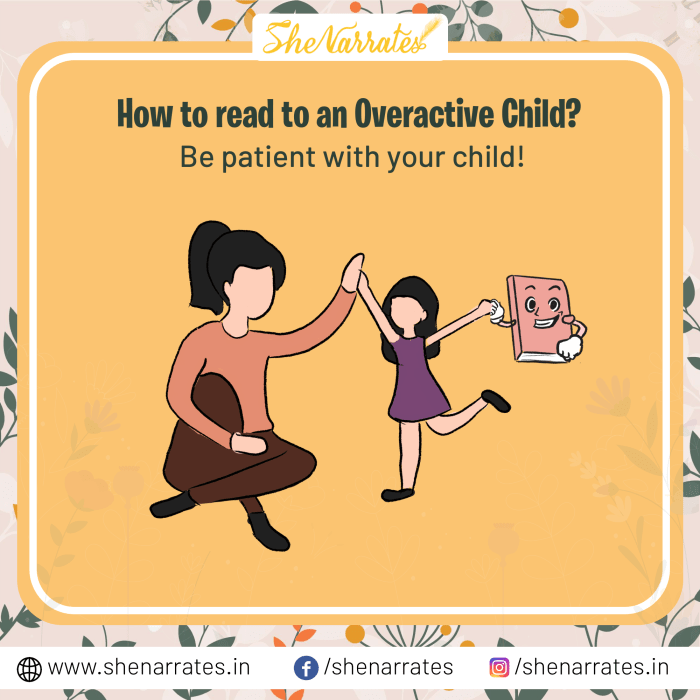
7. Be patient with your child.
It is easy to get frustrated and annoyed by a spirited child’s energy. In most cases, the first reading attempt is a failure. Practice patience when you read to your child. Do not hesitate to read the same book twice or thrice, multiple times. Remember to see an overactive child’s energy as a positive thing and embrace them just as they are. I genuinely have a soft spot for overactive children.
Consider these tips as a few ideas to formulate a customised reading plan for your overactive child. Children who have difficulty focusing find it challenging to sit down still with a book and read. So let them BE sometimes, let them wiggle and bounce the energy out and remember they are still listening while bouncing around. And don’t forget to compliment your child on having completed a reading session successfully. Encourage interactive reading sessions with your child and help her/him participate with enthusiasm and vigour. Through these efforts, you would raise an inquisitive reader in no time.
I wish you a beautiful bonding time while reading to your child and rooting for you dear parent that all your reading sessions happen with ease!
“Opportunities of learning are everywhere, even while playing games!”
The three primary activities that form a part of early childhood experiences unless the formal education starts are- Playing, Eating and Sleeping- the only three mindful affairs at least the 90s born can remember, isn’t it!
Play is the leading form of learning, and games are the natural need for children. We all know that games (whether traditional or contemporary) positively influence the upbringing and growth of each individual. And if you as a parent, also trust that play can raise and help a child thrive in unimaginable ways, you’ll easily relate that as childhood is the budding age for growth and learning, playing games can lay the ground for children to learn essential life skills in play-way spirits; whether it is for learning human relations skills, pre-academic skills, healthy humour or it is moral, emotional, physical and mental development in children.
For this simple reason, we as parents want to pass on our favourite childhood games to our offspring. The added benefits of learning through play are many. Read** on to discover how each game finely and secretly models real-world situations and helps children learn how to live and act naturally.
**Our excitement ended up making this blog a long one. If you, too, are excited and can’t wait to try one of these classics, you can enjoy the list of games and the benefits of each game via the creatives we have made with extra effort!
Here are some of the classic childhood games that teach children essential life skills in play-way spirits :
Musical Chairs
5 people. 4 chairs. Always one chair less than the people playing. As soon as the music stops, everyone rushes to get their seats. Who will be left out?
Musical Chairs is one of the only games that teach children how to talk their way out of arguments. It teaches how to deal with the frustration of failure. Sharpening a child’s auditory skills is another perk. This game works on being happy for others and cheering them on from the sidelines. This game teaches a child how to be a cheerleader not only for others but also for oneself.
Moreover, musical chairs can be played by all age groups.
2. Name, Place, Animal, Thing!
A multiplayer paper-pen game. As the name of this game goes, all you need to do is make four columns on a paper and label the columns Name, Place, Animal, Thing. One of the player commands ‘Start’ and whoever completes the list first commands ‘Stop’. Now, who gets all the four columns (correctly) filled with the instructed letter of the alphabet in a row?
Playing this with your child can have surprising results and definitely increase her concentration levels. Teaching phonics becomes easy; introducing ‘Noun’ to a 5-year young child feels effortless too. Other perks of this game are: vocabulary development for sure happens, but more amazingly, geography and map reading happens too. Eagerness to learn and memorise names of cities, towns to quickly fill the row with correct feeds also ensues, independent thinking, time management, and spelling advancement… all can happen leisurely in play-way spirit.
3. Hide and Seek
A multiplayer game. 1 finder. Who will be caught first?
Hide and Seek is a game of rational thinking and patience. The finder has to think and memorise all the spots where the people could hide. At the same time, the hiders have to look for the best places to hide quietly, without making a sound. Patiently waiting is also an essential part of this game.
In real life hostage situations, the hide and seek game can be re-enacted. This game definitely makes to the list of games that prepare a child to determine and manage undesirable situations.
4. Dumb Charades
A multiplayer game, which can even be played among 2-3 people if the family is a nuclear one.
No materials required. All you do is hum a song or enact a folktale/story you’ve just heard/read together or act out a portion from the documentary series on Netflix you and your family may have watched together. Ask the participants to name the song, or story or documentary! It’s a lot of fun.
The benefits of this game are many; to list a few, here we go. It helps in listening skills, concentration and memory, audio processing of a child, and mindfulness practices.
5. Indoor Hopscotch
A multiplayer game. You can make a Hopscotch board with masking tape on the floor. And then be ready to hop, jump and balance with your little one!
With variations like hopping on the even/odd numbers or the count down 10 to 1, or adding numbers and jumping on the resultant number makes learning numbers fun
How about alphabet hopscotch for letter recognition?
Hoping, jumping, and balancing on one foot helps develop good gross motor muscles and provides exercise that children (and we!) need staying indoors.
Psst! Gross motor movements keep everybody sane! Not only can Hopscotch keep the child physically strengthened, but also can help them learn numbers and letter recognition on a hop. It also supports decision making, positive relationship, self-regulation, patience and turn-taking skills.
6. Monopoly
28 properties. 3-8 players. Two dice. 1 board. Who will be the richest in the end?
Monopoly (also known as a Business Game) is a contemporary game based on strategy and tactical skills, which helps a child with financial literacy, the most important in building 21st-century life skills. It is never early for a child to have financial skills and budgeting knowledge. It sharpens the mind of the young ones and teaches them monetary control. The feeling of being organised and having complete control of your assets is what Monopoly promotes.
Currently, Monopoly has 1144 versions, fictional and real editions included. It is a must-have game.
7. Table Tennis
2 people. 1 table. 1 ball. Who will miss the shot first?
Table Tennis is an Olympic sport practised in schools and colleges, too. This indoor sport mainly focuses on hand-to-eye coordination and impulses. Being cautious and focusing on the ball are some of the other perks that later can be used. It helps fasten your impulses and to withdraw from the jump-away-from-the-ball-coming-towards-you impulse that people generally have.
Playing this with your child can have surprising results and definitely increase his concentration levels.
8. Rock! Paper! Scissors!
A simple and interesting hand game usually played between two individuals in which the participants simultaneously outstretches one of the three shapes- rock (a closed fist), paper (a flat hand), scissors (we all know how! Victory sign with index and middle finger making a ‘V’ shape). The possible outcomes are only two: a draw or one of the participant wins.
This simple game helps in consciousness, concentration and control of the mind, identifying patterns and predicting the future behaviour of the player. For adults, this game can be 5 minutes’ de-stressor between work intervals.
9. Football
11 people in 2 teams each. 2 goal nets. 1 ball. Who will land a goal first?
Football is one of the leading sports worldwide, which is making parents put their child into this rapidly growing field. Teamwork and sportsmanship are two of the main reasons why football makes it to this list.
The intricate art of hand-to-leg coordination and anticipating your teammate’s move at any given time makes the players alert 24/7. Not only does it physically strengthen the child, but it also makes her learn how to play and dribble a ball to perfection.
10. A – Z Gratitude Game (our featured and most talked-about game)
Gratitude journaling and mindfulness practices help everyone sail well and bounce back, especially when the going gets tough.
So, here’s a little about the game. Read the full blog here.
Name an object or a toy that begins with each letter of the English Alphabet: Starting from A till Z, ask the child to look around for all the toys, favourite and not so favourite objects/things/items present in and around the house. Sort of treasure hunt!
‘A – Z Gratitude Game’ helps your child look for his long unattended toys, re-connect with the things she/he has, feel grateful for the things he already has. This game also aids in vocabulary development in young children.
Conclusion
Children are at home during the pandemic, and a child’s mental health is more important than academics at the moment, is what I feel. And what better than learning in play-way spirits for children can happen because we know learning opportunities are everywhere, even while playing games!
While many of the above games teach patience, perseverance, self-regulation and turn-taking, some games from the above list also teach about other facets of real-life secretly. And most of the games mentioned above can have variations and extensions and can be made age-appropriate.
Virtues and morals are essential for social skills development, helping a person act duly according to the situation. Aside from reading moral stories, these games form an integral part of the learning process, assisting children bond with peers and adults in a better way at the same time teaching them life skills.
Mentally and physically strengthening our young ones is one of the first steps to parenting. Inculcating values for life in children in their early life stages helps them later in life.
Pandemic has come as a gift of time when it comes to spending priceless bonding time with family members. Bonding over playtime is an activity that all age groups enjoy. So, why not make the most of this time to cherish it forever and re-experience the childhood days with children in a whole new episode.
So jet-set-go, grab a pen and paper, note down the games you can plan with your child next time they ask you to play, unless it is an outdoor game ‘Football’, if you have a spacious backyard, then why wait, go ahead!
Help them learn and grow into well-rounded human beings.
Thank you for reading, and have a happy, playful parenting!