One evening, my little one and I went to a vibrant and colourful mela (fair) in our locality that had captivating rides, exhilarating activities, and delightful swings for children. As we were roaming about in the fair enjoying our ice creams, someone came up to us from behind and gently tapped my hand. I turned around to see a small girl sobbing and continuously wiping away tears with her tiny hands. Overwhelmed by concern, I knelt down to the girl’s eye level, comforted her, and gently patted her. When I noticed a glimmer of hope twinkle in her eyes, I inquired about the reason behind her tears in a compassionate voice, not before asking why was she by herself, unescorted by any adults.
She radiated a remarkable skill she possessed.
Taking a deep breath, she began narrating the situation in a step-by-step, precise manner about how she got separated from her parents in the fair. She first introduced herself to me, starting with her name. She spelled out her first name, A-D-I-T-I, and then told me she was 7 years old. Later, she went on to explain her situation nicely.
She told me that as she wandered through the fair with her parents, she became captivated by a colourful carousel spinning in mesmerizing circles. Unable to resist the temptation, she hopped aboard one of the gleaming horses. Lost in her own world of joy, she had failed to tell her parents that she was going on the ride. Her parents had gone forward thinking that she was close behind them, as this was the norm and they didn’t normally hold hands.
When the carousel ride ended she realized she was alone. Panic washed over her, and she started crying.
After hearing her story, we took Aditi to the fair’s concierge. The host reassured her and informed her that her parents would soon be reunited with her. He asked her some personal details, such as her name, her father’s and mother’s names, and contact numbers if she knew of anyone. My little one and I watched as she confidently shared all the asked-for details.
The host was also impressed by Aditi’s confidence, and he immediately made an announcement about the lost child. He contacted the provided numbers so that her parents could reach her as soon as possible. Thanks to the personal details Aditi had memorized, she was quickly reunited with her parents.
To Aditi it felt like an eternity, but in reality, it was only a short while before her parents arrived at the concierge’s desk. Their concerned faces reflected relief as Aditi’s eyes welled up with tears of joy. She ran into her parents’ warm embrace. They were immensely proud of their little girl, and their diligent efforts in teaching her to memorize personal details- such as the spelling of her name, their names, grandparents’ names, complete address along with the PIN* code, nearest police station, post office, and their contact number- had proven to be a lifeline in this moment of distress.
From that day onwards, Aditi’s experience became a powerful anecdote in my life, emphasizing to children and parents alike the importance of memorizing personal details.
Here are some parting words for parents:
Dear parents, I urge you to instill in your children this valuable life skill. The Power of Memorizing Personal Details can prove to be empowering in moments of urgency or emergency. Having these details memorized could be the key to a child’s safety and well-being. Children can also be enlightened about the first steps to take when they get separated from their parents or get lost in a fair or find themselves stranded in unknown places.
Aditi’s experience at the fair teaches everyone a vital lesson: sometimes, the most valuable skills are not the ones measured by academic success but rather the ones that empower children to navigate the world safely.
For your children aged 3 years and above, start emphasizing the importance of memorizing personal details such as spelling of their names, father’s name, mother’s name, grandparents’ names (optional), complete address along with the PIN code, nearest police station, post office, contact number of parents and caregivers (optional), and nationality.
“Things keep changing, evolving and refining in a child’s growing years. Every age is a new stage of exploration, refinement and new growth for them. New tastes, new ways, the new knowingness of themselves keep happening in the growing years.”
She Narrates
We all know children eat better and complain less when they are engaged in planning the meals, or helping in the kitchen garden or making things with their own hands or even helping their parents with the vegetables and fruit shopping.
A surprisingly new discovery for me was that my child also eats better when the food on his plate is neatly arranged, and the plate isn’t big a “hotchpotch”. Yes, my little one did make a mention of the word ‘hotchpotch’ when he was whining seeing the food served on his plate. He eats with his eyes first, which is what I fathomed. Presentation matters to him and many kids. His eating habits are frequently changing these days. He has outgrown his once-upon-a-time favourite plate. He says he wants the same big plate as us. Our plate offers more room to mix foods well, and he is able to move his fingers around to mix foods easily on a big plate. (We like eating with our hands.) And he said, “some days not always” he would like to be served and some days “I would help myself, take the food on my plate the way I like it to be”, “Well, fine! No problem, mum does not mind being a support in your paths of self-discovery!”
So next time you see your child complaining about how and what has been served on their plates, especially when they do it often, know that “it is a sign!” indicating that they are warming up to new tastes, new ways, the new knowingness of themselves, new portions of what appeals the most to their taste buds, what matters more to them, how much is enough etc.
Things keep changing and evolving and refining in a child’s growing years. Every age is like a new stage of exploration, refinement, and new growth for them.
Keep your spirits high and venture into the new, unknown, and unpredictable – full of unexpected twists and turns, adventurous ride with your little ones. Because parenting is the most courageous, adventurous and thrilling sport in the world. *winks*
Have you noticed that all babies and toddlers have a natural instinct to do things on their own? This cue is the beginning of independence, and as parents, it is important we encourage and nurture this instinct.
Giving our little ones the gift of independence tells them that we value them as individuals and they grow up developing a strong sense of self-belief. This not only helps children in their optimal growth and development but also helps them build confidence and competence, thereby fostering their inquisitive and creative mindset.
Fostering a sense of security is the first step before promoting independence. Having a sense of security helps children know that they always have a safe place where they can return to fearlessly, without being judged. And when a child has developed this sense of security, we can then encourage them to explore the world beyond. This allows them to know themselves better, understand their capabilities, and develop a sense of competence, security, and healthy independence.
Independence, when nurtured from an early age, allows them to make decisions, take responsibilities and solve problems on their own. The self-confidence coming from an independent mindset further boosts an understanding of societal values and norms and moulds them into kind and empathetic human beings.
There are many ways in which we can help our child to learn to be independent. Let’s talk about a few of them.
Give children space to explore
We can only nurture a child’s inherent curiosity by giving them space to explore, and make mistakes. Experience is the best teacher. Let the children make mistakes and learn from them, and find out ways to not make the same mistakes again.
Ask them open-ended, thought provoking and reflective questions pertinent to situation/s as means of support to help children handle affairs in a better or more efficient way. Let them think and answer.
As a parent, finding the middle grounds is important so that if the child ends up in a strenuous situation, they are aware of the ways to face it and come out of it. Try to keep the surrounding secure, but not over-protective.
Offer choices to children
Give your child the freedom of choices, and add ceiling guidelines. For example, what s/he wants to have for lunch can be a choice, but that it will not be changed once the food of choice is prepared acts as a cap. This way, it helps in fostering the sense of responsibility in children and gives them the freedom of choices. It also helps a child honor boundaries.
Such choices make children think logically and shape their personality traits. This further helps children to hone their independent mindsets and become independent players. Offering choices help develop a healthy sense of independence in children. And being able to make good choices is a skill that children can carry into adulthood and use for the rest of their lives.
Here’s the thing to note, offer choices and options only when the child will truly be allowed to follow their choices.
Involve children in household work and develop the sense of responsibility
Doing household work helps children learn essential relationship skills, feel good, competent and responsible while contributing to family life. Praising a child’s performance and efforts boosts their confidence in doing the given work. Age-appropriate household work can motivate a child to do things on their own. Young children can sort toys after playing, help in dusting, fold their clothes, and water the plants. Older children can help set the table, clean, cook, manage kitchen inventory and more.
You may also encourage your child to handle a particular situation. Give him or her some money and let them make a choice of what to spend them on. Allow them to take care of their siblings or pet/s at home.
Such activities will boost the self confidence in children. It’ll give them a feeling that what they’re doing is important and they are contributing to the family’s well-being.
Participation in household work/chores helps children live independently if parents are away from home for a while. They will be able to take care of themselves and the house without much problems.
Doing household work is a good way in honing healthy independence among children.
Engage them in outdoor activities
“No playtime outside can make Jack a dull boy.”
Encouraging children to regularly engage in outdoor activities and unstructured playtime outside of the house gives children opportunities to imagine, create, develop positive self-esteem, try out new activities, take risks independently. This further nurtures their curiosity and motivates them to learn good social skills.
Children find a number of opportunities to learn and grow independently when they engage in outdoor activities on their own. The ceiling of the house offers limited opportunities to learn, but outside, children can actually find their interests, hobbies and more.
Also, sending children out to play, on their own gives them a chance to take care of themselves, have fun and make mistakes when no one is watching. This helps them think independently, do things well on their own and achieve even more.
Make sure that road and pedestrian safety rules have been imparted. Staying safe from and around outdoor hazards is equally important and the children should be taught about it.
Build an open and comfortable communication space
We always say parents are the child’s first friends. So isn’t it important to keep the ‘fear’ of being honest out of the equation? By teaching them to be honest but not letting them be one, we aren’t helping them. Appreciate them for their honesty, hear them out attentively and, of course, for unavoidable behaviours and severe mistakes; discipline them accordingly.
How we communicate with our children and respond to their concerns today has a direct impact on shaping up their future behaviours and relationships with us and others.
If the child shares something and parents start judging or yelling, they feel worse and start perceiving their parents as moral police.
Therefore, it’s important for parents to BE that FIRST friend to a child so that the child finds a safe harbor in their parents and knows they can exchange their thoughts/concerns/situations openly and comfortably. This way, the parents also get to know and understand what goes on with their child and will be able to help them feel comfortable and confident to communicate anything and everything under the sun without any fear.
We all know good communication is a two-way process, and good communication with children involves listening and speaking in a way that makes them feel important and valued. Affirmative dialogue can instill just the confidence your child needs in dealing with real-time situations independently.
What’s Next?
“Treat a child as though he is already the person he’s capable of becoming”- Haim Ginott
Aren’t our children the most beautiful, most capable? Then why hold them back? A little gift of independence, not looking down upon what they want to do and a little reassurance can go a long way! Don’t worry about them, be with them!
Healthy independence plays a huge role in the optimal growth and development of any child. Thus, it is important to provide such learning space from the very beginning, to boost their confidence and help foster independence from early on.
As a parent, I intend to raise my child as a socially and emotionally intelligent being, one who reaches his highest potential in all walks of life. I strongly believe that early childhood is the best period to impart and develop the necessary and all-important skills, viz: critical thinking, creativity, communication and problem-solving abilities. As a result, I am always on the lookout for ways, methods, tools, techniques and resources that can bring out the best in me as a parent-teacher and my child as a young learner.
Here I bring to you ten activities that will help develop problem-solving skills in young children:
Building with Blocks
Building blocks are toys that come in different shapes, sizes, types, materials (such as wood, foam, cardboard, silicone or plastic) and for various play purposes that can help children in their construction games. And when the building blocks are a bit more sophisticated, as LEGO are, a much more comprehensive range of things can be built. Early childhood is the best time to nurture a child’s imagination and through it, creativity, as young children have more active imaginations than adults.
During a child’s free playtime, let them experiment with the blocks, identify and sort blocks based on colour, shape, and size; let them build free because anything a child builds or rebuilds requires thinking on how to put pieces together and bring ideas to (closest) its desirous shape, design or function.
During guided playtime, you can challenge them to build something you’re sure they’ve seen before. As they begin to visualize the thing in their minds, you can sit back and watch them attempt the challenge. Or how about offering them a book that has fun ideas and can get children thinking and building for themselves or people around them! One such book is ‘100 Ways to Rebuild the World‘ by Helen Murray.
Playing Memory Games with Cards
Memory games help in testing and improving a child’s memory. There are different kinds of memory games. You can begin with matching card games.
Place the cards face down on the table. Each player turns over two cards to find a matching pair. If they do not match, the cards are turned face down and returned to their original position. If they match, the player keeps the cards and continues the game. When all the cards are paired, the player with the most pairs of cards wins the game.
The key in the matching card game is to remember where the cards were; that’s why it’s called the memory card game because if you can remember where the cards were, you’re going to have a lot better chance of finding a match and winning the game.
We use UNO playing cards which is easily available on Amazon.
Putting Together Puzzle Pieces
Solving puzzles are an effective way to provide children with exciting learning opportunities. It helps develop fundamental skills, such as shape recognition, mental focus, decision making, patience, and attaining a sense of accomplishment. Children must have a daily (if possible!) exposure to puzzles. Games and puzzles like Sudoku, jigsaw puzzles, Math puzzles, Chess, Scrabble, and Rubik’s cube are great for developing thinking and reasoning skills.
For young children, starting with jigsaw puzzles (picture based as per the age group) is a great way, and for toddlers, shape sorters, peg puzzles, shape stackers are the best, and if they are wooden ones, nothing like it!
Shakuntala Devi’s Puzzle books are famous in India, but they are for elder children. Solving reasoning puzzles is also important for children of 6+ years.
Practising activities in Activity Work Books
Activity books help children develop a wide range of skills, including reading, understanding, and critical thinking. They engage in various steps to complete an activity, which naturally improves their cognitive skills.
A few of my favourites are here as an example:
Spot the hidden object:
Set up a goal for your child and get them started with the activity.
For example, show them a situation in which a monkey has lost all its bananas.
And then say, “Let’s find those bananas for the monkey.” Now, let them search through the picture and encourage them further after they’ve found each one to stir up their interest.
Spot the difference between two pictures or spot the difference between two given sentences, dot to dot activities, pattern matching
These are some of the other great exercises to get the children practising new and different that target and hone other skills.
Activity workbooks for children are easily available locally in India or on Amazon (type in the search bar ‘activity work books’ and you’ll have lots of them to filter from but our favourite publications are Wonder House Books, Navneet Publications, Dreamland Publications and Om books).
One more thing, suggested age group isn’t only the important factor in making the purchase decisions; flip through the pages, read reviews and personally (if you can) go through the content to determine a book’s appropriateness for your child.
Attentively executing what ‘Simon Says’
In the game ‘Simon Says’, one person is designated as “Simon,” while the others are the follower-players. Simon, standing in front of the group, instructs and asks the players to follow instructions carefully and consciously. The players obey commands that start with the words “Simon Says.”
If Simon instructs, “Simon says touch your head, shoulder, knees and toes”, all players must follow that. Players must not move if Simon says “move” without saying the words “Simon says” first. Those who move are out of the game.
This game helps children learn to distinguish between which instructions to follow and which ones to ignore. Playing this fun game offers multiple benefits like improving listening and grasping skills, developing sportsmanship, fostering spontaneity, following instructions, and correctly executing tasks.
Playing Board Games
Childhood must be a combination of good food and board games, what do you say!
Playing board games is a great way to develop problem-solving skills in children.
In addition to bringing a lot of fun, board games indirectly help children develop valuable skills. For example, games like Snakes and Ladders and Ludo help children develop persistence in the face of failure.
Monopoly (also known as a Business Game), a contemporary game based on strategy and tactical skills, helps a child with financial literacy, the most important in building 21st-century life skills. It is never too early for a child to have financial skills and budgeting knowledge. It sharpens the mind of the young ones and teaches them monetary control. The feeling of being organised and having complete control of your assets is what Monopoly promotes.
Coming out of Mazes
Maze games can take various forms and can be done even without an activity book.
If you wish to give your child a more realistic experience, you can create a large maze on a walkway. Make a few passages, one or two of which will lead nowhere. Ask your child to get herself/himself out of a maze!
This kind of game improves strategic thinking and motor skills, which significantly help in improving problem-solving skills.
Reading Story Books
Children learn a lot from stories, and reading aloud can be one of the best ways to nurture a child’s imagination. Reading to a child has proven to be “brain-changing.”
Young children instinctively love listening to stories that have rhyming words, rhythmic lines and repeated sounds. You can make the story session more interesting by asking situational questions like
What would you do if you were that old man?
Do you think the monkey was right and why?
Questions like these allow children to think, and make connections with things they already know, decide if character/s resonated with them or not, and understand the moral of the story.
As parents, making sure what side of the story children are learning from is really important, and we can gauge that only by asking them situational questions.
Playing the classic- Hide and Seek
Hide and seek is one of the traditional and well-known games played by one and all, irrespective of the age group. It is a game of rational thinking and patience. The finder has to think and memorise all the spots where the people could hide. At the same time, the hiders have to look for the best places to hide quietly, without making a sound. Patiently waiting is also an essential part of this game.
It helps in enhancing intuitive thinking and improved attention too. If your child is tired of playing indoor games, this game would be a great saviour!
Engaging in Imaginative Plays
Engage your child in imaginative plays and encourage them to look around for objects or everyday items to utilize for their play instead of their usual toys. It can help spark their imagination even more and help them relate to the world around them much better.
For example:
a) ‘laundry baskets’, which are used to store dirty or used clothes before washing, can be used by your child to sit inside to enjoy drive-thru experiences, Vroom! Vroom!
b) A ‘stick’ in the hand can become a magic wand or a cricket bat or a sword.
c) Vegetables and fruits could be used as currency for Monopoly.
Concluding now…
The games listed above were chosen from a large selection of games, toys and books that can both entertain and educate young ones. These are also the ones we expose our children at home to. You can create similar games based on these concepts to make your child’s learning process fun and super easy.
Happy Parenting!
Disclaimer: None of the links mentioned above is affiliate links or for promotional purposes. It is only to ease your search process.
Compared to the usual fast-paced, the slower and relaxed way of life during the lockdown made almost everyone appreciate nature, and the fact that it was blooming in all its glory was on everyone’s lips! Almost everyone remarked on the chirping birds and other nature sounds. People observed flora and fauna more closely, and it was no different for us either. We, too, would wake up to slow mornings and enjoy the nature sounds in our sanctuary – our little green garden, for an hour or so. We would watch the birds chirping and singing around, observe butterflies flittering and fluttering from flower to flower, notice the busy ants marching back and forth carrying food, hear the bees and insects buzzing and droning here and there! And ‘Chocolate’, our neighbour’s dog, would never miss wagging its tail seeing my little one!
Well, so many things happen in nature and in my little one’s wandering mind around animals, insects and birds! Most of what goes unnoticed by me are always brought to my attention by my little one! We are kind of instinctive partners for each other to grow and learn, you can say.
It is during this time that I got thinking if I am doing enough to teach my little one about nature, its resources, its importance for our well-being, to our existence, economy, and society at large. Are we conscious and active enough about our participation in nature and wildlife conservation?
Though wildlife primarily exists in the forests or outside the city limits but if we look closely, the creatures and animals sharing the world with us can be found just under our feet or up above us in the sky. In the garden, there are birds looking for water in the summers, squirrels hoarding nuts for winters in the backyard, frogs croaking in the pond during the rainy season and dog/s crossing the road during heavy traffic. ‘Saving one animal won’t change the world, but surely for that one animal, the world will change forever’. Survival of even one rescued animal or creature would send a ripple through the ecosystem. I AM SURE OF IT.
Ahh! Feeling grounded to the bountiful nature and Mother Earth!
Without further ado, let me share with you some fun ways and activities that I like to follow to help my little one actively participate and learn about nature and wildlife conservation. Trusting that if not all, at least some from this list would definitely bring you and your children closer to nature and we can all participate in our small little ways to help build and maintain the ecosystem.
Here goes:
Explore parks and go for nature hikes
Take your little ones out on nature hikes and let them explore wildlife sanctuaries. They will appreciate what they see from their point of view. You could have a Q&A related to nature and wildlife. The Wild Wisdom Quiz book series can be your great partner if you like to travel with books.
The first thing that I like to do whenever we go out to any new place is, ask my child to list down (orally) 5 or 10 things he saw, heard or noticed around. With this approach, I have seen a child usually zooms in and become mindfully present to the surroundings he/she is in and appreciates the environment a little more. Try this with your little ones too and let me know if it was a helpful tip or not! As a multitasker, I also follow this exercise myself to become consciously aware of what I’m doing, the purpose of work at hand, how I’m contributing, etc.
We can shape compassionate and responsible future citizens by creating awareness about nature. Associating kids with the natural world can help preserve our natural environment and even enhance it. It will help them gain a deeper appreciation of life and lead them to respect our planet.
Watch documentaries/shows related to the topic
A nature documentary, show, or movie can be an excellent educational experience for children. This can be very beneficial in inculcating awareness about nature and furthering conservation efforts. It is one of the simplest and quickest ways to foster nature and wildlife conservation learning.
Feed birds
The benefits of having interaction and discussions with our children about nature and animals are immense. It helps children develop empathy for other living creatures. Along with taking care of the environment, children also learn to take care of plants and animals.
Include little details like the types of birds you see and the types of food they eat in your interaction with them. For example, some eat insects, bugs, and worms, while others prefer seeds and fruits.
In addition to having fun, they will identify bird species and understand the concept of co-existence.
We can also engage in a simple activity of feeding birds and keeping water for them (especially in the summers) and encourage them to start doing so independently.
Practice Tree therapy and Plant a Tree
Educating the next generation on the importance of trees is another step in protecting the environment.
Consider creative ways to share your thoughts on trees; perhaps walking amongst the trees is the easiest. Allow them to climb trees. Let your children take photos of as many different trees as they can find. Pause and check if there are any peacocks or birds or squirrels in them.
A trip to Nainital (Uttrakhand, India) is what we prefer during the long weekends, especially in July.
And don’t miss out on the golden opportunity of participating in tree plantation drives with your little ones if one is happening in your locality or society!
Promote nature photography by encouraging it
Ask your young ones what they’d prefer to photograph? Encourage them to capture images of insects and bugs and see how excited they get. This will help them appreciate nature and the diversity of life it sustains.
By teaching our children to photograph the outdoors from an early age, we not only allow them to make good use of their free time but also help them experience a whole new world. As a result of all this, children who pursue nature photography as a hobby are more likely to be creative, confident, and socially aware adults.
I want to add that hobby is always a personal choice; never impose a particular one on a child, but help them find one that they would like to follow.
Book Reading
We live on a planet that is home to incredible and diverse animals. Yet, many of them are on the brink of extinction. They are either being forced out of their homes, or their lives are in danger because they cannot find food and water for survival.
These books contain valuable information for beginners, including helpful recommendations and the experiences of many trying to help safeguard nature and its wildlife. You will also find lots of fun activities and DIY projects to try at home in these books!
One of my favourites is ‘Wild Symphony‘ by Dan Brown- the debut picture book of Dan Brown- it has mindful, mysterious, musically entertaining content. Read the book aloud keeping a prop in your hand and enjoy life-lessons that every wildlife animal has got for our children and us.
Help them grow their flowers and vegetables
Children have a lot of fun when they garden, and it can be beneficial to them in many ways. For instance, they will learn new skills and understand the process of growing their food.
Moreover, gardens attract various kinds of butterflies, ladybugs, and other fascinating insects. You can start by giving them their own garden space (if possible!) Make sure it is a safe place with age-appropriate gardening tools.
You can even visit nurseries and gardens for ideas. Introduce composting, recycling and gardening techniques to teach children about sustainability.
Reduce, Reuse, Recycle
Various people are working to preserve nature in different ways. Waste creation has risen significantly as a result of the increase in the population, making recycling more crucial than ever. It eases some of the pressure on limited natural resources.
Ensure that your children always throw items in the appropriate bins. Create different types of crafts by using recyclable materials such as cartons, newspapers, cardboard boxes, etc.
You might also like to create flashcards that contain images of recyclable and non-recyclable items.
In my opinion, children need to be taught the importance of recycling from an early age to shape the young minds early on and make the world a better place.
Let them adopt a pet
Pets can instill compassion and respect for nature and its surroundings in children. In addition to teaching children responsibility, it also gives them a sense of nurturing. Caring for their pets also helps them build empathy towards all living beings.
Allow them to care for them. Additionally, it may provide them with an insight into the natural cycles occurring around them. My little one will be a pet parent soon. Wait for our announcement!!!
And finally,
Educating children need not be boring at all. We must introduce them to nature at an early age. We got to let children experience everything they do as part of the learning process, and the best way to achieve this is to incorporate fun activities into these teaching moments.
Happy Parenting! May you always feel the healing and restorative power of nature!
A picture communicates a thousand words! Indeed! Complex and sometimes multiple ideas can be conveyed by a single image, which conveys its essence more effectively than any verbal description. Wordless illustrations can effortlessly create greater engagement with the readers. We often assume that it’s the books with words that develop literacy skills, and we often underestimate the extraordinary benefits and skills that wordless picture books help develop. In addition to teaching the visual language, they improve a range of skills, including comprehension skills, creative thinking, oral narrative skills, inference skills and multiple perspective understanding. Most of all, creating one’s own narrative from the images using one’s own imagination, perspective, creativity and vocabulary.
Wordless Picture Books are as important as other regular books. These books provide ageless benefits, especially in the formative years. It encourages early readers and young children to construct the story on their own and apply their viewpoints to the images, nurturing independence, confidence and enhancing creativity, imagination, language, and vocabulary growth.
For the older readers, the challenge is to think more deeply and technically about storylines, sequence of events, character interplay, the mood of the story, and the desired plotline.
However, it comparatively has a greater effect on young children as it has a number of advantages that are listed below.
Simple Access- Books with no words are an ideal source for children having developmental or learning disabilities to learn new things easily. It also helps kids with language-based disabilities who find the reading process difficult.
Inferential thinking- Inferring ideas from the images becomes an excellent way to enhance comprehension skills in children. It also helps them develop skills like hints-developing and conceptual understanding.
Story Telling- Wordless picture books are the best means for children to learn the basic story structure. They can create their individual narratives through the portrayed images and incidents. It allows them to recall what happened in the story from the beginning to the end.
Gain Confidence- Instilling a lasting love for reading in a child must be done with conscious care and this is where reading Wordless picture books helps. Wordless picture books help them gain strength and confidence when they leaf through and read a book on their own.
Improve Vocabulary- Visual representations can help children easily connect and point out things they see around them, which helps them improve their vocabulary quickly and easily.
Love for Learning- Wordless picture books contain colourful images and appealing drawings on each of their pages, which evoke a child’s interest, and intrinsically motivates them to want to learn and understand without getting distracted or frustrated.
10 Wonderful Wordless Picture Books
1. “Wolf in the Snow”- Matthew Cordell
The award-winning book “Wolf in the Snow” by Matthew Cordell is a lovely wordless picture book that has rich paintings and easy to follow images that add eloquence to the reading experience and convey the story in the most satisfying, heartwarming manner. The story opening with a tender portrait of the family can’t be missed! This story is about a girl returning from school getting caught up in a blizzard. On her way back home, she meets a wolf pup who too is lost in the snow. The little girl chooses to abandon her planned route to reunite the pup with its family. At last, they both find their way back to their homes after encountering some dangers and difficulties along the way.
This wintry tale of kindness, trust and bravery is sure to bring warmth and reassurance to you and your little ones.
“Chalk”-Bill Thomson
The story ‘Chalk’ by Bill Thomason has a fine message about being visionary. The book opens with three kids walking in the rain headed towards a park. They notice a bag of chalks hanging from the mouth of one of the dinosaur rides. One out of the three takes a yellow piece of chalk from the bag and draws the sun. The sun comes to life, and it goes up into the sky and drives away all the rain. The kids are enthralled by the act of drawing and seeing things coming to life. They use their visionary ideas to draw some really cool things and to solve some problems. Pick up the book to find out what problems the kids solve with the magical chalks.
Can all our visionary ideas have a beautiful exciting outcome? Read the book with your children to find out the answer.
Realistic images add so much beauty to the creative storyline that they make the story even more magical.
“Ammachi’s Glasses”– Priya Kuriyan (Tulika Books)
The awe-inspiring wordless picture book “Ammachi’s Glasses” by the Indian author Priya Kuriyan offers several moments of laughter to the readers. The story opens with Ammachi (grandmother) waking up one morning, trying to find her glasses by the bedside, but she is unable to find one. Once she leaves her bedroom, she bumbles and stumbles through the day because she’s unable to see anything clearly. She’s seen stepping on the dog, washing her pet cat along with the daily laundry, and then hanging the cat out to dry with the other clothes. She’s also seen cooking a pair of slippers, wearing her granddaughters’ top; many such hilarious topsy-turvy events ensue as the story progresses.
The fine detailing of every character, their expressions in the sequence of events and the local setup adds eloquence to the reading experience. Memorable characters and the little quirks make the book a great retreat.
One important lesson from Ammachi’s story that we get to learn is, not all days are the same and not each new day can have a planned beginning. Do not allow the unplanned beginnings to disappoint you and believe in the magic of beginnings. You can be happy and unstoppable just like Ammachi. She brings forth her smile and goes about her daily chores even without the glasses.
“The Surprise”-Sylvia Van Ommen
‘The Surprise’ by Sylvia Van Ommen is an entertaining, engaging, and a morally sweet wordless picture book. It has a coherent, easy-to-follow sequence of events. A simple storyline ‘Sheep to Sweater’ cannot be produced as marvellously as it is here; the use of complementing colours in the illustration makes the story a delightful journey.
A heavily furred sheep uses its fleece to knit a sweater for his friend giraffe. A simple story plot walks you subtly through wool obtaining process from a sheep and makes the story known with its easy-to-follow realistic images. The story also brings together the message of friendship, caring and giving.
“South”- Patrick McDonnell
‘South’ by Patrick McDonnell is an adorable wordless picture book with a universal message on friendship, cooperation, love, kindness and change. The story revolves around a little bird who wakes up to find its friends and family gone to the south for winters, and he is left behind on his own. In between the search and call out process for the flock, the story takes a turn and leads to an unexpected friendship between the little bird and Mooch, the cat who helps him find his way.
The soft artwork of the fall and fine comical illustration of the cat and bird crossing boundaries, walking between the forest trees and legs of people, birds singing and flying in flocks, are intriguing and engaging for children and adults both.
Note: This book is pretty expensive but worth every penny.
“Coming Home”- Greg Ruth
This nearly wordless picture book ‘Coming Home’ by Greg Ruth is an attempt to pay tribute to the resilience of soldiers and their families. The story reveals a soul-stirring reunion of a little boy with his military parent. The words accompanying the photorealistic wide images, ‘Waiting’, ‘Watching’, Oh, yes!’ captures the boy’s apprehension beautifully in subtle progressions of his expressions. Oh, the tear-jerking twist makes the story emotional and unforgettable! Having a parent away fighting a war — is unnervingly large for a child; we’re also reminded that the children of military parents often have much more responsibilities than the kids their age.
Realistic illustrations and the story based on a military parent-child separation makes the book a heart-warming, tear-jerking treat for the readers.
“The Journey Trilogy”-Caldecott Honoree Aaron Becker
If you and your children like magical adventures, then the series ‘The Journey Trilogy’ by Caldecott Honoree Aaron Becker is a must-read. The wordless series (Journey, Quest and Return) takes you on exquisite, breathtaking journeys. Visually fascinating stories in the series have castles, magical creatures, enchanting world of kings, daring landscapes and more which captures the reader’s attention. Finely detailed, appealing artwork in these stories showcase how a few dreams can bring new worlds or perceptions to life.
Suggestion- 1) You may buy the books of this wordless series ‘Journey’, ‘Quest’ and ‘Return’ separately if the trilogy combo is unavailable online or overpriced. 2) Read them in the order 1, 2, and 3 (‘Journey’, ‘Quest’ and ‘Return’ respectively) because the stories are interconnected.
“The Girl and the Bicycle”- Mark Pett
A young girl notices a bicycle in a shop window and decides to buy it. But she doesn’t have enough money to make the purchase. So, she sets out to earn money. She works hard and saves up every penny until she has enough to buy the bicycle. What follows illustrates the true essence of work, grit, faith and kindness.
‘The Girl and the Bicycle’ by Mark Pett, an iconic classic, carries the message of nobleness and selflessness. The heart-warming, unexpected ending makes it an excellent gift for middle-grade kids and young adults. Not to miss are the business ideas that the little girl comes up with, to support herself in making enough money for the bicycle!
“Spot, the Cat”-Henry Cole
This visual narrative and finely detailed wordless picture book by the award-winning author-illustrator Henry Cole takes us on a wordless journey, giving us the insides of a day in the life of a cat named Spot who journeys in and out of the city often. Spot is seen walking through bustling, busy streets, to a local farmer’s market, to a park crowded with kite-fliers, and beyond. On the other hand, his beloved boy owner is looking for him while missing him all the time.
Spot’s story reminds us that no matter how far away from home one gets, there is always a way back home. And the sweet reunion at the end makes you go awwww….!
“Mary had a Little Lizard”-Kayla Harren
‘Mary had a Little Lizard’ by Kayla Harren is a hilarious contemporary retelling of ‘Mary Had a Little Lamb’. In this story, the little lizard sneaks into Mary’s backpack and creates chaos in her kindergarten class. The lizard is seen doing mischievous things and making a mess in the class. But when it scares the teacher during story-time, it is sent to the principal’s office and made to wait till Mary’s mother picks the lizard up from school. The beautiful reunion of Mary and the lizard at the end makes you caress the book gently.
The book is a cheerful work of art, and the silly, satisfying celebration of new experiences and friendships make it an enjoyable choice.
And, to sum up
I believe you’ve re-examined your viewpoint on wordless picture books, as they have so much more to do with readers than you may have previously thought. Books of this kind are unique because of their freshness and incredible elements that lead to the formation of new worlds in our minds. Start exploring the world of wordless books, sooner than later. Ciao.
My favourite medium viz: books is simply one of the best ways to gain knowledge. This Republic Day introduce your kids to the multifarious facets of our beautiful nation- India, with our specially curated children’s literature. Discover art, culture, monuments, and much more with these lovely books about India, which also include topics around history, mythology etc. There are selections for all age groups of children ensuring that every child is covered and will find something enjoyable as well as learn from.
1. A Children’s History of India by Subhadra Sen Gupta
This book for children gives an overview of ancient Indian history. The beautiful illustrations and simple language make learning history both engaging and fun. Different periods of Indian history are divided into different chapters, thereby providing a clarity of events around that time period.
There is a brief explanation of the political, social events and the lifestyle of the people. Several facts are included that will prove beneficial as an academic study and help enhance knowledge of children. If your child is above 10 years of age and interested in learning history, this book is a must-have.
2. We the Children of India by Leila Seth and illustrated by Bindia Thapar
Seth’s book, which has amazing illustrations by Bindia Thapar, explains the Preamble of our Constitution to India’s youth. This book, which is packed with fascinating facts and rare images, is sure to be a hit in the classrooms too.
Some notable pictures from the India International Centre Library and the Nehru Memorial Museum in New Delhi are also included in this book. If your child is 8+ years and you want to foster patriotism in him, this is a good book to start with.
3. Let’s go Time Travelling: Life in India through the Ages written by Subhadra Sen Gupta and illustrated by Tapas Guha
Perfect for your 10-year-old child. This book delves deep into the time-traveling realms, leading youngsters on a journey through history that is both intriguing and furthers their curiosity. From the Harappans to the Mauryan, Mughals to the British, it’s almost like taking a step back in time. Explore the vibrant culture of India and gain an insight into some of the country’s most fascinating facts.
Most history books deal with the hard facts that are required for answering exam papers without explaining the whys and wherefores of everyday life. But this book is both instructive and amusing, with comic images that appeal to today’s children, occasionally touching on current Indian political events that everyone is aware of.
4. Little Indians written by Pika Nani
This book is a collection of fascinating facts and interesting stories from the different parts of the Indian continent. Discover the lives of many little Indians (child protagonists) as you travel through 15 different states of the country.
Within each story, the writer has spun fascinating facts and fictional tales. Explore the pages to find answers to the many questions woven in each chapter. There are many innovative stories, each of them connecting perfectly with the unique regions of this vast nation. This book is recommended for children between the ages of 9 to 12 years.
5. Jawahar Lal Nehru – The Jewel of India by Aditi De
The author recounts the life of one of the leading figures of India. She discusses his thoughts and actions, describes his interest in the subjects like science and books, his time in England as a student, and his involvement in the Indian Independence Movement. In addition, she details how he helped shape the new democratic Republic of India.
Through this book, the young ones (9+ years old) can gain an insight into the life of the first Prime Minister of India and the events that shaped it.
Fun Fact: On August 14, 1947, at 12 a.m., Jawaharlal Nehru stood to address the newly independent India as its first Prime Minister. He was clad in a pale cream achkan and wore a white khadi hat.
6. Amazing India: A State-by-State Guide by Anita Vachharajani
Providing an impressive tour of the Indian States, this book is a fascinating read for children between 9 to 12 years. It focuses on the different states of India. There is extensive information about the languages, cultures, and fine arts of each state. A perfect book for children to read and learn at the same time. This book includes colorful illustrations that can keep children actively engaged.
7. Mahatma Gandhi – The Father of the Nation by Subhadra Sen Gupta
This book by Gupta is an inspiring narrative about a brave freedom fighter and a lauded visionary. Using Mahatma Gandhi’s journey and his struggles as a model, the book explores the real life of this great Indian leader. The author discusses Gandhi Ji’s efforts and dedication to free our country from the tyranny of British rule.
The perfect book to introduce your children (aged 10 years and above) to his history and legacy.
Fun Fact: Nelson Mandela refers to him as a “holy warrior,” while others refer to him as “the spinning wheel’s saint,” and we now refer to him as our “Father of the Nation.”
8. Subhas Chandra Bose – The Great Freedom Fighter by Anu Kumar
Netaji was a brilliant political theorist and radical nationalist who was highly engaged in India’s political life. During World War II, he was a leader of the Indian National Congress (INC) in the 1930s and the Indian National Army (INA). This gripping history is ideal for kids aged 7 to 12 years andprovides fascinating insights about Netaji’s illustrious life, and sheds light on his enigmatic death in 1945.
Netaji continues to inspire young readers even today with his skills like leadership, honesty, integrity, and courage.
To Conclude–
As a parent, is there anything more rewarding than seeing our child read and learn at the same time?
It’s our responsibility to make sure we don’t miss out on teaching-learning opportunities. With books (especially history books) that have interesting narratives, fascinating facts and intriguing illustrations, we can instill a love of learning in our children and help them develop a sense of pride in our country, heritage and eventually make them responsible citizens who will willingly go all-out to make the nation better.
Here are a few other interesting facts about Republic Day
On 26th January 1950, “The Constitution” came into effect in India. That’s why this day is known as Republic Day.
Every year, a parade is held at Rajpath.
Dr Rajendra Prasad was sworn in as the first President of India.
Writing the constitution took 166 days, spread over 2 years, 11 months, and 18 days.
There are two handwritten copies of the Indian Constitution preserved in cases filled with helium at the Parliament of India.
So today, in this blog, we are answering the number one concern among parents and caregivers, i.e. children being picky eaters or not naturally reaching out for fruits and vegetables. The risk it comes with is that it makes them prone to unhealthy snacking!
When it comes to planning and serving healthy meals, it is essential to be creative and innovative to strike a balance between taste, nutrition, favourites, expenses, and more.
But have you ever noticed how we rarely complain about what we build or make with our own hands? Replicating the same sense of involvement, it would be a good idea to involve children and give them some ownership around making and planning meals. So, hold your little partner’s hand, get onto making your grocery list, planning weekly food chart, and enjoying the goodness together!
Here are some ideas for you:
1. See-food
Yes, you read it right! We are not talking about “seafood,” but “seeing” the fruits and vegetables differently. Make sure to keep fruits and vegetables where your children can see them—places like table-tops or front shelves of the fridge or stands where you usually keep your snacks. Make sure to keep snack-sized packets accessible for your children. These snack-sized packets can be filled with raw fruits and veggies, or you can try making vegetable chips at home for children. So now, keep fruits and vegetables at places where children look and go for food first whenever they feel hungry. You can also have fun with cute-shaped fruit cutters! (This might be a little extra and is totally optional. Also, we don’t encourage the use of plastic cutters or cutlery or props. )
2. Alphabetical fruits and vegetables- It’s as easy as ABC
The first thing that school teaches is alphabets. We all have learnt A for apple and B for ball. Now it’s time for our children to make their own list of things with each letter of the alphabet. Why not A for apricot and B for broccoli? Fusion of learning along with eating healthy can be a little innovative. Let your child use their imagination to find more fruit and vegetable names and make their own ABCs. As they learn new names of vegetables and fruits, their curiosity to know about these plants will grow. This technique will not just keep your children busy to find new words, but you can also introduce new fruits and vegetables to them by including those in your child’s food menu. This method can lead to healthy learning along with making your child fall in love with their healthy friends.
3. Play with the rainbow
Children love colours, don’t they? So why not include these natural colours in the food plan. You should not just stick to green vegetables or red apples when you include fruits and vegetables in a meal for your child. Why? Because every colour of food has unique and special nutritional value. A colourful plate will not only make your child excited to eat, but it is one of the easy ways to make them eat healthily. Even doctors advise eating at least two different colours of fruits and three different colours of vegetables every day. Also, introduce the idea of having seasonal and locally-grown fruits and vegetables to little ones.
4. Half a plate diet check
While preparing a food plate for your child, plan a diet that has the right amounts of fruits, veggies, grains, proteins, and dairy products. Fill half of your child’s plate with fruits and vegetables, one-fourth of the plate with protein-rich food, and the remaining one-fourth with grains that can be your roti made of multigrain flour, rice, etc., that will fulfil the requirements of carbs for the child. This is an easy way for any parent to create a proper whole nutrition diet plan for their child. Also, it might be a good idea to introduce them to these concepts- the carbohydrates, proteins, fibre, vitamins, and more- early on so that they are less prone to getting caught up in diet fads and are more encouraged to respect the nourishing food.
5.Super six “S”
If you are still confused about how to include fruits and veggies in your child’s diet here, you just need to remember these super six “S” while making a meal – salad, sandwich, smoothies, snack packs, soup, and stew. Salads can be made with raw fruits or vegetables. Children love sandwiches, and you can put vegetables in them. Smoothies are better than juices as smoothies contain more nutrition and fibre than juices (and you can always sneak in spinach, dates, and more, and no one would ever know!). Keep your snack packs ready for your child’s hunger pangs in between the meals. When schools reopen, you can add this to your child’s tiffin. Soups and stewed fruits and vegetables have one thing in common – water. You can put many vegetables in soups with the added dose of love from your heart and hands.
6.Let your child grow their vegetables
Children love to play and dig in the mud. Why not add purpose to this playtime! You can grow your own vegetables in your backyard or your apartment or even in small pots if space is a constraint. One can easily grow low-maintenance and easy-to-grow vegetables like peas, brinjal, spinach, carrots, radish, spring onions, and herbs like mint and coriander. It will not just bring your child closer to nature but will also teach them new skills like patience and help them gain confidence. This activity also helps strengthen the parent-child bond as you both do gardening together. As children grow their own food, they will respect both the food and the nature even more. It will also introduce them to the science behind plant growth in the most subtle way.
Conclusion
As the challenges with unhealthy or fussy eating evolve, we as parents need to keep reinventing and come up with new ideas for our children’s mental and physical health. Fruits and vegetables are essential for a child’s growth and immune system. At the same time, there should be no need for caregivers to force them to consume vegetables and fruits. Instead, we can try building and strengthening our partnership with our children and keep encouraging their involvement. These tips will surely make your child reach out for more fruits and vegetables. Let the children get friendlier with their food and respect the goodness that the Mother Earth provides us with, so pure and natural.
As parents, we always want the best for our children. We always try to cultivate a strong sense of kinship with them and envision the best for them. No effort or resource is ever spared in the process of helping them grow into confident, compassionate and self-sufficient beings. And one of the effective ways that I know and advocate, that helps bring about the best in them is instilling the love for ‘reading’. Is it that easy to get them into books? Well, if the books are full of pictures, have interesting stories with compelling characters, then yes! Graphic novels are loved by children of all ages, and here’s the list of some of the best graphic novels for children aged between 6-9 years.
Go on, if not yet started your kids onto reading, this is a good time and all the required help that you need is right here!
1. Narwhal and Jelly series by Ben Clanton
The two remarkable characters of this graphic novel series, ‘Narwhal’, a carefree one-toothed whale (unicorn of the sea) and ‘Jelly’, a straightforward jellyfish, do not have much in common, but the two fondly love waffles, parties and adventures. Narwhal and Jelly series showcases the value of friendship and celebrates unalterable optimism and creativity. The added dose of fun facts about narwhals and jellyfishes makes it praiseworthy and purchase worthy for the little ones. Each volume in the series features three interconnected stories.
Enjoy the sparkles of fantastic with your little ones as you dive into the stories!
2. Tiny Titans: Adventures in Awesomeness by Art Baltazar
Tiny Titans showcases a kid-friendly, elementary school environment with several individual stories as opposed to just following a single storyline. Take a look at what life is like for the young heroes of the Sidekick Elementary school when they head into space and transform into monkeys. Parents trying to instill creativity in their children should look no further than this. The artwork is all entertaining, captivating and colourful. Tiny Titans and all its volumes in the series also make a good offering for the seasoned fans of the Teen Titans cartoon.
3. CatStronauts: Mission Moon by Drew Brockington
You heard that! The cats have taken up the responsibility to set up a solar power plant on the moon to save the world as the world faces a global energy shortage. Yes, they have!
‘CatStronauts’ is filled with science and humour to keep children engaged till the end, and the characters in the story will have your child bursting with laughter. Trust me!
4. Bunny Vs Monkey, Written and illustrated by Jamie Smart, Scholastic Inc.
This children’s graphic novel is a hilarious tale of good versus evil, science versus nature, bunny versus monkey! The story goes like this – a team of scientists have sent a monkey into space, but the mischievous noisy little fur-bag (monkey) barely clears the first hilltop and crash-lands in a peaceful forest on the same planet (Earth) itself. Here, the monkey thinks that he has successfully landed on the other, and tries to colonize the land of (supposedly) another planet. He tries to make his own new world on the planet and decides to drive out all other animals.
The novel is replete with hysterical interactions between the monkey and other animals that can surely get children laughing aloud.
5. Bird & Squirrel on Fire by James Burks
After a crazy round-the-world trip, Bird and Squirrel have come back to their beloved forest home only to find a lot of problems waiting for them. Their house needs cleaning, an annoying beaver has dammed up the river, and all the other animals are scared of a new growing menace.
The story fuels the curiosity in the minds of little ones as they wait to find out how the duo finally saves the forest’s life. In fact, the whole ‘Bird and Squirrel’ series has hilarious adventures!
6. Sparks! (#1)Written by Ian Boothby and illustrated by Nina Matsumoto, Scholastic Inc.
Sparks – a comedy-action children’s graphic novel about two cats who pilot a powerful robotic dog suit – is a story about cats named August and Charlie. August is a genius inventor while Charlie is a crack pilot, and together they work to save the lives of people in need. An evil Princess is on her mission to enslave the entire humankind, but the cat duo is not backing out anytime soon. It is interesting to see how August and Charlie manage to stop the princess’s evil plans. Along with hilarious action sequences, Sparks’ series explores themes of friendship, team spirit, facing your fears, forgiveness, and kindness to people and animals, making it an excellent read for children and adults alike.
7. Sonic the Hedgehog: Fallout by Ian Flynn
The work of our children’s most beloved character ‘Sonic’ the Hedgehog hasn’t gotten over even after the epic battle. The Hedgehog and his journey in this collection features a new guest star ‘Blue Blur’ who brings in some brand-new adventures. Sonic the Hedgehog was successful in stopping Dr Eggman in his evil plans, but Dr Eggman’s rogue robots continue to attack small villages around the globe and to defeat them, Sonic teams up with his friends and some new allies. It is interesting to see how they save the villagers from these robots in this collection. This graphic novel’s bright and colourful artwork is sure to keep children hooked through the small story arcs.
8. Amulet (#1-8) by Kazu Kibuishi
A young girl Emily moves into her deceased great grandfather’s house with her younger brother Navin and mother after her father’s tragic death, but the locals call that house a haunted one. In this thrilling children’s graphic novel, it is interesting to explore how this family overcomes the challenges they face after moving into that house. Amulet series is a must-have for all fantasy novel fans. Personally, it is a good recommendation for children above 8 years.
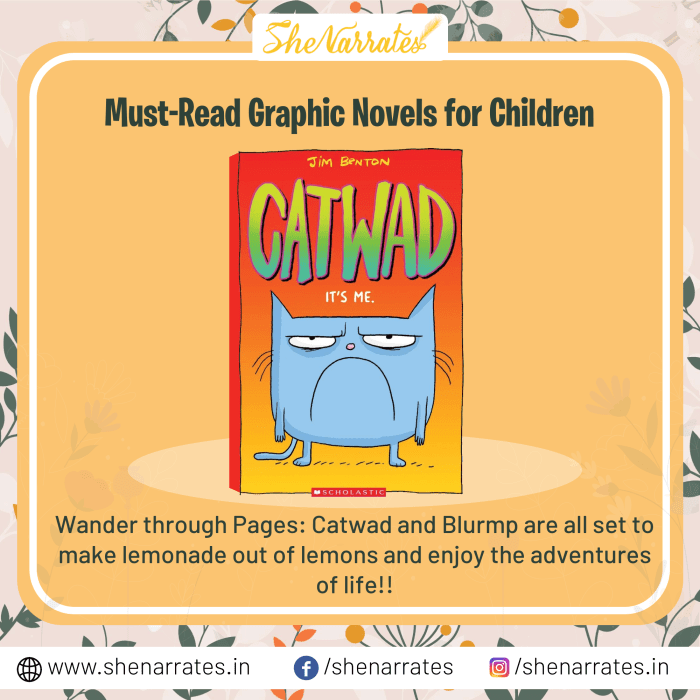
9. Catwad: It’s Me. By Jim Benton
It’s Me – the first in the Catwad series, introduces two main feline characters, Catwad a grouchy and grumpy cat, and Blurmp (Catwad’s best friend) a bouncy, carefree kitty. It is a fun engaging novel filled with hilarious adventures of Blurmp and Catwad who as friends balance each other in all the adventures together. When life gives Catwad lemons, Blurmp makes lemonade with his optimism and positive can-do attitude in the face of adversity. It is another great graphic novel perfect for young readers.
10. Dog Man: The Epic Collection by Dav Pilkey
Heroes come in all shapes, sizes & forms. And this hero ‘Dog Man’ was born when Greg, the police dog and his partner cop, get seriously injured on a mission, and are close to death. The only way doctors could think of saving them was by stitching them together! Hence, surgery was done to save both of them, and now they’re no longer separate individuals, they are a dog and a man combined. It is a fun novel where this new Dog Man fights criminals and creates new history.
11. ‘I Am Gandhi‘ by NYT bestselling author Brad Meltzer
This philanthropic Graphic Novel is the one you can’t afford to miss for your little ones! The extraordinary biography is a team effort that exemplifies Gandhiji’s selflessness and love for humanity. Galvanized by the Gandhiji’s empowering thoughts, his gentle activism, the artwork from some of the finest illustrators working in the comics field today, this memorabilia of Mahatma Gandhiji’s life and achievements cannot be missed. There’s art, history, inspiration, and more!
I would say the ‘Ordinary People Change the World’ series by Brad Meltzer is a must for children, if not all, then at least ‘I Am Gandhi’ needs the space on your children’s bookshelves.
Conclusion
Give your children some time to develop a fondness for graphic novels, and they’ll surely come back asking for more. Once they start to associate books with fun and joy, reading will come naturally to them.
As food is nutrition to the body, reading is to the mind. Let your children explore the world of graphic novels, and you’ll be surprised by how fast they develop reading habits. Help them become the happily engaged, thinking and informed individuals.
Reading for pleasure or leisure reading, aka recreational reading, may or may not have a purpose, but it certainly has become a significant activity for bonding between young children and their parents in the present times. Like everything that has changed with the times that we live in, literature too has taken various forms to cater to different tastes & palettes and to accommodate the decreasing attention spans due to paucity of time.
While many parents are still hesitant to let their children decide on what to pick up for their recreational read time, some others are allowing comic books and graphic novels to encourage reading and reap the benefits of this unique way of learning. My own experience says – both are great!
Both comic books and graphic novels are stepping stones for developing skills like patience, empathy, problem-solving, and emotional stability in children. These are also great for teaching values like honesty, loyalty, friendship and love, everything that we expected a reading habit and the conventional literature to do. Let us discuss the comic books and graphic novels among the various options available.
Most people are still confused about which is a better pick – comic books or graphic novels? Are you too?
Well, then read on to understand what separates the two wonderful forms of literature. I hope you not only find your answers but are better informed to make considered choices.
What are Comic Books?
Comics are short stories, also called periodicals, focusing on a particular incident or adventure from a story. They are expressed through illustrations and text bubbles (speech bubbles). Comics are sequential excerpts from a larger narrative published in parts throughout a year or sometimes decades. They are issued weekly or monthly and in many formats. Most popular are comic books, comic strips, newspaper strips, webcomics and caricatures.
Comic books gained a mainstream in the 1930s with the release of Action Comics. DC Comics and Marvel Comics are the largest comic books production industries. They produce science fiction books based on superpowers and superheroes. Marvel Comics has released approximately 37,000 comics since it was established in 1939. Even though Marvel and DC are most famous and demanded, there are many other independent comic publications.
Here are a few Comic Books suggestions for young readers:
Toon Books Publication. Only publication with an age-based variety of comics (Age: 6+ years)
Angry Birds Comics: Sky High by various authors (Age: 6+ years)
All’s Faire in Middle School by Victoria Jamieson (Age: 8+ years)
Super-Man, DC Comics (Age: 9+)
Avengers, Marvel Comics (Age: 10+)
What are Graphic Novels?
Graphic novels, like comics, comprise both illustrations and text. However, graphic novels are complete stories with all the elements of novels, i.e., theme, plot, characters, conflict, resolution, setting and style. The story is either narrated in one book or through a series of 2 – 3 books.
Graphic novels are more complex and substantial. They always have elaborate character development, personal journeys’ and thematic messages. Sometimes, a series of comic books are combined to create a graphic novel.
The first graphic novel, A Contract With God and Other Tenement Stories by Will Eisner, published in 1978, was an adult novel. Later after it, graphic novels for kids became popular.
Here are a few Graphic Novel suggestions for young readers:
Narwhal and Jelly by Ben Clanton (Age: 5+)
Unicorn Dairies by Rebecca Elliott (Age: 6+)
Ganesha’s Sweet Tooth by Sanjay Patel (Age: 6+)
Little Indians: Stories from Across the Country by Pika Nani (Age: 9+)
Difference between Comic Books and Graphic Novels:
.
Comic books and graphic novels are the most effective tools that help children identify sounds (onomatopoeia – e.g. ouch, sizzle, pitter-patter, oink, etc.), words, and language. It helps them develop early literacy skills and expands their vocabulary. Graphics support the meaning of words, and comics help to clarify their meaning.
Graphic Novels give kids the extra help they need to get through a text. They are especially appealing to children. The combination of text and illustration gives context to stories kids might not otherwise understand. Graphic novels are engaging and are of great quality. Graphic novels sometimes can be overwhelming. As parents, you can let your young ones decide when they want to move from comics to graphic novels.
Above all, be it comic books or graphic novels – both are excellent means to learn and grow. Both types of books are high in demand, not only in the younger generation but also in adults. It does not matter what children choose, as long as they continue to explore new things and grow to be exceptional little human beings.
Before I conclude this blog, I want to say that reading comic books or graphic novels is still reading, and anything that excites a child to continue turning the pages is a win-win. So, do let your child indulge in this form of reading (recreational reading with comic books and graphic novels) which is entertaining, recreational and educational, all at the same time.