5 Indian Books for Children that Celebrate Islamic Faith and Culture

Blog on '5 Indian Books for Children that Celebrate Islamic Faith and Culture'

The world’s second-largest religion, Islam, witnesses about 1.8 billion faithful followers. The Islamic culture has a strong emphasis on monotheism. Islam comes from an Arabic word that means ‘to surrender to God’. It centers its belief on five key elements – the profession of faith, prayer, alms, fasting, and pilgrimage.

It is vital to teach the religious culture and its practice to the younger generation in an authentic and natural way. However, it is challenging to teach the importance and spirit of the culture to children. Thanks to technology, it is getting easier by the day.

Books often outrun the desire for technology and can become one of the prime sources that can impart the knowledge of faith. Also, if you are looking to help your little ones understand their culture and faith more. Or, if you want to broaden their horizon and make them more empathetic toward their Muslim peers, your child can learn a lot from books.

Here is a detailed list of 5 Indian books for children that celebrate the culture and faith of Islam. I have also included a few quotes from the books as well. This is a list that is definitely worth checking out, as they have been written in simple language which are easy for kids to understand.

  1. “Allah and Me” by Vinni Rahman

The tiny chapters of ‘Allah and Me’ have Quran verses, Islamic values and virtues. Author Vinni Rahman has thoughtfully highlighted the importance of prayers, gratitude, charity, and respect one must have for one another.

The small yet meaningful chapters encourage children to learn to live Allah’s way.

“Allah is pleased when a man eats or drinks something and then praises Him for it.”

  1. “Muezza and Baby Jaan, Stories from the Quran” by Anita Nair

A curious baby camel named Jaan and a cat’s friendship is depicted in this book. The camel a djinn-turned-angel, and Prophet’s favourite cat share a ton of teachings of Islam. It mesmerizes the readers with stories like Nuh’s ark, the mighty king Sulaiman, the first man and woman, and much more.

The author has used her imagination brilliantly in building the two creatures. Their journey in an unending desert and the bond between the two is simply stupendous. The storyline is crafted meticulously and the illustrations are a treat for the eyes.

“He began the creation of man from clay”

  1. “Ibrahim’s Sacrifice” by Ziya Us Salam

Ziya Us Salam, a literary critic and author, has written this enthralling book. This book revolves around the religious man Ibrahim and his son Ismail. Prophet Ibrahim was ordered in the dream by Allah to give his only son Ismail as a sacrifice on Mount Arafat. The prophet though loved his son, obeyed Allah’s instructions. But, Allah had something else in store for them. Pick up the book to know what happens.

The author has used a clever tone in narrating the mystery of this story.

“But Prophet Ibrahim was determined to obey Allah’s command. He proceeded with Ismail to Mount Arafat”

  1. “Tell Me About Hajj” by Saniyasnain Khan

Have you been to Hajj? What is it? Why it’s so important?

These questions are all answered in this book by the author. The pilgrimage story begins 4000 years ago. Prophet Ibrahim was gracious and pure in heart. Allah gave him wisdom and made him his best friend. Allah ordered him to travel to present-day Makkah with his family including his son, Ismail.

Author Saniyasnain Khan has made a delightful narration of the story. He explains the importance of Hajj and its teachings. Appealing illustrations to show the iconic places are noteworthy.

“If Allah has ordered you to do so, then he will not let us die”

  1. “The Story of Khadija” by Saniyasnain Khan

Khadija was one of the most dignified women in Islam. She is an inspiration to many believers and is considered to be the worthiest of all women present during the time of Prophet Muhammed. She was noble and wise. She is believed to share her importance as the ‘four ladies of heaven’ along with Mary – the mother of Jesus, Asiyah, and Fathima.

This book portrays the dedication, sacrifice, and hard work of Khadija and the entire family of the Prophet. Khadija dedicated her energy, time and wealth to Islam and has set herself as an example to many.

“She paid extra to each employee for every item he sold.”

Why we love stories rooted in faith?

Faith allows us to take the next bolder step, a constant ray of hope that keeps us all going no matter what or who comes in the way.

Faith is the principal element of all religions. All religions and their practices offer the same message of love & eternal hope. Islam is no exception as faith forms a major part of Islamic culture. Many believers in the past have followed the prophets and their teachings with enormous respect. They have been crucial in enlightening the generations with the teachings of Allah.

We share equal responsibility in uplifting the faith of our children. Nurturing faith and culture need wisdom accompanied by patience. As individuals, we hold a major share in contributing to uplifting the faith of the children. And the above-mentioned books for kids can help you in the journey.

Before closing the blog, here’s something I want to share, something personal with you.

Growing up, I didn’t get to read books about Islamic culture

Growing up, I never had a chance to read about the Islamic faith and their culture at this basic level, and I must acknowledge that I am as young in my knowledge about their faith and culture as is my little one, who is 6- years old at present.

Mmm! Had my intention been not clear enough to read books of all kinds to my child, I would have never arrived at the promotional packets of kids’ books on Islamic culture and faith. To be honest, I did have a lot of resistance to reading these books with my child and writing this far for you.

The more we learn, the more open our world-view becomes

But here’s one thing that I know for sure, these books listed above are good for young readers and can set the stage for young ones to spark conversations about the Islamic faith, culture, tradition and Muslim protagonists. The list also makes for a good read during Ramadan and Eid or all year long.

‌Wishing that you and your little ones get to learn a bit more about Islamic culture and faith from this blog and from these books listed above.

‌Keep reading to your child and always take out some time to have a happy reading time to and with your child. There’s nothing better than reading aloud to children!

Happy Reading!

P.S.- This is also a featured post on Women’s Web, and the link to this blog is HERE!

Why Poems, Plays and Stories by Rabindranath Tagore are good for Children? And 6 Must-read

Here's a blog highlighting the reason why the works of Rabindranath Tagore are important for children, this blog also includes 6 Books important for young readers.

“Because his works are like celebrating literature, culture and patriotic values.”

First Asian poet, novelist, playwright, composer, and pioneering educator, Nobel Prize winner, Rabindranath Tagore was born in Kolkata in 1861 and passed away in 1941. He was born into a family whose roots were steeped in culture – art, music and literature. Some say that he penned his first poem when he was just eight. Many considered him as one of the most influential literary figures among Indian writers. Everyone acknowledged him as the “Bard of Bengal”.

Rabindranath Tagore is also recognized for the composition of India’s national anthem, “Jana Gana Mana”, and that of Bangladesh, “Amar Shonar Bangla”. Most importantly, he was one of the major Indian writers who believed that children should be endowed with literature of high quality.

He loved the idea of incorporating the concept of childhood in his works. As a matter of fact, childhood was the major source of inspiration for all his well-known writings. His poems, plays, short stories, and novels all revolved around the young readers. According to Tagore, childhood is that one phase in life that represents the perfect example of human existence.

One of the major themes of many of his works is centered on the tender relationship between a mother and child. This is so because Tagore lost his mother when he was only a child. Unfortunately, he also lost his wife when he was only 29 and had to be both a father and mother to his children. In an attempt to get back on his feet and bring up his children, he wrote quite a lot of poems.

Tagore’s works are moralistic, and the best sort of books parents can give to their children. His books also open the doors to information about life in the 20th century giving us a glimpse of what India was like then.

A few of his acclaimed works to explore with children are:

  1. The Little Big Man

Growing up, almost every child dreams of fitting into their elders’ shoes. And nearly all of us have tried on our elder’s shoes at home. Have you too? Let us know in the comments section below.

Well, the story in the poem ‘The Little Big Man’ is about a young boy who too tries on his father’s shoes, almost every day, but it is of no avail. ‘The Little Big Man’ is more than a poem; it’s a feeling, a feeling that both a child and an adult can relate to while reading. What it is like for a child to wear his father’s shoes, the desire to grow up fast, understand the world of responsibilities adults have… all of it has been beautifully crafted in the magical verses by Tagore!

 So, it is a must-have for all, and recommended age group for this book is 3+ years. 

  1. The Astronomer

The book is essentially a conversation between a young girl and her elder brother. The entire story in this poem focuses on the girl’s belief that she can catch the moon and her attempts to persuade his brother. Pick up the book and catch the moon through their eyes.

It is a short narrative poem appropriate for children 5+ years.

  1. Kabuliwala

This classic Bengali story is about a five-year-old Bengali girl and an Afghan moneylender who form an incredible bond; this story is full of emotions and humour. Tagore also addresses a number of social evil practises, such as child marriage and education of girls.

Kabuliwala’s narrative is appropriate for children aged 7 to 14.

  1. Clouds and Waves

Clouds and Waves is a poem about a young boy who prefers to spend time with his mother over playing with his friends. In the company of his mother, the youngster appears to be really content and joyful. The Clouds & Waves story will surely appeal to children aged 9 to 14.

  1. The Prince and Other Modern Fables

This classic collection of short stories will be easily understood by children aged 9 to 14. It is a compilation of several short stories revealing the simple truths of life. It consists of accounts of a young boy who loses his mother to a tribal girl who is misunderstood as a fairy. Do explore the stories with your children!

  1. The Land of Cards: Stories, Poems and Plays for Children

This collection brings together many iconic Tagore titles.  The title piece, ‘The Land of Cards,’ is a parody of the orthodoxy of rules, while in ‘The Post Office,’ a boy feels suffocated by his constrained environment and fantasizes about freedom in the world outside. 

Tagore’s works demonstrate his compassion and deep awareness of human relationships, from a son’s cherished yearning to protect his mother in the poem ‘Hero’ to a fruit-seller’s longings for his daughter staying far away.

Children between the ages of 14 and 18 will understand the stories readily.

To Sum Up

The collection of notable stories not only helps expand children’s vocabulary, but also helps improve their English. Each narrative contains a moral that will aid in the social and moral growth of children.

Rabindranath Tagore’s works are a source of delight for both children and adults alike.

Happy Reading with children!

List of 15 Publishers Recommended for Children’s books- A Parent’s Guide

It is a blog that lists 15 Publishers Recommended for Children’s books- A Parent's Guide. This guide enlists the established and most trusted publication houses that can help you find age-appropriate good books for your kids easily.

For a child to come up with imaginative and fascinating ideas, chances are he or she is a bookworm at heart. Imagination & thinking out of the box for a child mostly comes from the environment that majorly comprises of different books that he/she has been reading.

Encouraging our little ones to read from a very young age undoubtedly stimulates their imagination and cognitive thinking. As Taylor Swift puts it, “Books train your mind to imagination to think big.”

As parents, it is understandable that we want the right kind of books, that are age-appropriate and from the established and most trusted publication houses. To meet this need, I am enlisting a few popular and sought-after publication houses for children’s books.

Here are the recommended ones:

  1. Penguin Books

A British publishing house founded in 1935, has been successfully publishing high-quality fiction, non-fiction, classic and audiobooks for children between six to fourteen years of age. This publishing house has its presence in different countries across the world – the US, India, Australia, and Canada to name a few.

  1. Puffin Books

Puffin Books publishers were founded in 1940 in the UK. In 1988, Penguin merged with New American Library and Dutton and created a new powerhouse Puffin list. It is one of the leading children’s book publishers in the world. It was established on the grounds of strong literary traditions. It successfully publishes a mix of classic children’s fiction and new literature. It caters to children between seven to nine years of age.

  1. HarperCollins Children’s Books

The Book publishing house is home to a few of the most popular authors of children’s literature today. It mainly focuses on publishing content on interactive games and enhanced learning tools for children.

  1. Walker Books

It is an Australian independent book publishing house that is well known for issuing books and content for children of all ages. It includes story and picture books that centre around the themes of nature and animals.

  1. Tulika Books

It is an Indian independent book publisher that was founded in 1996. Its focus is on publishing picture books in other Indian languages apart from English for children. Books addressing diversity and inclusion written from Indian perspective and mindset by the Indian Authors are what we like about them a lot.

  1. Oxford Owl or Oxford

A UK book publisher bringing out books for children between six to fourteen years of age. It focuses on publishing content with creative graphics and compelling narratives. It also includes a wide selection of academic and story books.

  1. Templar

Templar, established in 1987, is one of the well-respected book publishers for children across the world. It caters to young readers of all ages. It publishes fiction, non-fiction, picture books in 25 different languages across 50 countries.

  1. Usborne

Usborne is a leading independent family-owned business. It provides high-quality content for children of all ages. It has branches worldwide and publishes books in English and 130 other languages.

  1. Piccadilly Press

A publishing house that caters to children between five to twelve years of age  They publish books with genres centred around fun, and family. It aims at creating classics in various formats such as hardcover, paperback, e-book, and audio.

  1. Ladybird

Ladybird is a publishing business established in London that focuses on children aged three to five. Its goal is to create a love of reading in youngsters. Ladybird publishes books in a variety of genres, including phonics, vocabulary, and sentence structure, as well as building skills of reading, listening, speaking, writing, and critical thinking.

  1. Disney Books

It is a well-known book publishing firm that specializes in picture books for children aged three to five years old.

  1. Bloomsbury Publishing

Bloomsbury Publishing Inc. is a book publishing company whose books are well-loved and read by both children (aged nine and above) and parents alike. It includes books written by J.K Rowling, Katherine Rundell, Catherine Doyle, Ben Bailey Smith, Katya Balen, Miranda Krestovnikoff, Renée Watson, Greg James and Chris Smith, and Neil Gaiman to name a few.

  1. Scholastic Books

This book publishing firm focuses on the needs of students in schools. Its goal is to foster children’s intellectual and personal development. It covers all types of academic learning.

  1. Macmillan Children’s Books (Pan Macmillan)

It is a well-known UK-based publishing house that has been producing fascinating and adventurous children’s books for over 150 years. It was the first to print The Adventures of Alice in Wonderland and The Jungle Book, two great works. They are home to classic picture books such as The GruffaloDear ZooPeace at Last. Books for children zero to teen are extensive out here and best-selling too.

  1. DK (Dorling Kindersley) publishers

DK publishers is an award-winning book-selling firm catering to kids of all ages. It includes fun and factual content from dinosaurs, to craft activities besides other genres.

To sum up

When you encourage your children to read from an early age it enhances not just their vocabulary but also their level of imagination. It helps them to see the world in a different light from the pages of the books they read. Each of the above publication houses is our go-to book publishing company to buy children’s books. These are a few well-known publishers we know catering to a large number of children’s tastes and interests.

If this list recommendation helped you, let us know by liking the post, leaving us a feedback and support us by sharing the post with other parents. Thank you.

Happy Reading!

10 Books to help children appreciate Diversity and inculcate Inclusion

Blog on Diversity and Inclusion- topic-10 Books to help children appreciate Diversity and inculcate Inclusion

“The thoughts of young minds build the future of the world.”

Diversity exists in everything – nature as well as institutions made by humans viz: cultures, religions, genders, castes, skin color, socio-economic factors, family structures etc. Introducing children to Diversity and Inclusion at an early age helps them appreciate differences while embracing their own uniqueness. It’s almost every day that our children meet people from different cultures, races and gender; talking and discussing about Diversity and Inclusion at an early stage, is the best way to move forward.  It helps them to identify and learn about themselves from a variety of sources – people belonging to various races, cultures, and abilities in the world. It develops an open mindset and serves as an ideal base for growing into empathetic individuals who respect and care for those around them.

Having conversations with our children is an excellent first step to introducing children to Diversity and Inclusion. Books are an effective source of communication. Reading books on Diversity and Inclusion to children is a wonderful way to spark conversations and educate them. It helps them recognize the similarities and accept the differences of others, paving the way for inclusive behaviour.

So, here’s a list of ten books, specially curated, that can serve as great resources, encourage conversations and get children thinking about diversity, difference, inclusion, and acceptance.

  1. “All Are Welcome” by Alexandra Penfold
Book- 'All are welcome' by Alexandra Penfold- teaches little ones the value of accepting people for who they are and to remain united at all times.

This book by Alexandra Penfold focuses on the theme of “celebrating differences”.

The story follows a day at school where children of various races, religions, backgrounds, and abilities come together to do all kinds of activities, like working on projects, pointing to their family’s origin on a map, and playing together in the playground.

All Are Welcome” allows children to know that they are all valued as individuals and received with open arms in their school, regardless of differences. It teaches little ones the value of accepting people for who they are and to remain united at all times.

This book is recommended for children aged 5 to 8 years.

  1. “It’s Ok to Be Different” by Todd Parr
Book- "It's Ok to Be Different" by Todd Parr- enhances the emotional development of young children, instils positive thoughts and helps children feel unique and confident about themselves.

This classic book inspires thoughts of acceptance, self-confidence, and uniqueness in young children.

The illustrations in the book are simple, appealing and colourful, making it attractive and easily relatable to children. The repetitive usage of the words “It’s okay to be” in bold letters on each page of the book motivates children (and adults, too) to embrace their individuality by accepting others and celebrating Diversity.

This book enhances the emotional development of young children, instils positive thoughts and helps children feel unique and confident about themselves.

This book is appropriate for children aged 3 to 6 years.

  1. “Sulwe” by Lupita Nyong’o
Book- “Sulwe” by Lupita Nyong’o- delivers a great message - that everyone is beautiful, irrespective of their skin colour and that it is important to love and accept ourselves just as we are.

This bestselling children’s fiction by award-winning actress Lupita Nyong’o talks about a sensitive topic- people of colour- in a uniquely reassuring way.

Sulwe, a small girl, has the darkest skin in her family and her friends at school. However, she later starts to love her skin colour after returning from a magical journey through the night sky.

The story in the book delivers a great message – that everyone is beautiful, irrespective of their skin colour and that it is important to love and accept ourselves just as we are.

This book is appropriate for children aged 4 to 8 years.

  1. “Last Stop on Market Street” by Matt de la Pena
Book- "Last Stop on Market Street" by Matt de la Pena-  beautifully depicts real-life experiences, encouraging children to appreciate Diversity and understand different lifestyles.

This award-winning modern classic by Matt de la Pena invests kindness, gratitude and empathy in children.

The book narrates and presents a story about a boy named CJ who visits church every Sunday with his grandmother and takes a bus ride after praying. But on a particular day, after noticing his friend in a car, he wonders why he was on a bus while his friend had a car; why he doesn’t have an iPod like the other boys on the bus. When he asks his grandmother about it, she shares her perspective and helps him find and appreciate the beauty in everything. The heartwarming celebration of cross-generational bonding and vibrant illustrations make the book a must-have for children.

This book beautifully depicts real-life experiences, encouraging children to appreciate Diversity and understand different lifestyles.

This book is appropriate for children aged 3 to 5 years.

  1. “The Big Umbrella” by Amy June Bates
Book- "The Big Umbrella" by Amy June Bates- sends a strong message about making room for everyone in our hearts by treating them equally, just like an umbrella does.

The Big Umbrella” is a lively picture book about inclusivity, selflessness, and equality.

The story begins with a small child who pulls out a red umbrella on a rainy day. And the big friendly umbrella covers and protects everything and everyone who comes under it, no matter who they are.

This book sends a strong message about making room for everyone in our hearts by treating them equally, just like an umbrella does.

This book is appropriate for children aged 4 to 8 years.

  1. “I Will Be Fierce!” by Bea Birdsong
Book- "I Will Be Fierce!" by Bea Birdsong- encourages children to see themselves as heroes who can add tremendous value to their own life uniquely and much more confidently.

I Will Be Fierce!” is an empowering picture book that presents the idea of courage, confidence, self-esteem and about looking for extraordinary things and opportunities in everyday moments.

As a new day begins, a young girl decides to face the world with lots of courage and bravery. She sets off on her journey like a little warrior on a quest of adding tremendous value to her life. From home to school and back again, she learns her subjects at school well, gains knowledge by reading books in the library, makes new friends and walks a victorious way back home.

“I Will Be Fierce!” encourages children to see themselves as heroes who can add tremendous value to their own life uniquely and much more confidently.

This book is appropriate for children aged 3 to 6 years.

  1. “I Can Do Hard Things” by Gabi Garcia
Book- "I Can Do Hard Things" by Gabi Garcia-  encourages children to build resilience, believe in their abilities, and to stay strong when navigating through hard times.

The book “I Can Do Hard Things” helps discover the inner voice of oneself while reflecting on the Diversity of the world.

This book has affirmations that can help children strengthen their inner voice and tune in to them when the critical outside voices tell otherwise about them or how they should be in the world. 

This book is a treasure to keep, as it encourages children to build resilience, believe in their abilities, and to stay strong when navigating through hard times.

This book is appropriate for children aged 5 to 10 years.

  1. “The Day You Begin” by Jacqueline Woodson
Book- "The Day You Begin" by Jacqueline Woodson- creates a significant impact on the sensitive minds of young children and can help them embrace their uniqueness with the story of their own. This book can help them feel self-assured as individuals.

This delightful book of art sows the seeds of courage and confidence in young minds, helping them explore the beautiful world full of people from varied walks of life.

The book contains beautiful illustrations that tell the story of a young girl who feels different and weak as she compares herself to others when she enters a new environment. She finally gains courage after she decides to see the beauty in her life.

The Day You Begin‘ can make a significant impact on the sensitive minds of young children and can help them embrace their uniqueness with the story of their own. This book can help them feel self-assured as individuals.

 The book ‘The Day You Begin’ is appropriate for children aged 5 to 8 years.

  1. “Thank you, Omu!” by Oge Mora
Book- "Thank you, Omu!" by Oge Mora- teaches children the value of selflessness.

This award-winning, fun-filled picture book leaves a beautiful, lasting impression on young minds with its heart-warming words and gestures of friendship, gratitude and inclusivity.

The story is about Omu, who prepares a delicious stew and shares it with her neighbours, who knock at her door after smelling the food. The generous lady gives everything she has and is left with nothing for dinner. However, the community members express their gratitude by bringing her food and having fun together.

Thank you, Omu!” is an admirable read as it teaches children the value of selflessness.

This book is recommended for children aged 4 to 8 years.

  1. “Love Makes a Family” by Sophie Beer
Book- "Love Makes a Family" by Sophie Beer- teaches children about the importance of love and its purity, helping them develop a positive mindset, live an endearing life and spread love throughout the world.

Love makes a Family“, and so it is! Love is one of the essential binding elements that make a family one and strong.

This colourful, inclusive, attractive book depicts the happy activities performed by different families from morning until bedtime. And it emphasizes the message that it doesn’t matter whether a child has two moms or two dads, a single parent, or both. What matters is the love that binds them together, making them a family – one and strong.

This board book teaches children about the importance of love and its purity, helping them develop a positive mindset, live an endearing life and spread love throughout the world.

This book is recommended for children aged 3 to 4 years.

Bottom Line

As parents, we all want the best for our children at all times. Nothing in this world can bring us more happiness than watching our child grow up into a person who everyone loves and appreciates. It’s just a little effort on our side that can make it happen. It is never too late to start adding value into their lives and teaching the right things.

We must create a space to engage in conversations about Diversity with our children. And books, as always, are a great resource to spark conversations and get them thinking.

A well-known author, Uma Krishnaswami, says- “Books can disrupt and challenge ideas about Diversity through multifaceted and intersecting identities, settings, cultural contexts, and histories. They can place diverse characters at these crucial intersections and give them the power to reframe their stories. Through the fictional world, they can make us question the assumptions and practices of our own real world.”

In Diversity, there is beauty, AND there is strength. However different or diverse we may be, we all deserve to be loved, appreciated, accepted and feel belonged.

Every single one of us is beautiful, capable, and enough, however different we may be.

Thank you, and enjoy reading these books with your children!

Why Wordless Picture Books are Important and 10 Wonderful Wordless Picture Books for Everyone

A blog on 'Why Wordless Picture Books are Important and 10 Wonderful Wordless Picture Book recommendations for Everyone'

A picture communicates a thousand words! Indeed! Complex and sometimes multiple ideas can be conveyed by a single image, which conveys its essence more effectively than any verbal description. Wordless illustrations can effortlessly create greater engagement with the readers. We often assume that it’s the books with words that develop literacy skills, and we often underestimate the extraordinary benefits and skills that wordless picture books help develop. In addition to teaching the visual language, they improve a range of skills, including comprehension skills, creative thinking, oral narrative skills, inference skills and multiple perspective understanding. Most of all, creating one’s own narrative from the images using one’s own imagination, perspective, creativity and vocabulary.

Wordless Picture Books are as important as other regular books. These books provide ageless benefits, especially in the formative years. It encourages early readers and young children to construct the story on their own and apply their viewpoints to the images, nurturing independence, confidence and enhancing creativity, imagination, language, and vocabulary growth.

For the older readers, the challenge is to think more deeply and technically about storylines, sequence of events, character interplay, the mood of the story, and the desired plotline.

However, it comparatively has a greater effect on young children as it has a number of advantages that are listed below.

  1. Simple Access- Books with no words are an ideal source for children having developmental or learning disabilities to learn new things easily. It also helps kids with language-based disabilities who find the reading process difficult.
  2. Inferential thinking- Inferring ideas from the images becomes an excellent way to enhance comprehension skills in children. It also helps them develop skills like hints-developing and conceptual understanding.
  3. Story Telling- Wordless picture books are the best means for children to learn the basic story structure. They can create their individual narratives through the portrayed images and incidents. It allows them to recall what happened in the story from the beginning to the end.
  4. Gain Confidence- Instilling a lasting love for reading in a child must be done with conscious care and this is where reading Wordless picture books helps. Wordless picture books help them gain strength and confidence when they leaf through and read a book on their own.
  5. Improve Vocabulary- Visual representations can help children easily connect and point out things they see around them, which helps them improve their vocabulary quickly and easily.
  6. Love for Learning- Wordless picture books contain colourful images and appealing drawings on each of their pages, which evoke a child’s interest, and intrinsically motivates them to want to learn and understand without getting distracted or frustrated.

10 Wonderful Wordless Picture Books

1. “Wolf in the Snow”- Matthew Cordell

Wordless Picture Book- Wolf in the Snow by Matthew Cardoll
It is the tale of kindness, trust and bravery as the littles girl reunites the wolf pup with its family!

The award-winning book “Wolf in the Snow” by Matthew Cordell is a lovely wordless picture book that has rich paintings and easy to follow images that add eloquence to the reading experience and convey the story in the most satisfying, heartwarming manner. The story opening with a tender portrait of the family can’t be missed! This story is about a girl returning from school getting caught up in a blizzard. On her way back home, she meets a wolf pup who too is lost in the snow. The little girl chooses to abandon her planned route to reunite the pup with its family. At last, they both find their way back to their homes after encountering some dangers and difficulties along the way.

This wintry tale of kindness, trust and bravery is sure to bring warmth and reassurance to you and your little ones.

  1. “Chalk”- Bill Thomson
Wonderful Wordless Picture Books- “Chalk” by Bill Thomson. While you wander through the pages take a look at the magic created by chalks, helping kids bring solutions to life!

The story ‘Chalk’ by Bill Thomason has a fine message about being visionary. The book opens with three kids walking in the rain headed towards a park. They notice a bag of chalks hanging from the mouth of one of the dinosaur rides. One out of the three takes a yellow piece of chalk from the bag and draws the sun. The sun comes to life, and it goes up into the sky and drives away all the rain. The kids are enthralled by the act of drawing and seeing things coming to life. They use their visionary ideas to draw some really cool things and to solve some problems. Pick up the book to find out what problems the kids solve with the magical chalks.

Can all our visionary ideas have a beautiful exciting outcome? Read the book with your children to find out the answer.

Realistic images add so much beauty to the creative storyline that they make the story even more magical.

  1. “Ammachi’s Glasses”– Priya Kuriyan (Tulika Books)
Wordless Picture book- Ammachi's Glasses by Priya Kurian. One important lesson from Ammachi’s story that we get to learn is, not all days are the same and not each new day can have a planned beginning. Do not allow the unplanned beginnings to disappoint you and believe in the magic of beginnings. You can be happy and unstoppable just like Ammachi. She brings forth her smile and goes about her daily chores even without the glasses.

The awe-inspiring wordless picture book “Ammachi’s Glasses” by the Indian author Priya Kuriyan offers several moments of laughter to the readers. The story opens with Ammachi (grandmother) waking up one morning, trying to find her glasses by the bedside, but she is unable to find one. Once she leaves her bedroom, she bumbles and stumbles through the day because she’s unable to see anything clearly. She’s seen stepping on the dog, washing her pet cat along with the daily laundry, and then hanging the cat out to dry with the other clothes. She’s also seen cooking a pair of slippers, wearing her granddaughters’ top; many such hilarious topsy-turvy events ensue as the story progresses.

The fine detailing of every character, their expressions in the sequence of events and the local setup adds eloquence to the reading experience. Memorable characters and the little quirks make the book a great retreat.

One important lesson from Ammachi’s story that we get to learn is, not all days are the same and not each new day can have a planned beginning. Do not allow the unplanned beginnings to disappoint you and believe in the magic of beginnings. You can be happy and unstoppable just like Ammachi. She brings forth her smile and goes about her daily chores even without the glasses.

  1. “The Surprise”- Sylvia Van Ommen
Wordless Picture Book- The Surprise by Sylvia Van Ommen. The lesson of friendship has been re-iterated as the sheep uses its fleece to knit a sweater for his friend giraffe!

‘The Surprise’ by Sylvia Van Ommen is an entertaining, engaging, and a morally sweet wordless picture book. It has a coherent, easy-to-follow sequence of events. A simple storyline ‘Sheep to Sweater’ cannot be produced as marvellously as it is here; the use of complementing colours in the illustration makes the story a delightful journey.

 A heavily furred sheep uses its fleece to knit a sweater for his friend giraffe. A simple story plot walks you subtly through wool obtaining process from a sheep and makes the story known with its easy-to-follow realistic images. The story also brings together the message of friendship, caring and giving.

  1. “South”- Patrick McDonnell
Wordless Picture Book- “South” by Patrick McDonnell. An unexpected friendship comes to life as the little bird sets out on the search of her family!

‘South’ by Patrick McDonnell is an adorable wordless picture book with a universal message on friendship, cooperation, love, kindness and change. The story revolves around a little bird who wakes up to find its friends and family gone to the south for winters, and he is left behind on his own. In between the search and call out process for the flock, the story takes a turn and leads to an unexpected friendship between the little bird and Mooch, the cat who helps him find his way.

The soft artwork of the fall and fine comical illustration of the cat and bird crossing boundaries, walking between the forest trees and legs of people, birds singing and flying in flocks, are intriguing and engaging for children and adults both. 

Note: This book is pretty expensive but worth every penny.

  1. “Coming Home”- Greg Ruth
Wordless picture book- “Coming Home” by Greg Ruth. It is a soul stirring reunion of a little boy with his military parent.

This nearly wordless picture book ‘Coming Home’ by Greg Ruth is an attempt to pay tribute to the resilience of soldiers and their families. The story reveals a soul-stirring reunion of a little boy with his military parent. The words accompanying the photorealistic wide images, ‘Waiting’, ‘Watching’, Oh, yes!’ captures the boy’s apprehension beautifully in subtle progressions of his expressions. Oh, the tear-jerking twist makes the story emotional and unforgettable! Having a parent away fighting a war — is unnervingly large for a child; we’re also reminded that the children of military parents often have much more responsibilities than the kids their age.

Realistic illustrations and the story based on a military parent-child separation makes the book a heart-warming, tear-jerking treat for the readers.

  1. “The Journey Trilogy”- Caldecott Honoree Aaron Becker
Wordless picture book series- “The Journey Trilogy” by Caldecott Honoree Aaron Becker takes you on exquisite magical journeys!

If you and your children like magical adventures, then the series ‘The Journey Trilogy’ by Caldecott Honoree Aaron Becker is a must-read. The wordless series (Journey, Quest and Return) takes you on exquisite, breathtaking journeys. Visually fascinating stories in the series have castles, magical creatures, enchanting world of kings, daring landscapes and more which captures the reader’s attention. Finely detailed, appealing artwork in these stories showcase how a few dreams can bring new worlds or perceptions to life.

Suggestion- 1) You may buy the books of this wordless series ‘Journey’, ‘Quest’ and ‘Return’ separately if the trilogy combo is unavailable online or overpriced. 2) Read them in the order 1, 2, and 3 (‘Journey’, ‘Quest’ and ‘Return’ respectively) because the stories are interconnected.

  1. “The Girl and the Bicycle”- Mark Pett
Wordless picture book- “The Girl and the Bicycle” by Mark Pett. As you wonder through the pages you experience the selflessness of a little girl who sets her aim at buying the bicycle with grit, faith and kindness!

A young girl notices a bicycle in a shop window and decides to buy it. But she doesn’t have enough money to make the purchase. So, she sets out to earn money. She works hard and saves up every penny until she has enough to buy the bicycle. What follows illustrates the true essence of work, grit, faith and kindness.

‘The Girl and the Bicycle’ by Mark Pett, an iconic classic, carries the message of nobleness and selflessness. The heart-warming, unexpected ending makes it an excellent gift for middle-grade kids and young adults. Not to miss are the business ideas that the little girl comes up with, to support herself in making enough money for the bicycle!

  1. Spot, the Cat”- Henry Cole
Wordless picture book- Spot, the Cat” by Henry Cole. Walk through the city from the perspective of a cat!

This visual narrative and finely detailed wordless picture book by the award-winning author-illustrator Henry Cole takes us on a wordless journey, giving us the insides of a day in the life of a cat named Spot who journeys in and out of the city often. Spot is seen walking through bustling, busy streets, to a local farmer’s market, to a park crowded with kite-fliers, and beyond. On the other hand, his beloved boy owner is looking for him while missing him all the time.

Spot’s story reminds us that no matter how far away from home one gets, there is always a way back home. And the sweet reunion at the end makes you go awwww….!

  1. “Mary had a Little Lizard”- Kayla Harren
Wordless picture book- “Mary had a Little Lizard” by Kayla Harren. As you wander through the pages experience the laughter and chaos as Mary's lizard enter her kindergarten class!

‘Mary had a Little Lizard’ by Kayla Harren is a hilarious contemporary retelling of ‘Mary Had a Little Lamb’. In this story, the little lizard sneaks into Mary’s backpack and creates chaos in her kindergarten class. The lizard is seen doing mischievous things and making a mess in the class. But when it scares the teacher during story-time, it is sent to the principal’s office and made to wait till Mary’s mother picks the lizard up from school. The beautiful reunion of Mary and the lizard at the end makes you caress the book gently.

The book is a cheerful work of art, and the silly, satisfying celebration of new experiences and friendships make it an enjoyable choice.

And, to sum up

I believe you’ve re-examined your viewpoint on wordless picture books, as they have so much more to do with readers than you may have previously thought. Books of this kind are unique because of their freshness and incredible elements that lead to the formation of new worlds in our minds. Start exploring the world of wordless books, sooner than later. Ciao.

Why Read Aloud to Children?

Why Read Aloud to Children, benefits and importance

“Every time we read to a child, we’re sending a ‘pleasure’ message to the child’s brain”, Jim Trelease (Bestselling Author of The Read-Aloud Handbook’)

So, why wait, bond over a book and read aloud to your little ones! Trust me, there’s nothing more entertaining than children’s books. Pictures, dramatic illustrations, rhymes, and rhythms make you wishing for more, and if you have little bundles of joy around you to read out to, then it’s the joy of joys! 

Coming straight to the topic, let’s look into some of the reasons why reading aloud to children is so important.

We all know that a child is able to respond to the auditory stimuli around them even before they take birth. Early language development in children happens by listening, and children learn a lot by listening and talking.

Psychologists suggest that reading to children plays a vital role in developing the initial and essential neural pathways in a child’s brain. Reading aloud to children helps them in oral language development, teaches them new words and paves the way for easy and effortless parent-child interaction. Besides that, very recent studies have suggested that reading aloud also helps in the reinforcement of new words and phrases, fosters word consciousness, provides mental nourishment and helps build a strong literacy ground for them.

Children are developing readers and learners of different books. Just visualise this – a child wrapped up warmly in her parent’s lap, being read her favourite stories and rhymes with conscious care and undivided focus, feeling reassured with the comforting voice of her parent. Does it not give positive and feel-good vibes? 

This learning and development of a child happening beneath the wings of her parents with conscious care blooms the child naturally, helps them grasp things quickly and retain things for long. The brain makes connections with the outside world easily, and the child feels reassured with the comforting voice and presence of her parent/s. 

Reading aloud books and stories to children provides a smooth and supportive scaffolding from the contrasting reality of their environment and helps them form a stronger social-emotional connection and rewiring of the existing neural networks. Reading aloud to children also helps them learn new concepts easily, improve their focus and attention span, introduce the child to a rich vocabulary, develop better grammatical understanding and foster effective literacy.

Now, let us take a deep dive into some of the key reasons as to why and how reading aloud to children is helpful:

  • Reading aloud to young children helps fill the word gap and build a foundation for success
Reading aloud to young children helps fill the word gap and build a foundation for success and in fostering word consciousness in children early on.

Words matter! As Geoff Barton says, ‘Words lie at the heart of our quest to address social mobility.’

We can share a wealth of words by reading out books to our children and help bridge the word gap to a large extent. A recent study ((Logan, Justice et al, 2019 [A]) highlighted that children entering kindergarten who were never read any books by their parents or caretakers till the age of 5 years had an approx. “word gap of one million” compared to those who were read one picture book every day by their parents or caretakers at home. According to that study, parents who read a picture book every day to their children enter kindergarten hearing 1.4 million additional words than the children who are never read to by their parents.

Please note: The purpose of the above data is to help you predict reading skills in school and the later literacy success of a child who is read daily by her/his parents. The above data doesn’t mean that children who have heard a million words by the age of 5 years begin to read or write the new words. It only means that a child is more word conscious and that these words would eventually transfer onto their writing and reading as they move up the academic ladder. 

Reading aloud to children daily along with the parent-child discussions and imaginative plays [B] helps shorten the word gap in children early enough, thus enabling them to communicate with confidence, having good oral language and extensive vocabulary, which eventually leads to academic success.

  • Develop global competencies and attributes-
To develop 21st century skills reading aloud books to children is very important. It helps in developing global competency skills.

Technology has made the world flat/small, and global competency skill is an important 21st-century skill to keep in mind to make our children future-ready. The probability of children (in their teens or even in tweens or earlier) collaborating and working together with children from different parts of the world on a common project or idea is high. So, children who develop an interconnected worldview and have global mindedness in their early years thrive; work well with mission oriented-feelings and a collaborative problem-solving mindset. And what better resource to help them navigate through different cultures and social conventions than children’s books, child-friendly magazines and journals there can be. And who better than parents there can be to teach them that.

Do listen to the views of the renowned researcher and a passionate advocate of children’s literacy Dr Keisha Siriboe’s TEDx Talk on this.

  • Reading aloud enhances children’s imaginative and creative abilities
Reading Aloud books to children stimulates their imagination and expands their understanding of the world

Reading aloud to children introduces them to a world that differs from theirs and exposes them to myriads of situations and experiences. This new world acts as a stimulant and unlocks the child’s imagination and creativity, opening the door of enquiry and possibilities.

  • Reading aloud books develops emotional faculties and benefits behaviors-
Reading Aloud books to kids helps in developing emotional faculties and therefore benefits behaviours

An author’s work always contains a range of emotions. When we read aloud to our children, we give voice to the words and expressions with the rise and fall in our voice. As we read, the child is able to relate with the characters and context in the book easily and becomes sensitive to such emotional variations. Children also learn to use words to describe their feelings in the process. They are able to express their needs and uncomfortable feelings in a better way. When children are able to express their needs and big emotions, they feel more regulated and better in charge of their emotions. So, reading aloud benefits behaviors.

  • Reading aloud helps children cope up with stress and anxieties-
Another powerful reason of reading aloud to children is it helps children cope up with stress and anxieties.

“Every time we read to a child, we’re sending a ‘pleasure’ message to the child’s brain”, says Jim Trelease. Despite the book containing intriguing images and artwork, one-to-one narration and reading time with parents makes the whole reading and learning experience a positive and a nurturing activity for children.

“Reading aloud to children is the magic bullet for creating a lifelong reader”, says Jim Trelease*. Reading aloud helps in creating a positive view of books and reading in a child’s mind. This bonding moment over reading helps children return to reading later in life if they get busy with work or childrearing responsibilities because ‘reading’ reminds them of happy times with parents, and there’s nothing better than reading. So, reading aloud to children today helps them later in life also.

  • Read aloud to build Vocabulary and better Grammar understanding-
Another powerful reasons of reading aloud books to children is that reading aloud helps build Vocabulary and develop better Grammar understanding

When parents read aloud to children, children pick up new words and expressions, right syntax, pragmatics and semantics, the correct pronunciation of words, understand grammar better. While you explain the meaning of words, they understand the context through the sentences and also memorize complex words. Regular reading helps children build their vocabulary, have a better grip on their speech and expression, resulting in them becoming fluent, confident readers and speakers.

  • Setting social contexts, imparting cultural knowledge, instilling values-
One powerful reason of reading aloud books to kids- It helps in setting social contexts, imparting cultural knowledge, instilling values

Reading aloud to children opens to them whole new worlds of enquiry, exposes them to an array of real-life situations, diverse cultures, abundant characters and expressions. Children are able to think, identify and imagine situations while listening to their parents. They also grasp their own lessons and morals during the narration process and store them in memory. So, by reading aloud the right kind of children’s picture books and stories to our children we can create awareness of real-life situations that can be averted. This form of education is known as Preventive Education, which is very important for children. 

The benefits of reading aloud to children are infinite. To sum up, in a few points, here I go… Reading aloud helps children in:

  1. Improving their focus in reading and their attention span,
  2. Enhancing their brain functioning in supporting literacy,
  3. Fostering word consciousness,
  4. Promoting active listening skills
  5. Channelling the behaviors like aggression and hyperactivity
  6. Formation of stronger social-emotional connections with peers,
  7. Setting social contexts and imparting cultural knowledge,
  8. Imagining more richly, promoting creativity
  9. Boosting their confidence,
  10. Learning how to use comprehension strategies
  11. Widening perspectives,
  12. Strengthening the bond between parents and child,
  13. Establishing a successful reading habit, and
  14. Gaining the lifelong love of reading

The good news for parents is that the parenting wisdom ‘Read Aloud to children every day’ is easy to follow. Reading aloud to your child requires only book/s and parent’s willingness to spend a little quality time with little one/s every day.

There is more good news:

Reading aloud to a child doesn’t need to happen in a particular language. And there’s no point in reading to a child in the language a parent is not comfortable in. Also, do not worry about non-native English accent and fluency because the works of many authors are available online as audio recordings done by the speech-over artists, which can help along the way.

Consider reading aloud to your little one as soon as she/he is able to sit up in your lap and all the way to their tweens and teens. Only the reading aloud strategies and ways for different age group children can vary. One can even read to children a line, an excerpt, a paragraph or two when they are grown up adults doing very well in their careers. Maybe it would not be the bedtime stories for a young adult; it could be anything you have read on the internet, a classic novel, a self-help book, or op-ed pieces in the press. It can absolutely be anything we can read aloud in our voice to nourish and nurture the reading habit, the bond and the connection.

And when our children start sharing what they are reading with us, the parents, then we know we have done our job well and helped them become the readers and thinkers, says Matthew Raggett (The Doon Schools’ 10th Headmaster). He also cautions us to be careful not to make reading a source of conflict. I highly recommend parents reading the book ‘How Your Child Can Win in Life’ by Matthew Raggett, at least the first three chapters of the book.

As parents and caregivers, we must make choices to ensure the time spent with our children is of a high-quality one over quantity. As simple as, taking out time for face-to-face interaction-based reading time can nurture the young mind multi-fold and help parent-child make fond memories.

Savour the moments and make memories by reading aloud to your little ones, and thank you so much for reading the blog! Happy Parenting, and see you on the next blog topic, “How to Effectively Read Aloud to A Child? (Tips for Parents)”!

References: [A] Logan JAR, Justice LM, Yumuş M, Chaparro-Moreno LJ. When Children Are Not Read to at Home: The Million Word Gap. J Dev Behav Pediatr. 2019 Jun;40(5):383-386. doi: 10.1097/DBP.0000000000000657. PMID: 30908424.

[B] Alan L. Mendelsohn, Carolyn Brockmeyer Cates, Adriana Weisleder, Samantha Berkule Johnson, Anne M. Seery, Caitlin F. Canfield, Harris S. Huberman and Benard P. Dreyer Pediatrics May 2018, 141 (5) e20173393; DOI: https://doi.org/10.1542/peds.2017-3393

* Quoted from Jim Trelease’s handbook (The Read-Aloud Handbook)

How to Read to an Overactive Child?

7 ways to develop the reading habit in overactive children

Some children are just more active, enthusiastic, and bouncy than average. They are spirited like an intense ball of energy. Unfortunately, the high amount of energy these children have gets in their own way, hindering their ability to accomplish things. It is challenging for an overactive child to complete tasks that demand patience and alertness. Reading is one such activity that requires a calm mind and attention. But by harnessing the child’s high energy in a positive, mindful manner, they can become an avid reader, incredibly creative and productive.

Who is an overactive child?

A child who possesses more energy than most children of their age is considered an overactive child. The unique characteristics of an overactive child are as follows:

  • The child is a ball of energy.

The child has excess energy that makes her or him fidget. Due to this high level of energy, she or he has low concentration levels. The child gets distracted easily and is unable to complete the task at hand.  

  • The child has a wandering mind.

As the concentration span is shorter, the child tends to get lost in her or his thoughts. As a consequence, she or he has weak listening skills.

Some of the unique characteristics of overactive children: they are ball of energy, they have wandering mind, they are over-enthusiastic, have high emotional range.
  • The child is over-enthusiastic.

As an overactive child contains high energy, she or he is impulsive, zealous and likes to do everything faster.

  • The child has a higher emotional range.

An overactive child experiences a higher range of emotions in a shorter time than other children. She or he goes through sadness, worry, restlessness, happiness, and excitement in a small amount of time. 

7 ways to Read to overactive children

If your child is (indeed) overactive, you can conduct constructive reading sessions with your child by following these tips:

  1. Reading sessions conducted after outdoor activity.
Conducting reading sessions after outdoor activities helps an overactive child stimulate the production of neurotransmitters such as dopamine and serotonin that are crucial for impulse control, learning, focus, and attention

A simple walk amidst nature or an hour-long swimming session will help to burn out the excess energy in your child’s body. Moreover, physical activities stimulate the production of neurotransmitters such as dopamine and serotonin that are crucial for impulse control, learning, focus, and attention. You can also make reading a part of the morning and night-time ritual when the child is feeling all relaxed.

2. Create a warm and welcoming book nook!

A warm ambience and a welcoming book corner is also one of the ways to develop the reading habit in kids

Ambience plays a significant role in setting up the mood. Therefore, create a reading environment for your child which is devoid of distractions. Place different books, stationery and indoor plants in the reading corner to make it inviting. Design the corner in a way that it radiates warmth. Or maybe build a reading tent in the designated space with lots of couch pillows (Eric Carle’s pillows, Book Nook pillows) for relaxing reading session/s. 

The key is to create a warm and welcoming space with limited distractions possible. The space got to be inviting for the child and parent (both).

3. Play some soothing music in the background!

Play soothing music in the background can help an overactive child focus and developing the habit of reading becomes easy.

Instrumental music lowers energy levels and regulates emotions. Exposing your child to such music can help her or him to calm down. Your child might associate reading with music and consider them as pleasant activities that go hand in hand.

4. Direct your child’s excess energy into activities accompanying reading!

To develop the reading habit in an overactive child Kinesthetic learning has proven to be the best form of learning for an overactive child.

Kinesthetic learning is the best form of learning for an overactive child. If your child starts fidgeting and they are losing interest, engage them in activities like 

  • Enacting a character from the book. 
  • Raise their curiosity by asking them to predict the story. 
  • Make props or portraits or bookmarks of the characters and utilize them during the reading sessions to enhance the reading experience. 

This way, you gain your child’s undivided attention to the reading session as you convert the passive act of reading to an active act of role-playing.

5. Begin with the easy stuff!

To develop the reading habit in overactive children begin with easy and short books! It encourages a feeling of accomplishment and boosts your child's confidence.

Always begin with easy and short books. Since an overactive child struggles with focusing on a larger span, she or he will feel motivated to have completed the book. It encourages a feeling of accomplishment and boosts your child’s confidence. Once the reading habit is in place, gradually move to books of higher level. 

6. Chapter books over picture books

How to read to an overactive child? Prefer chapter books over picture books

Being mindful in the book selection is crucial. Chapter books with more words work better over the picture books. Children who have difficulty focusing find it challenging to sit down still with a book and read. So, let them BE, let them wiggle and bounce the extra energy out, and you keep reading. Remember, they are still listening while bouncing around; they still hear the words.

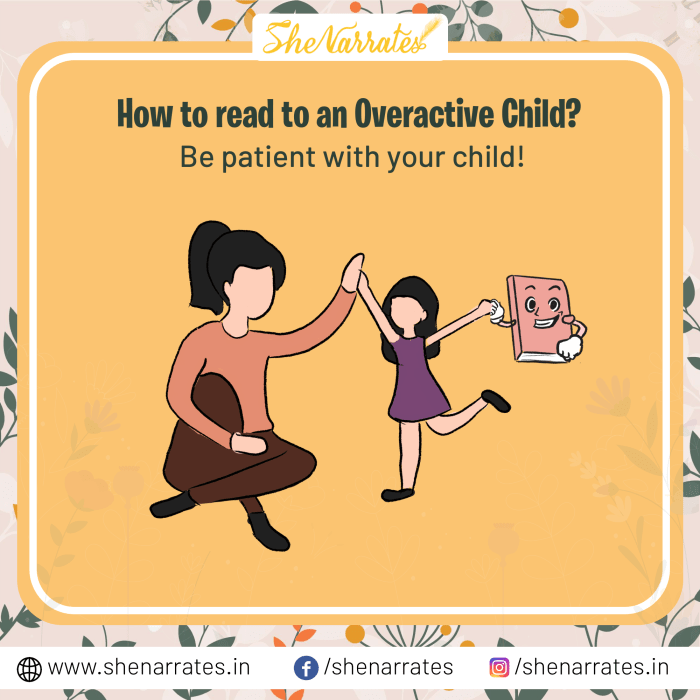
7. Be patient with your child.

How to read to an Overactive child

It is easy to get frustrated and annoyed by a spirited child’s energy. In most cases, the first reading attempt is a failure. Practice patience when you read to your child. Do not hesitate to read the same book twice or thrice, multiple times. Remember to see an overactive child’s energy as a positive thing and embrace them just as they are. I genuinely have a soft spot for overactive children. 

Consider these tips as a few ideas to formulate a customised reading plan for your overactive child. Children who have difficulty focusing find it challenging to sit down still with a book and read. So let them BE sometimes, let them wiggle and bounce the energy out and remember they are still listening while bouncing around. And don’t forget to compliment your child on having completed a reading session successfully. Encourage interactive reading sessions with your child and help her/him participate with enthusiasm and vigour. Through these efforts, you would raise an inquisitive reader in no time.

I wish you a beautiful bonding time while reading to your child and rooting for you dear parent that all your reading sessions happen with ease!

Read. Raise. Rise.

#readraiserise