Graphic Novels or Comic Books or both?

Blog on the difference between Graphic Novels and Comic Books

Reading for pleasure or leisure reading, aka recreational reading, may or may not have a purpose, but it certainly has become a significant activity for bonding between young children and their parents in the present times. Like everything that has changed with the times that we live in, literature too has taken various forms to cater to different tastes & palettes and to accommodate the decreasing attention spans due to paucity of time.

While many parents are still hesitant to let their children decide on what to pick up for their recreational read time, some others are allowing comic books and graphic novels to encourage reading and reap the benefits of this unique way of learning. My own experience says – both are great!

Both comic books and graphic novels are stepping stones for developing skills like patience, empathy, problem-solving, and emotional stability in children. These are also great for teaching values like honesty, loyalty, friendship and love, everything that we expected a reading habit and the conventional literature to do. Let us discuss the comic books and graphic novels among the various options available.

Most people are still confused about which is a better pick – comic books or graphic novels? Are you too?

Well, then read on to understand what separates the two wonderful forms of literature. I hope you not only find your answers but are better informed to make considered choices.

What are Comic Books?

Comics are short stories, also called periodicals, focusing on a particular incident or adventure from a story. They are expressed through illustrations and text bubbles (speech bubbles). Comics are sequential excerpts from a larger narrative published in parts throughout a year or sometimes decades. They are issued weekly or monthly and in many formats. Most popular are comic books, comic strips, newspaper strips, webcomics and caricatures.

Comic books gained a mainstream in the 1930s with the release of Action Comics. DC Comics and Marvel Comics are the largest comic books production industries. They produce science fiction books based on superpowers and superheroes. Marvel Comics has released approximately 37,000 comics since it was established in 1939. Even though Marvel and DC are most famous and demanded, there are many other independent comic publications.

What are Comic Books? Comic Books are short stories focusing on a particular incident or adventure expressed through illustrations and speech bubbles.

Here are a few Comic Books suggestions for young readers:

  • Toon Books Publication. Only publication with an age-based variety of comics (Age: 6+ years)
  • Angry Birds Comics: Sky High by various authors (Age: 6+ years)
  • All’s Faire in Middle School by Victoria Jamieson (Age: 8+ years)
  • Super-Man, DC Comics (Age: 9+)
  • Avengers, Marvel Comics (Age: 10+)

What are Graphic Novels?

Graphic novels, like comics, comprise both illustrations and text. However, graphic novels are complete stories with all the elements of novels, i.e., theme, plot, characters, conflict, resolution, setting and style. The story is either narrated in one book or through a series of 2 – 3 books.

Graphic novels are more complex and substantial. They always have elaborate character development, personal journeys’ and thematic messages. Sometimes, a series of comic books are combined to create a graphic novel.

The first graphic novel, A Contract With God and Other Tenement Stories by Will Eisner, published in 1978, was an adult novel. Later after it, graphic novels for kids became popular.

What are Graphic Novels? Graphic Novels are complete stories with all elements of a novel with a substantial focus on character development expressed through illustrations and text.

Here are a few Graphic Novel suggestions for young readers:

  • Narwhal and Jelly by Ben Clanton (Age: 5+)
  • Unicorn Dairies by Rebecca Elliott (Age: 6+)
  • Ganesha’s Sweet Tooth by Sanjay Patel (Age: 6+)
  • Little Indians: Stories from Across the Country by Pika Nani (Age: 9+)

Difference between Comic Books and Graphic Novels:

Difference between Comic Books and Graphic Novels

.

Comic books and graphic novels are the most effective tools that help children identify sounds (onomatopoeia – e.g. ouch, sizzle, pitter-patter, oink, etc.), words, and language. It helps them develop early literacy skills and expands their vocabulary. Graphics support the meaning of words, and comics help to clarify their meaning.

Graphic Novels give kids the extra help they need to get through a text. They are especially appealing to children. The combination of text and illustration gives context to stories kids might not otherwise understand. Graphic novels are engaging and are of great quality. Graphic novels sometimes can be overwhelming. As parents, you can let your young ones decide when they want to move from comics to graphic novels.

Above all, be it comic books or graphic novels – both are excellent means to learn and grow. Both types of books are high in demand, not only in the younger generation but also in adults. It does not matter what children choose, as long as they continue to explore new things and grow to be exceptional little human beings.

Before I conclude this blog, I want to say that reading comic books or graphic novels is still reading, and anything that excites a child to continue turning the pages is a win-win. So, do let your child indulge in this form of reading (recreational reading with comic books and graphic novels) which is entertaining, recreational and educational, all at the same time.

Importance of Comic Books for Children

Importance of Comic Books reading for Children. Powerful benefits of reading comic books.

Comic books have existed in our world for over 80 years. But the last fifteen years have particularly witnessed how comic books have taken over cinemas, toys, clothing. Some even prefer comic character-inspired names for their pets. A whole culture has developed around these imaginaries over the top stories.

Comic books are art, art that is designed in the best way to help children learn and grow; visual stories in them have a stronger and staying influence. The ultimate simultaneous integration of visual and verbal communication in comic books assists in developing visual thinking skills and nurtures curiosity in children. 

Yes, comic books are ‘entertaining’, but ‘not just entertaining’; their benefits go infinity and beyond. Let us explore the positive aspects of comic books and their importance for children with this blog.

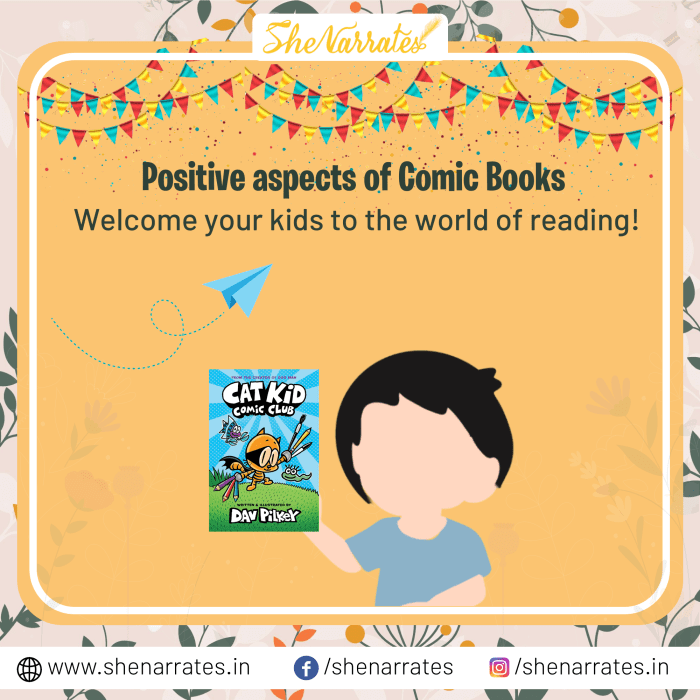
  • Welcome your kids to the world of reading!

In today’s time, television, mobile phones, and video games dominate children’s senses. Because of this, a lot of children miss out on the captivating beauty of reading. They don’t find reading as vibrant as the gadgets’ world. Comic books can offer a powerful solution to this problem. Mixing vibrancy and reading, they provide a very entertaining Segway for introducing children to reading. Once they start getting interested in reading, they will grow exponentially. Don’t be shocked if one day, your child starts to skim through hundreds of books as fast as “The Flash”. 

Reading Comic Books is important for Children as it helps them grow exponentially.

In the formative years of your kids, you might have taught them by using picture books. Comic books are an extension of picture books. Comic books, through their pictures, give the word a visual representation. They are visual stories.

The books that are not considered literature can teach verbs, adjectives, punctuations, and other parts of speech to the kids in a much easily conceivable format.

  • Improve inferential thinking and become a detective!

The world of a comic book is immersive. Kids can read and build their world and also get better at problem-solving. Have you heard of “The Batman” effect?

Studies suggest that children engaging in pretend play while performing mundane or difficult tasks can have enhanced focus and better attention span. While they role-play Batman or any fictional character, they tend to engage longer and be more focused. They tend to mirror the qualities they admire in their favourite characters and take steps towards building perseverance. The Batman effect also helps kids improve their decision-making skills when they imagine themselves in different scenarios and approach the task at hand by self-distancing.

Reading Comic Books is important for Children. It helps improve inferential thinking in children.

In comic books, unpredictability and magic exist. Plus, the whole comic creation process has several stages of development, from conception to completion. In the comic creation process, first, the story ideation, plot development, and scripting happens. Once the script is ready, it goes through the Art Production stage, which again has a few sub-stages of development and then the final editing, re-editing, printing, marketing, and distribution, happens. You might be wondering why I am talking about the comic creation process here! It’s because children get a chance to look at the finest art in their hands and figure out hidden details about the story, which helps a child improve their inferential thinking and their capability to depend on their intuition. So, don’t let your child miss upon the fine benefits of reading comic books mindfully.

  • Become righteous and save the world!
Benefits of reading comic books to children can be life-altering. It can encourage children to become righteous as a Superman and save the world.

A lot of comic books come with high moral values. These values exist in their characters and the story and are not taught like moral science lessons. Children get to use their own reasoning to make sense of these values, which strengthens the personality they build in life. Maybe your child can get inspired by the righteousness of “Superman” and bring a better change to this world. 

  • Fly in and out of beautiful imaginations!
The powerful benefits of reading comic books to children are many. It helps children become more creative.

Comic books usually follow nonlinear storytelling, which means that the stories in comic books take months through years to finish. With such a huge time frame, children can make up their own stories using their imagination to fill the gaps. The more they read these stories, the more ideas they come up with. And the more ideas they come up with, the more creative they become. One day you might even see your child writing the story for the next “Avengers“. 

  • Expanding memory, enhancing powers!
The empowering benefits of reading comic books to children are many. Reading Comic Books help children enhance their memory, and expand their imaginations.

The human brain registers more when there are more sources of information. Each shape, frame, colour, layout serves as an individual source. Comic books have multiple colours and various layouts that design the environment and its characters. When texts/words get added to these, the cherry meets the cake. Children get to see many such sources, and with time they begin to link real-world information to the shapes, colours, frames in comic books. Who knows, your child could develop a memory like “The Thinker” and come up with mind-boggling innovations. 

  • Not all heroes fly!
The powerful benefits of reading comic books to children are many. It helps enhance children's perspectives and introduce them to new concepts about the world!

Comic books don’t just mean superheroes. Superheroes comics became a lot more famous due to the grandiose they have. A lot of other comics like “Owly” and “All’s Faire in Middle School” deal with friendships, social issues, family, etc. exist. These different types of comics can enhance children’s perspectives and introduce them to new concepts about the world. 

Some other great comics that you can offer your children are “Teen Titans” by Art Baltazar and Franco Aurelian and “Chi’s Sweet Home” by Konami Kanata.

Rich collections of Indian comics that you can offer your children is “Tinkle Comics” by the Publisher Amar Chitra Katha (ACK), and some cool comics for new-gen children between the age-group 2 to 9 years are by KathaKids and the names are “Laugh with Tenali Raman“, “Panchatantra for Kids“, “Funtales of India“, “Ganesha Mythology for kids” and “WOW Stories! Evergreen Folktales”.

Comic books will continue to influence and change the world. Their impact in the last decade has seen the formation of new communities, connections, and friendships. They are much more than being a source of entertainment; they are a catalyst for harmony.         

When you see your child reading a comic, do not think they are wasting their time. Reassure yourself that your child is taking a fun approach to growing and learning. And make sure to give them the best comic books available!

And as always, I say ‘Introduce your Child to Diverse Genres’. When a child reads books of various genres, she or he can maintain a balance between fiction and reality and prevent the onset of “anti-social” behaviour. Introducing diverse genres is our simple solution for those who maintain this critical concern towards reading. 

Enjoy the sweet treat of comic books with your children sometimes and raise happy, self-confident readers!